• Bhubaneswar India
  • Contact+ 91-9938772605
  • Mon - Sat : 10:00AM - 6:00PM

Archive: November 1, 2026

Eveready Industries continues growth momentum in Q2 FY27; Revenue up 10.7 % with stable EBITDA margins at 12.6%


Posted the eighth consecutive quarter of YoY revenue growth on an expanding base

Kolkata, Nov 01: Eveready Industries India Limited (BSE: 531508 | NSE: EVEREADY | CSE: 000029) announced its unaudited financial results for the quarter and half year ended 30th September 2026. The Company reported double-digit revenue growth, marking its eighth consecutive quarter of YoY growth. Margins were maintained despite rising input costs, while lower-than-normal rainfall affected seasonal demand.

Q2 and H1 FY27 Financial Highlights

·Consolidated revenue from operations stood at INR 428.2 crore (Q2 FY26: INR 386.8 crore), registering growth of 10.7%.

·EBITDA stood at INR 53.8 crore (Q2 FY26: INR 49.4 crore), with EBITDA margin at 12.6%, despite higher zinc prices and other inflationary pressures.

·Profit after tax stood at INR 31.9 crore (Q2 FY26: INR -7.9 crore, which included an exceptional loss of INR 37.7 crore).

·For H1 FY27, consolidated revenue stood at INR 836.0 crore, up 9.9% YoY, while profit after tax was INR 68.9 crore, up 209.0%.

·Commodity hedging and tactical pricing actions helped maintain margins amid higher input costs.

Business and Strategic Highlights- Q2

·Battery segment: The overall battery segment grew 9.1% in value while Alkaline batteries sustained strong momentum, with value growth of 36.5% and volume up by 30.0%.

·Jammu alkaline facility: The facility has commenced commercial production in May 2026 and now supports the Company’s manufacturing localization plans and the growth of its alkaline battery portfolio.

·Flashlights: While the Overall flashlights grew 17.3%, the rechargeable segment grew by 33.2%, supporting overall segment growth despite softer conventional battery-operated demand and monsoon-related headwinds.

·Lighting and electrical accessories: The lighting segment recorded a strong growth of 10.4% led by the Emergency LED bulbs growth of 26.3%. Electrical accessories continue to build on the growth momentum.

·New product development:

·SHOR- India’s only torch with an animal alarm to ward off stray animals for farm protection. Eveready was also the developer of SIREN torch with an alarm for personal safety.

·Xtra Bright emergency LED – Emergency bulb with 2X the brightness vs other EME bulbs during power cuts, strengthening our emergency portfolio.

·Mosquito racquets – A part of the emerging homecare portfolio, it performed well, with Eveready establishing a position among the leading brands within three years of launch.

·Liquid vaporizers: Eveready is strengthening its Home Care portfolio with India’s 1st portable, rechargeable anti-mosquito liquid vaporizer that enhance consumer convenience and offer greater flexibility beyond conventional formats.

·Distribution: All our B2C channels grew strong with E-commerce and Quick commerce growing 50%+ YoY.

“Our eighth consecutive quarter of revenue growth reflects the strength of the business and gives us confidence in sustaining this progress. Alkaline batteries and rechargeable products remain important growth drivers, while portable Liquid vaporizers expand our mosquito protection portfolio, supported by the launch of the “Unplug and use anywhere campaign”. Our focus remains on strengthening the product portfolio, expanding market presence and driving sustainable growth.” – Anirban Banerjee, Chief Executive Officer

“We remain focused on profitable growth, disciplined working capital management and strengthening the balance sheet. We are taking calibrated pricing action to protect profitability and maintain margin stability, while commodity and forex hedging helped us manage the impact of higher input costs. As the Jammu facility ramps up, our priority will be to improve capacity utilisation and realise the cost benefits of local manufacturing.” – Bibek Agarwala, Executive Director & Chief Financial Officer

Balance Sheet and Outlook

Net Debt at 30th September 2026 stood at INR 153 crore (INR 164 crore at Q1 FY27). The registration/transfer of Plot B2 of the Noida property was completed subsequent to the reporting date on 13th October, 2026.

Looking ahead, Eveready remains focused on scaling up the Alkaline portfolio, building adoption of liquid vaporizers, and other rechargeable products. Higher input costs remain a watchpoint. The Company will continue to review pricing in line with input-cost movements while progressing the Jammu facility ramp-up.
 

Nucleus Software Announces Q2 FY 2026–27 Results: Reinforces Focus on Customer Experience, Innovation and Execution Excellence


The Company continues to strengthen its lending and transaction banking platforms, organisational agility and customer engagement across global markets.

New Delhi, India, Nov 01: Nucleus Software, a leading provider of lending and transaction banking products to the global financial services industry, today announced its financial results for the quarter ended September 30, 2026.

Key Highlights of Q2 FY 2026–27

  • Revenues in Q2 FY 2026–27 stood at Rs. 227.70 crores on a consolidated basis.
  • EBITDA stood at Rs. 15.41 crores on a consolidated basis.
  • Profit After Tax (PAT) stood at Rs. 21.25 Crores on a consolidated basis.
  • Earnings Per Share (EPS) stood at Rs. 8.08 on a consolidated basis.

Revenues on a consolidated basis stood at Rs. 227.70 Crores for the quarter ended September 30, 2026, compared with Rs. 213.51 Crores in Q2 FY 2025–26. Profit After Tax stood at Rs. 21.25 Crores against Rs. 26.29 Crores in the corresponding quarter of the previous year, while Earnings Per Share stood at Rs. 8.08 compared with Rs. 9.99.

On a standalone basis, revenues stood at Rs. 208.09 Crores against Rs.196.37 Crores in Q2 FY 2025–26. Profit After Tax stood at Rs.19.12 Crores compared with Rs. 27.85 Crores, while Earnings Per Share stood at Rs. 7.27 against Rs. 10.58 during the corresponding period.

During the quarter, Nucleus Software continued to advance its priorities around product innovation, customer experience, execution excellence and organisational agility.

The Company continued strengthening FinnOne Neo® and FinnAxia®, with investments in intelligent automation, modern architecture and responsible AI aimed at helping financial institutions modernise while maintaining reliability, security and business continuity.

Key product developments during the quarter included the launch of FinnOne Neo® 9.0 and FinnAxia® 9.0 at Nucleus Synapse Vietnam, reinforcing Nucleus Software’s focus on continuous platform innovation, modernisation and long-term customer value.

Alongside its flagship platforms, Nucleus Software continued strengthening its Digital Services capabilities across cloud transformation, application modernisation, AI-led automation, data engineering and infrastructure services to support broader transformation priorities of financial institutions.

Internally, the Company continued embedding Hoshin Kanri and Lean practices to strengthen alignment, accountability, cross-functional collaboration and delivery predictability.

Nucleus Software also maintained an active presence across key industry forums including the CNBC-TV18 Banking Transformation Summit 4.0, Global Fintech Fest, Nucleus Synapse Vietnam and Sibos 2026, engaging banking leaders on responsible AI, digital lending, intelligent treasury and the future of transaction banking.

The Company’s innovation efforts received further recognition through the CII National AI Awards 2026, where its Generative AI-powered Visual Report Agent received the Most Innovative Practice recognition. Nucleus Software was also named Oracle ISV Partner of the Year at Oracle AI World, becoming the only recipient from the APAC region.

Commenting on the results, Mr. Vishnu R. Dusad, Co-founder and Managing Director, Nucleus Software, said:

“Our four decades of experience in banking technology have taught us the importance of understanding not only what customers need today, but also how their requirements will evolve. Working closely with financial institutions gives us valuable insights into the challenges and opportunities that lie ahead. We continue to build on this domain knowledge and our understanding of emerging technologies to help customers navigate change with confidence and prepare for the next decade of banking.”

Mr. Parag Bhise, Chief Executive Officer and Executive Director, Nucleus Software, added:

“Our focus during the quarter remained on strengthening execution, deepening customer engagement and maintaining operational discipline. We continue to invest across FinnOne Neo®, FinnAxia® and Digital Services to address the evolving technology requirements of financial institutions.

Our people play a critical role in making this possible. By attracting diverse talent and encouraging fresh perspectives, we are strengthening our capacity to innovate and respond to change. Alongside this, Hoshin Kanri and Lean practices are helping us improve alignment, collaboration and accountability across teams. These priorities remain central to building an agile organisation and delivering consistent value to our customers.”

Looking ahead, Nucleus Software will continue investing in the evolution of FinnOne Neo® and FinnAxia®, with particular emphasis on responsible AI, intelligent automation, platform agility and customer experience.

The Company remains committed to strengthening its presence across global markets, deepening customer and partner relationships and building capabilities that support the long-term needs of financial institutions.


KOKUYO Workplace India introduces Duora2, bringing Japanese design innovation to India’s evolving workspaces

KOKUYO Workplace India introduces Duora2, bringing Japanese design innovation to India’s evolving workspaces


The company plans to bring 3 to 5 more KOKUYO Japan products to India over the next 24 months.

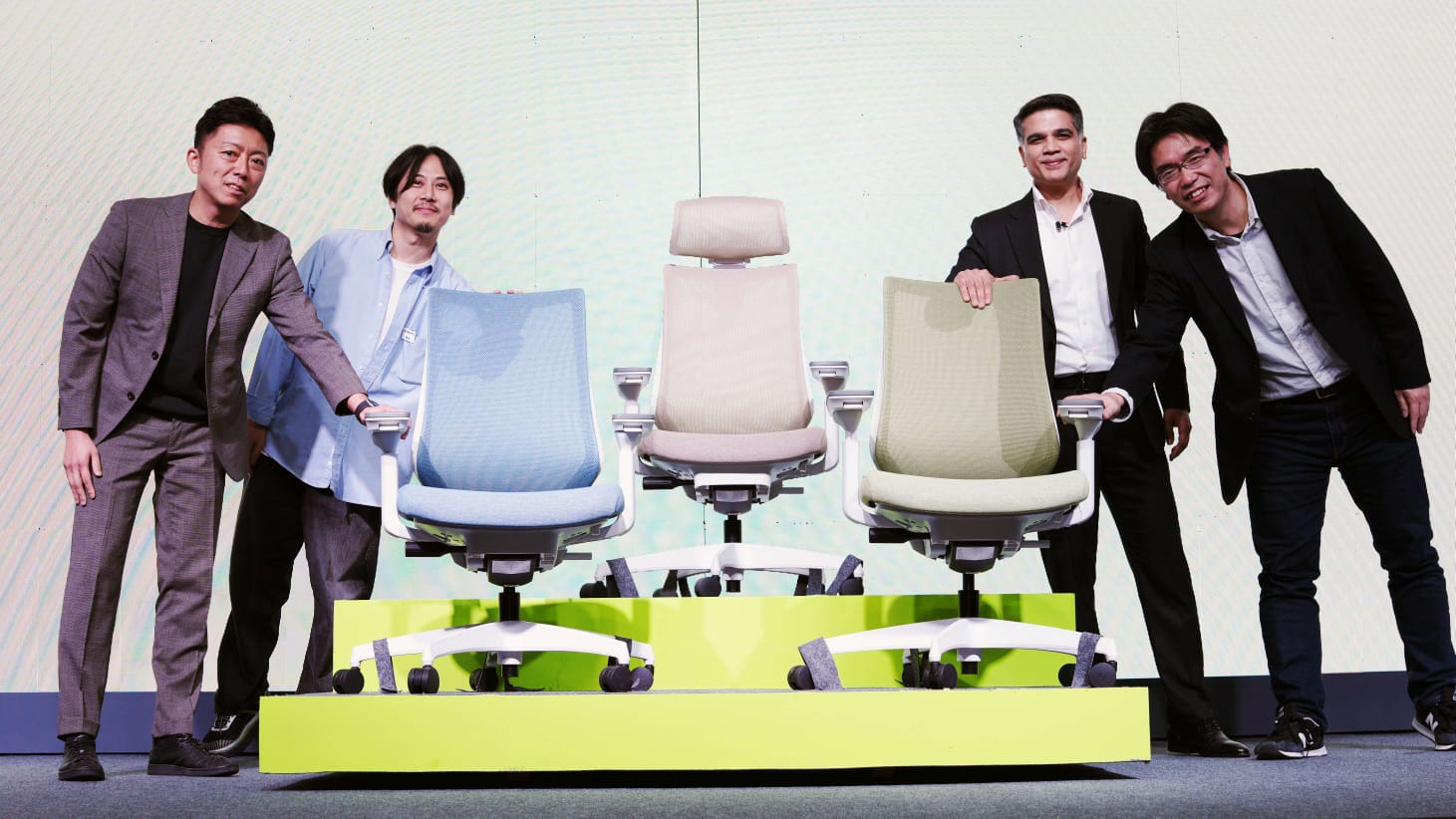
Bengaluru, Nov 01: KOKUYO Workplace India, the Indian subsidiary of Japan’s KOKUYO Co., Ltd., today launched Duora2, a task chair designed in Japan and manufactured at the company’s campus in Nagpur, Maharashtra. It is the first KOKUYO Japan-designed product to be launched by the company in India. Duora2 will also be sold directly to consumers through kokuyo-india.com, as the company steps up its focus on premium seating.

The chair was unveiled in Bengaluru by Karan Sachdev, Managing Director, KOKUYO Workplace India, Daisuke Watanabe, Head of the SEA and India Division, KOKUYO Co., Ltd., and Masayoshi Suzuki, Lead Designer of Duora2, in the presence of senior leaders from KOKUYO in Japan and India and an audience of architects, interior designers and corporate clients.

The launch comes as the company steps up its growth in India. KOKUYO Workplace India expects to grow its revenue by 40% this financial year over last and expects to double its revenue from the seating category in the next three years. KOKUYO plans to bring 3 to 5 more KOKUYO Japan products to India over the next 24 months.

This expansion comes at a time of strong demand for office space in India. The country recorded a record 82.6 million sq ft of office leasing in 2025, with Bengaluru, Mumbai and Delhi-NCR accounting for about 61% of it, according to CBRE. Global Capability Centres (GCCs) are among the largest drivers of this demand, and many are designing offices to draw employees back to the workplace for longer, more focused days.

Bengaluru, where Duora2 was launched, is at the centre of this demand. The city remained India’s largest office market in 2025, with a record 28.7 million sq ft of leasing, up 59% on the previous year, according to Knight Frank, driven largely by global companies setting up and expanding GCCs. Along with Gurugram, Mumbai, Pune and Hyderabad, where KOKUYO Workplace India runs its other Experience Centres, it is one of the company’s most important markets.

The move to longer, more focused days in the office is also changing what companies ask of office seating. A typical workday now moves between leaning into a laptop, sitting upright in meetings and reclining on calls, while most office chairs are built around a single upright position. Duora2 was developed in Japan around this pattern. Its lower-back support can be set for forward-leaning, upright or reclined work, and its seat tilts forward slightly as the user leans in, to help keep the spine in its natural curve. The chair is the second generation of KOKUYO’s Duora line and has been on sale in Japan since January 2024.

Karan Sachdev, Managing Director, KOKUYO Workplace India, said, “India’s offices are getting bigger and better, but the chair is still the piece of furniture people spend the most time with and think about the least. Someone working on a laptop, on a video call and in a review is sitting three different ways in the same hour, and their chair should keep up. Duora2 is the first KOKUYO Japan-designed product we are bringing to India, and we are making it in Nagpur. That is what we mean by In India, for India: Japanese design and engineering, built here for the GCCs and enterprises that now compete on the experience they offer their people.”

Masayoshi Suzuki, Lead Designer of Duora2, KOKUYO Co., Ltd., said, “We designed Duora2 by watching how people actually sit at work. Nobody holds one posture for long, so the chair had to support the body in each position without asking the user to keep adjusting it. It is exciting to see Duora2 made in India, for workplaces that are growing so quickly.”

Daisuke Watanabe, Head of the SEA and India Division, KOKUYO Co., Ltd., said, “India is one of the most important growth markets for KOKUYO. Launching Duora2 here, and manufacturing it in Nagpur, shows our commitment to bringing KOKUYO’s design to Indian businesses with the speed and support that local production allows.”

Duora2 is available through KOKUYO Workplace India’s Experience Centres in Gurugram, Mumbai, Pune, Bengaluru and Hyderabad and its dealer network across the country. Consumers can buy it online at kokuyo-india.com from 1 November 2026. The company will also showcase Duora2, including a one-off special edition, alongside other marquee KOKUYO products at ORGATEC India in Mumbai from 19 to 21 November 2026.


PPS Motors launches the all-new Audi Q3 in Kerala

PPS Motors launches the all-new Audi Q3 in Kerala


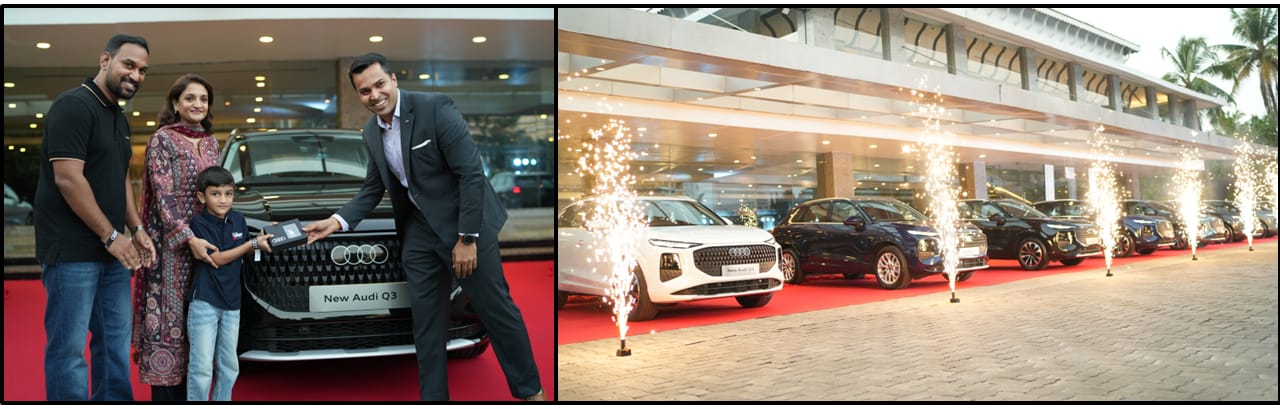
Kochi, Kerala, Nov 01: PPS Motors, a part of one of India’s largest automobile retail conglomerates, launched the all-new Audi Q3 in Kerala, bringing together 150 kW of power, quattro all-wheel drive and a suite of digital, lighting and comfort technologies in its compact luxury SUV. The All-New Audi Q3 features  technology-rich cabin with a digital stage panoramic display, head-up display and SONOS premium sound system.

As part of the launch event, PPS Motors also handed over the first 10 Audi Q3 to the customers in Kerala.

Locally assembled at the SAVWIPL plant in Chhatrapati Sambhajinagar, Maharashtra the all-new Audi Q3 is available at an introductory price of INR 51,99,000 (ex-showroom).

The all-new Audi Q3 features Digital Matrix LED headlights with micro-LED technology, four selectable daytime-running-light signatures and three advanced dynamic light sequencing while illuminated Audi rings add a distinctive lighting element at the rear. The new digital interface brings displays, controls and infotainment functions together around the driver, creating a more connected and intuitive experience. The all-new Audi Q3 also introduces a new integrated switch module where the lever on the right selects the gear, while the one on the left controls the lighting functions, windshield wiper and cleaning functions. A head-up display projects key driving information directly into the driver’s line of sight, complementing the digital cockpit and keeping essential information within easy view.

Commenting on the launch, Mr. Rajiv Sanghvi, Managing Director, PPS Motors said, “We are excited to launch the much awaited third-generation All-New Audi Q3 in Kerala. With its advanced technology, cutting edge features, and quattro all-wheel drive, the new Audi Q3 creates a new benchmark in the segment. Backed by our understanding of evolving customer needs and Audi’s advanced, future-ready vehicles, we endeavour to provide best-in-class ownership experience.”

Highlights:     

Drive & Performance:

●2.0-litre TFSI petrol engine with 150 kW and 320 Nm of torque for a dynamic driving experience

●0–100 km/h in 7.1 seconds

●quattro all-wheel drive for confident traction and control

●Progressive steering and Audi drive select with five modes- Balanced, Dynamic, Comfort, Efficiency and Offroad+ for a tailored driving experience

●Comfort suspension for a composed ride

●Hill hold assist and downhill assist for added confidence on inclines and descents

Exterior:

●Digital matrix LED headlights consist of 25,600 micro-LEDs with four selectable daytime-running-light signatures and advanced dynamic light sequences with three light projections

●The all-new Audi Q3 features advanced micro-LED technology, incorporating 25,600 individual micro-LEDs, each measuring approximately 40 micrometers, enabling lane and orientation lighting functions

●LED rear lights pro and illuminated Audi rings at the rear

●45.72 cm (R18) five-arm aero alloy wheels in Black, gloss-turned finish for a sporty stance

●Power-adjustable, heated and folding exterior mirrors with auto-dimming and memory function for added convenience

●Panoramic sunroof for a spacious cabin experience

●Projection light integrated into the exterior mirrors

Colors:

●Five exterior colors: Sage Green, Mythos Black, Glacier White, Navarra Blue and Tambora Grey

●Two interior color themes: Tamarind brown and Pergament beige

Interior & infotainment:

●Digital stage panoramic display comprising a 30.22 cm Audi Virtual Cockpit and 32.51 cm central

●MMI touch display for a connected, digital cockpit experience

●Head-up display for enhanced driver information

●Twin-spoke sport leather steering wheel, flat top and bottom, with multifunction controls and shift paddles for a sporty drive

●New integrated switch module that integrates gear selector , lighting and wiper functions, freeing up space in the center console

●SONOS premium sound system with 12 high-performance speakers and 420-watt amplifier output; Neutral, Concert, Lounge and Podcast profiles, plus a customizable profile

●Front acoustic glazing for door windows for better sound insulation

●Audi wireless smartphone interface, wireless charging and USB interfaces with higher charging capacity for seamless connectivity

●Ambient lighting package plus with 30 different colors, enabling a personalized lighting experience 

Comfort & convenience:

●Power-adjustable front seats, with memory function for the driver’s seat

●Leather/artificial leather upholstery for a premium cabin experience

●Adjustable rear-seat recline and a sliding function offer enhanced comfort and flexible space for passengers and luggage

●Three-zone deluxe automatic climate control for personalized cabin comfort

●Park assist plus with rear-view camera for convenient parking

●Reversing assist with 50 m reverse-route memory

●Convenience key for added ease of access

●Electrically opening and closing luggage-compartment lid for effortless loading and unloading

Safety & Technology:

●Nine airbags for enhanced occupant protection

●Adaptive cruise control for a relaxed driving experience

●Front emergency brake assist for enhanced safety

●Driver attention and fatigue monitor for added support on longer journeys

●Seat belt pretensioner

●Anti-theft wheel bolts for added security

Ownership Packages:

●Roadside Assistance (RSA) packages with coverage of up to 15 years

●Service Value packages with coverage of up to 10 years

●Extended warranty packages with coverage of up to 10 years

●Long duration finance offers with various financers:

●Long duration finance up to 10 years

●Balloon offers (lower EMIs)

●Various Assured buyback offers

●Introductory offer: 2 Year Comprehensive Service Value Package with 2+3-year extended warranty and/ or, 5 Year Comprehensive Service Value Package with 2+3-year extended warranty


Special Campaign 6: ECL turns mining scrap into symbol of coal’s contribution to nation-building

 
Asansol, Nov 01: Eastern Coalfields Limited (ECL), a subsidiary of Coal India Limited, has transformed discarded mining materials into an artistically crafted throne, symbolically depicting coal as the ‘King’ of India’s energy landscape in recognition of its enduring contribution to power generation, industrial growth and national development.
Created by coal miners of ECL’s Salanpur Area under Special Campaign 6, the throne has been installed at Martyrs’ Park, ECL Headquarters at Sanctoria here. The installation combines industrial heritage with artistic creativity, demonstrating how discarded materials can be transformed into meaningful creations through innovation and craftsmanship.
 
The concept of ‘Coal – The King’ draws upon coal’s pivotal role in powering India’s economy. As a principal source of electricity generation and an essential input for several core industries, coal continues to support industrial production, infrastructure development and the country’s energy security. The throne symbolises this contribution while also acknowledging the dedication and technical expertise of the workforce engaged in coal production.
 
The creation holds particular significance for ECL, which operates in the historic Raniganj Coalfields, recognised as the birthplace of commercial coal mining in India. It connects the region’s rich mining heritage with a contemporary message of responsible resource utilisation, creativity and environmental consciousness.
 
The initiative forms part of ECL’s successful implementation of Special Campaign 6, undertaken across its mines, workshops and administrative establishments under the guidance of Dr. Satish Jha, Chairman-cum-Managing Director, ECL. The campaign has achieved encouraging results in cleanliness, space optimisation, systematic scrap disposal, records management and administrative efficiency through active participation of employees across the organisation.
 
Beyond conventional cleanliness activities, the campaign has encouraged innovative approaches to waste management, with employees transforming discarded industrial components into artistic creations. The throne developed by Salanpur Area illustrates how engineering skills, imagination and craftsmanship can give industrial scrap a new identity and purpose.
In another notable initiative, employees of ECL’s Neamatpur Central Workshop fabricated a model of a naval warship using discarded mining machinery components. The model was presented to the 1 Bengal NCC Naval Unit as a tribute to the Indian Navy, reflecting the spirit of national service and the creative capabilities of ECL’s workforce.
 
Such initiatives demonstrate how Special Campaign 6 has emerged as a platform for encouraging employee participation, recognising workplace creativity and promoting innovative solutions beyond routine operational responsibilities. They also highlight the motivational value of employee-driven initiatives in strengthening teamwork, ownership and organisational pride.
 
The creations embody the philosophy of 3Rs – Reuse, Recycle & Repurpose, encouraging the transformation of discarded industrial materials into meaningful assets while promoting resource conservation, circular economy principles and sustainable waste management practices.
 
Through these initiatives, ECL has sought to extend the objectives of Special Campaign 6 beyond cleanliness and administrative efficiency to foster a culture of innovation, environmental responsibility and collective participation.
 
The throne at ECL Headquarters stands as a distinctive representation of this approach, celebrating coal’s contribution to India’s energy security and economic development while recognising the ingenuity of the people who produce it.
 
The initiative reinforces the message that industrial waste can become a resource for creativity and innovation, and that sustainable practices, supported by workforce participation, can contribute meaningfully to organisational excellence and national development.

14-year-old Jensi Kanabar pushes fifth seed Falkowska in Chennai Open qualifying

14-year-old Jensi Kanabar pushes fifth seed Falkowska in Chennai Open qualifying


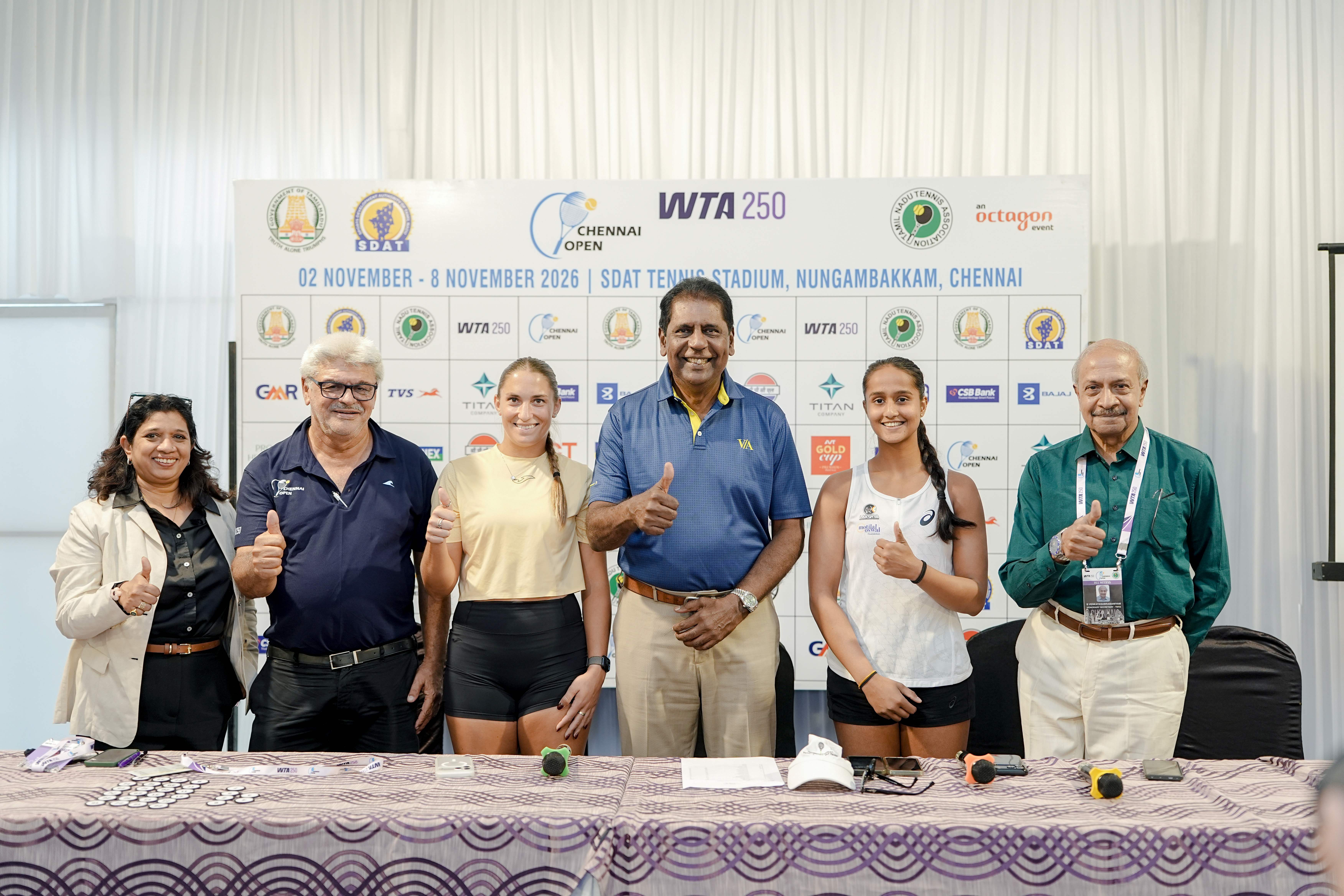
Chennai, Tamil Nadu, India, Nov 1:: Four Indians featured in the Chennai Open 2026 qualifying draw, with 14-year-old wild card Jensi Kanabar putting up a strong fight against fifth seed Weronika Falkowska of Poland before bowing out in three sets today at SDAT Tennis Stadium Nungambakkam Chennai.

After conceding the opening set comfortably, Jensi found her rhythm in the second, matching her experienced opponent shot for shot. The young Indian showed considerable composure to eventually convert her sixth set point and level the match. However, Falkowska steadied her game in the decider and held off two break points at 4-3 before taking control. Jensi, who had raced to a 40-0 lead while serving, was unable to close out the game, allowing the Pole to seal the contest.

Indian wild card Diya Ramesh also put up a good fight against second seed Kyoka Okamura of Japan, but the experienced Japanese player kept her composure to register a straight-set victory. The other two Indians in qualifying, Shrivalli Bhamidipaty and Zeel Desai, also bowed out against fourth seed Viktoria Morvayova and third seed Mei Yamaguchi respectively.

The singles main-draw ceremony was held on Saturday in the presence of Vijay Amritraj, President of the Tamil Nadu Tennis Association (TNTA), with tournament supervisor Sheetal Iyer conducting the draw. Defending champion and top seed Janice Tjen of Indonesia headlines the 32-player field, while three Indians, Vaishnavi Adkar, Sahaja Yamalapalli and Maaya Rajeshwaran Revathi, have been awarded wild cards. Adkar is the highest-ranked Indian in the draw at World No. 334, followed by Yamalapalli at World No. 369. The remaining four places in the main draw will be decided after the final round of qualifying on Sunday.
Austria’s Lilli Tagger is seeded second, followed by Poland’s Magda Linette at third and Hungary’s Panna Udvardy at fourth. Thailand’s Mananchaya Sawangkaew is the fifth seed, while Uzbekistan’s Polina Kudermetova, Serbia’s Teodora Kostovic and Poland’s Katarzyna Kawa occupy the sixth, seventh and eighth seed positions respectively.

In doubles, Rutuja Bhosale returns after reaching the semi-finals last year and will partner Vaishnavi Adkar. India will have four pairings featuring its players, including wild-card entries Diya Ramesh and Deepshika Vinayagamurthy, Shrivalli Bhamidipaty and Maaya Rajeshwaran Revathi, and Ankita Raina, who will partner Japan’s Hiroko Kuwata.

Singles Qualifying Round Results

[1] A. Falei (BLR) def. E. Yashina (RUS) 6-1, 6-4

[6] R. Zolotareva (RUS) def. M. Tkacheva (RUS) 6-1, 2-1 (RET)

[2] K. Okamura (JPN) def. [WC] D. R. Ramesh (IND) 6-4, 6-2

[8] M. Kobori (JPN) def. R. Matsuda (JPN) 6-4, 6-0

[3] M. Yamaguchi (JPN) def. Z. Desai (IND) 6-1, 6-0

Z. Kulambayeva (KAZ) def. [7] Y. Kotliar (UKR) 6-2, 6-3

[4] V. Morvayova (SVK) def. S. Bhamidipaty (IND) 6-2, 6-3

[5] W. Falkowska (POL) def. [WC] J. Dipakbhai Kanabar (IND) 6-2, 5-7, 6-3


Peace within oneself is the foundation of Mental Well-being”: Rotary District Governor Uday Pilani

Peace within oneself is the foundation of Mental Well-being”: Rotary District Governor Uday Pilani


Hyderabad, Nov 1: “Mental health is an extension of peace. Peace is an important area of focus for Rotary, and peace within oneself ensures better mental health. The absence of peace leads to disturbance,” said Rotary District Governor Uday Pilani, emphasising the importance of nurturing mental well-being among children during their formative years.

He was speaking at the closing ceremony of PEP-UP Menal Well-being, a ₹33-lakh student mental well-being initiative undertaken by the Rotary Club of Hyderabad Mavericks, which reached over 3,200 students through mental health awareness sessions and screened 2,686 students across eight government and private educational institutions in Hyderabad. It is the biggest and the longest Mental Well-being imitative ever taken up in the state of Telangana.  

The year-long project, designed for students in the 13–21 age group, concluded with a showcase event held on Saturday at G. Narayanamma Institute of Technology and Science, Shaikpet, Hyderabad.

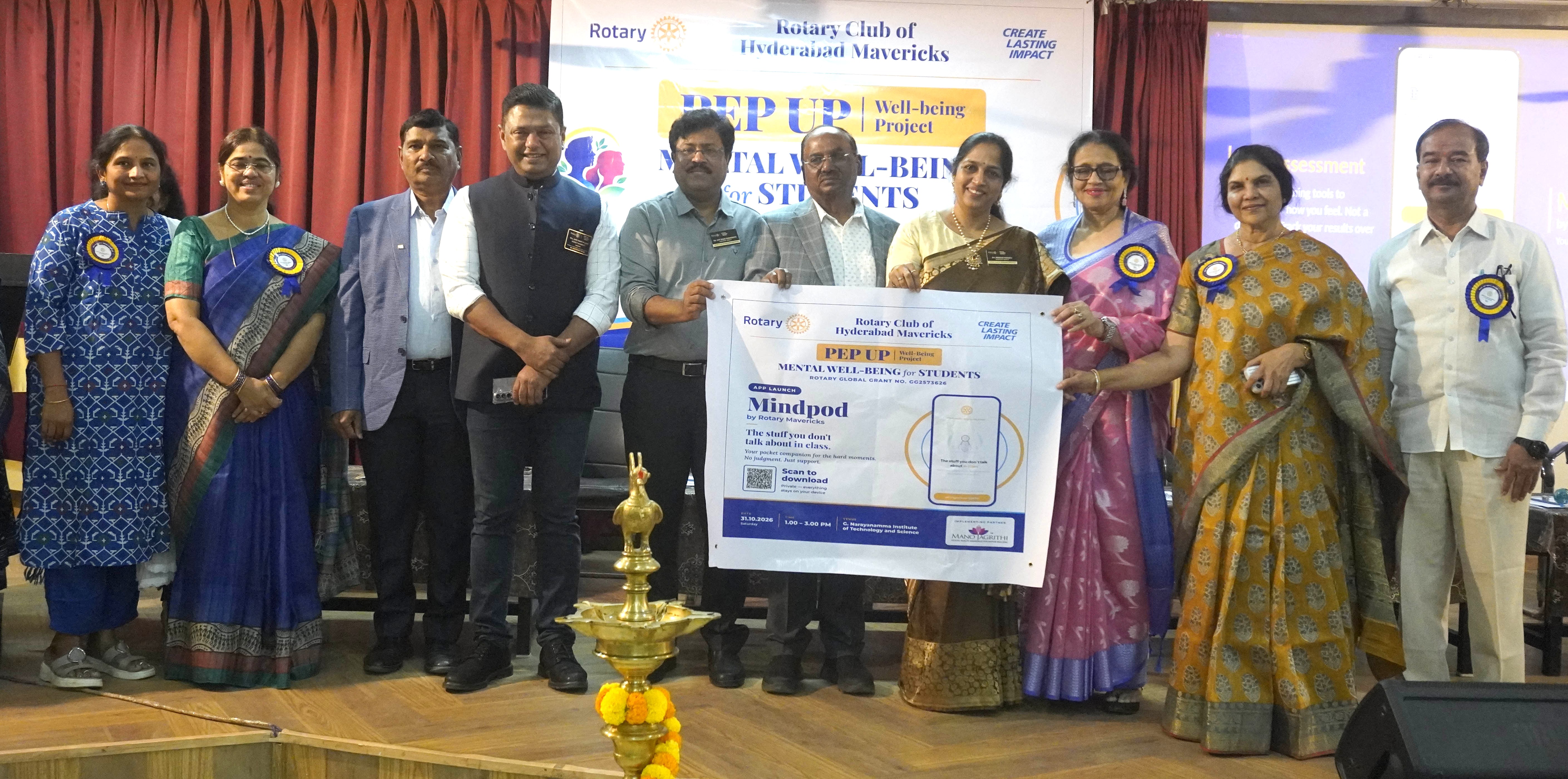
Uday Pilani, who was the Chief Guest, along with Ms. Rashida Adenwala, an entrepreneurial leadership icon and women’s empowerment advocate, the Guest of Honour, unveiled Mindpot, a mental well-being app for students, and a Well-being Toolkit, a practical handbook designed to support students. The annual report documenting the project’s implementation and achievements was also released in the presence of Rotarians, teachers and counsellors.

Speaking further, Uday Pilani observed that many successful adults continue to experience emotional challenges arising from impressions and experiences formed during their childhood. He stressed that positive experiences during the formative years are essential for nurturing emotionally healthy individuals.

He also drew attention to the role played by genuine spiritual leaders, who have millions of followers because they often serve as mental well-being guides and coaches. He emphasised the need to support students during their formative years so that they grow into emotionally balanced individuals.

Ms. Rashida Adenwala said that students, much like adults, face enormous pressure arising from marks, ranks, academic performance, peer comparison, social media, loneliness and excessive screen time.

Recounting an interaction with CA students, she said they expressed a constant dilemma of whether to sleep or scroll through their phones. Many were sacrificing sleep, which in turn was affecting their mental health. She emphasised that a healthy mind is essential for a healthy body and called for greater awareness of the impact of lifestyle choices on mental well-being.

Ajay Kumar Kambhampati, President of the Rotary Club of Hyderabad Mavericks, said that the ₹33-lakh initiative was implemented under Rotary Global Grant GG2573626, with a focus on mental health awareness, screening, prevention, counselling and early intervention. The project engaged eight educational institutions in Hyderabad, bringing structured mental health support and awareness to thousands of students.

Dr. Geetha Challa, Child and Adolescent Psychologist and Founder-Director of Manojagrithi, said that mental health awareness is the foundation of nation-building. She emphasised the importance of identifying emotional and psychological concerns early and creating supportive environments where young people feel comfortable seeking help.

The participating institutions included Sri Sahithi High School, ZPHS Kothaguda, New Bloom High School, ZPHS Kondapur, Samskruthi High School, Government Junior College, G. Narayanamma Institute of Technology and Science, and ZPHS Peddamangalaram.

According to the project’s impact report, mental health awareness sessions reached 3,207 students, while 2,686 students underwent Level 1 screening.

The programme followed a structured, multi-stage approach, beginning with awareness sessions, followed by standardised screening, further assessment of students requiring additional attention, counselling and post-screening reviews.

Of the 2,686 students screened at Level 1, 2,112 were categorised as Green, while 574 were categorised as Orange or Red, indicating the need for further attention and assessment. These screening categories served as indicators for additional support and were not clinical diagnoses.

The awareness sessions introduced students to common emotional challenges such as stress, anxiety, sadness and low confidence. They also covered coping strategies including deep breathing, mindfulness, journaling and speaking to trusted adults. Students were familiarised with the role of counsellors and the importance of seeking professional support when required.

The Rotary Club of Hyderabad Mavericks was the host club for the project, with the Rotary Club of Livermore serving as the international sponsor. Manojagrithi and Sudisha Counselling Centre were associated with the implementation and counselling support for the initiative.

The PEP-UP project sought to go beyond conventional awareness programmes by combining screening, early identification, counselling and follow-up, with the objective of creating a more supportive and emotionally healthy environment within educational institutions.

The project concluded with a call for greater attention to student mental health and the need for educational institutions, parents, teachers and community organisations to work together towards nurturing a healthier and more emotionally resilient generation.