At the Surajkund International Crafts Mela, Shikha’s Kariigarii presented a fashion show that blended heritage, handloom, and national emotion, redefining therunway as a living narrative of India’s artistic soul and collective conscience.
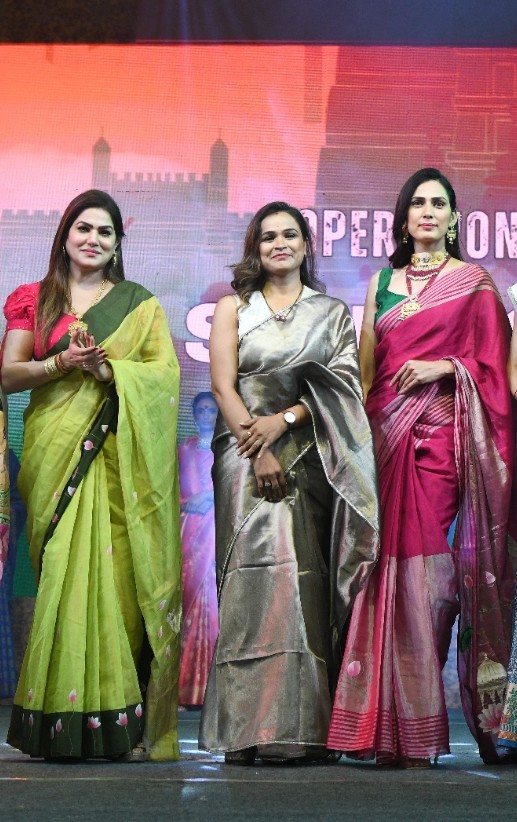
More than a fashion show, the presentation unfolded as a cultural journey, where each saree told a story of time, tradition and the human hands behind it. Crafted over weeks and months by artisans across the country, the collections celebrated the idea of art transformed into a wearable legacy.
The opening sequence, “A Tribal Life – Ek Bharat, Shreshtha Bharat”, paid homage to India’s indigenous communities and their textile traditions rooted in nature, survival, ritual and identity. From forests and hills to plains and plateaus, the drapes reflected how tribal women across regions had woven stories of resilience into fabric — each weave distinct, yet bound by a shared cultural memory.
The second sequence, “Silks of India”, showcased the regal diversity of Indian silks from Tussar and Gheecha of Chhattisgarh to Banarasi Butidar of Varanasi, Lachcha Buta of Mubarakpur, Chanderi of Madhya Pradesh, Venkatagiri of Andhra Pradesh and Kuthampully of Kerala. Every saree on the ramp stood as testimony to mindful craftsmanship, far removed from mass production.
A defining moment of the evening was “Tribal to Modern Art – Hand-Painted Sarees of India”, where fabric emerged as canvas and the saree as a moving gallery. The collection featured original hand-painted artworks inspired by Pichwai, Pattachitra, Warli, Gond, Madhubani, Assamese traditions and Chittara art. Created stroke by stroke by award-winning artists, each saree carried the unmistakable imprint of its creator, preserving traditions that dated back centuries while giving them contemporary relevance.
Speaking on the philosophy behind the collection, Shikha Ajmera, artist and promoter of the brand, said:
“For me, a saree was not just a garment — it was a moving canvas. Every brushstroke carried the artist’s memory, belief and lived experience. Through Shikha’s Kariigarii, my endeavour had always been to ensure that our traditional art forms did not remain confined to museums or walls, but lived, breathed and moved with people. When someone wore these sarees, they were not wearing fashion — they were wearing history, culture and the soul of an artist.”
Recently, Shikha Ajmera had also showcased Sarees of India at the International Film Festival of India in 2025, among other important international and national events.
The grand finale, “Pride of India – Operation Sindoor”, marked a first-of-its-kind fashion tribute, drawing inspiration from a contemporary moment that had unified the nation in grief, resolve and resilience. The sequence coincided with the historic milestone celebrating 150 years of the song Vande Mataram.
Set against the stirring strains of Vande Mataram, the finale transcended fashion, becoming a tribute to national pride, unity and emotional strength. Each walk symbolised dignity, courage and collective identity, echoing the sentiment of “Saare Jahan Se Achha, Hindustan Hamara.” The sequence was widely appreciated as a rare moment where the fashion ramp transformed into a space of remembrance and homage.
Shikha’s Kariigarii continued to work closely with nationally recognised artisans across India, ensuring sustainable livelihoods while preserving endangered art traditions. By converting art into wearable form, the brand bridged heritage with contemporary expression, making culture relevant for modern audiences. The show was executed under the direction of fashion director Mr Sandesh Navlakha, with expert choreography and styling support, culminating in a visually compelling and emotionally resonant experience.
The evening concluded with a standing ovation, marking one of the most memorable showcases at the Surajkund International Crafts Mela 2026, where fashion became a medium of culture, conscience and patriotism.
