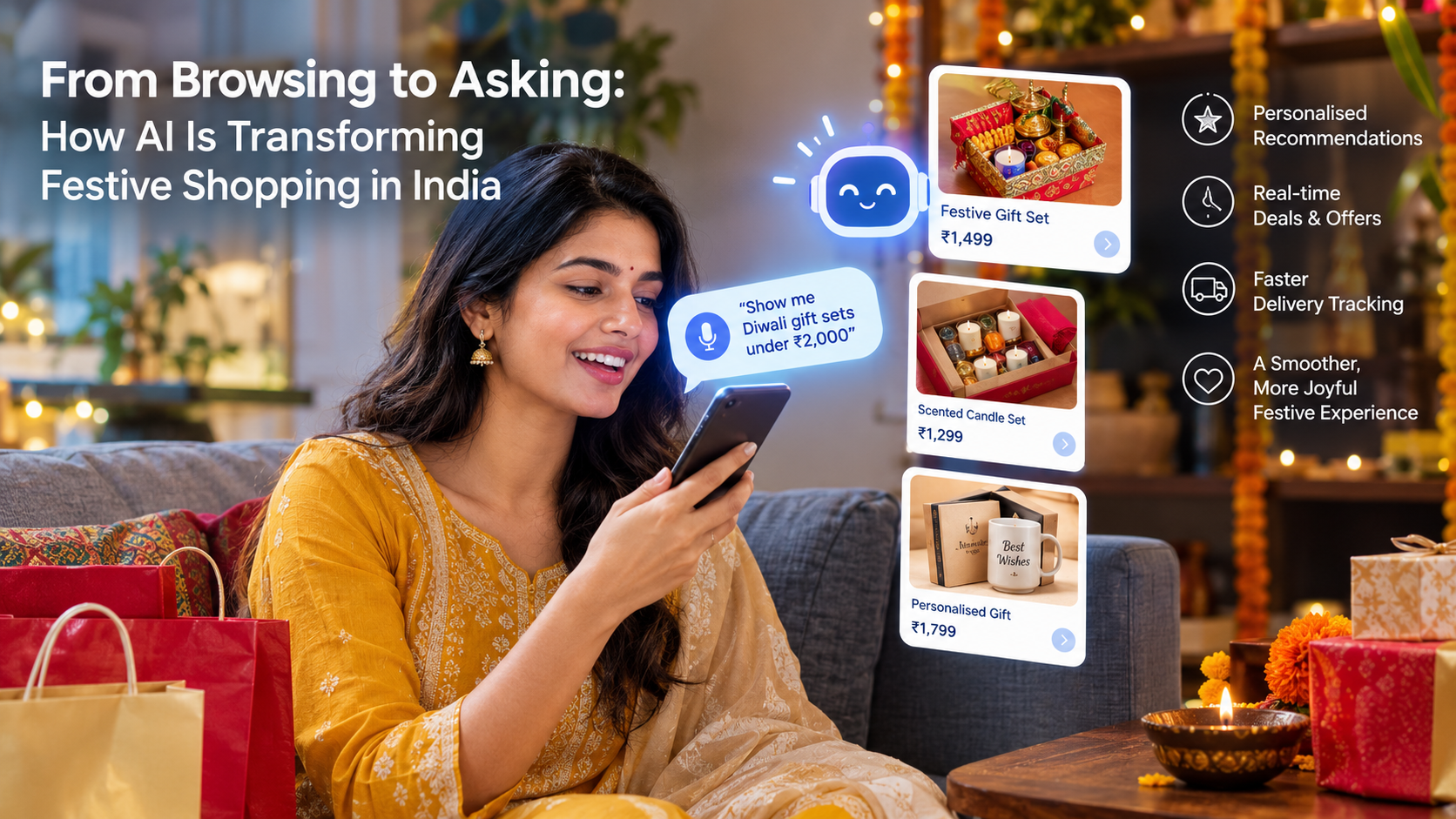
Sept 26: The festive shopping question in India may be changing.
Instead of asking, “Where can I buy this?”, consumers are increasingly asking, “What should I buy?”
That small change could have a big impact on ecommerce.
Artificial intelligence is moving beyond chatbots and content creation and becoming part of the shopping journey itself. Consumers can now ask AI to compare products, suggest gifts, find options within a budget and help them narrow down choices.
With India’s 2026 festive shopping season approaching, AI could increasingly become the digital equivalent of a personal shopping assistant.
AI Is Entering the Festive Shopping Journey
The numbers suggest that this is no longer a futuristic idea.
A September 2026 InMobi report found that four in five Indian shoppers are actively looking to use AI-powered shopping assistants for their festive purchases. The report also found that three in five shoppers plan to spend more than ₹10,000 during the festive season.
Interestingly, millennials showed greater interest in AI-based recommendations than Gen Z in the report, while shoppers from Tier 2 cities emerged as an important high-value segment.
The categories attracting strong purchase interest include apparel and footwear, jewellery, and groceries and daily essentials.
The message for brands is fairly clear: AI is becoming part of the consumer’s consideration process, not simply a technology experiment.
From Search to Conversation
For years, online shopping followed a familiar pattern.
A consumer searched for a product, opened several websites, compared prices and reviews, and eventually made a decision.
AI changes the starting point.
A consumer could now type:
“Suggest three Diwali gifts for my parents under ₹5,000.”
Or:
“Which smartphone under ₹50,000 has the best camera and battery life?”
The consumer does not necessarily need to know the exact product or keyword.
They can simply describe what they want.
That makes shopping more conversational.
And it gives AI a bigger role in the early stages of product discovery.
The Reports Show Consumers Are Already Using AI
The shift is visible in consumer data.
A 2026 Datum Intelligence report, based on a survey of 6,218 online shoppers, found that 51% had used AI chatbots to research an online purchase in the three months before the survey. Another 49% had used AI assistants offered by marketplaces.
That is significant because product research has traditionally been dominated by search engines, marketplaces, social media and review platforms.
AI is now becoming another route.
And it is a route where consumers can ask follow-up questions rather than simply scan search results.
Adobe’s India research also highlights the scale of this change. Its 2025 study of around 2,000 Indian consumers found that 73% already use AI to support shopping decisions, while 66% prefer AI for comparing products and 61% are comfortable allowing AI to complete approved purchases.
These figures point towards a broader shift: consumers are becoming comfortable allowing AI to participate in decisions that were previously made through manual browsing.
Festive Shopping Is Becoming More Digital
The AI trend is developing alongside a much larger digital advertising and ecommerce opportunity.
According to the 2026 Datum Intelligence report, India’s festive advertising expenditure is projected to reach ₹60,000–₹62,000 crore, with digital advertising expected to account for 67.8% of the total. Commerce and retail media alone are estimated at around ₹11,500 crore, while quick-commerce advertising is projected to reach about ₹2,200 crore.
The report also found that 72% of households plan to increase their festive spending this year.
For marketers, that creates a highly competitive environment.
There will be more brands competing for attention, more offers competing for consumer wallets and more digital platforms competing to influence purchase decisions.
AI adds another layer to that competition.
The New Question for Brands: Can AI Understand Your Product?
For years, brands have focused heavily on SEO.
The goal was straightforward:
Get the brand to appear when someone searches.
But AI-assisted shopping introduces another question:
Can AI understand why a consumer should consider your product?
Imagine a consumer asking:
“Find me a comfortable ethnic outfit for a family Diwali celebration under ₹4,000.”
The AI assistant needs information about products before it can make useful recommendations.
That makes product information increasingly important.
Brands should pay attention to:
- Clear product descriptions
- Accurate specifications
- Pricing and offers
- Genuine customer reviews
- Product availability
- Delivery information
- Product comparisons
- Frequently asked questions
- High-quality images
- Clear information about who the product is meant for
In other words, good product content may become just as important as good advertising.
Discounts Still Drive Festive Shopping
AI may be changing discovery, but traditional purchase motivations have not disappeared.
According to Datum Intelligence, discounts remained the leading reason for festive shopping, cited by 57% of respondents, followed closely by new product launches at 56%. Affordable EMI options were cited by 51%.
This is important for marketers.
AI does not replace price, value or promotions.
Instead, it can change how consumers evaluate them.
A shopper may no longer manually compare ten offers.
They could ask an AI assistant:
“Which of these offers gives me the best value?”
That means brands need to communicate value clearly rather than simply announcing that a sale is happening.
Tier 2 India Could Become an Important AI-Commerce Market
Another interesting part of the 2026 festive-shopping story is the rise of consumers beyond India’s largest metros.
The InMobi report identifies Tier 2 shoppers as an increasingly important high-value segment, with many planning festive budgets in the ₹10,000–₹25,000 range.
For brands, this presents an opportunity.
AI-powered shopping experiences could help consumers discover products without requiring them to visit multiple websites or understand complicated product categories.
But the experience needs to be simple.
Regional relevance, easy-to-understand product information, local availability and trustworthy recommendations could become increasingly important.
What This Means for Digital Marketing
The rise of AI shopping assistants does not mean traditional digital marketing is disappearing.
Instead, the consumer journey is becoming broader.
A shopper could discover a product through:
Google → Instagram → YouTube → Marketplace → AI assistant → Brand website
Every touchpoint can influence the final decision.
That means marketers may need to think beyond clicks and impressions.
1. Make Product Information Clear
AI cannot recommend what it cannot understand.
Brands should make product information detailed, accurate and easy to interpret.
2. Create Content Around Consumer Questions
Instead of focusing only on keywords, brands can create content answering real questions.
For example:
Which laptop is best for work and occasional gaming?
is closer to how consumers actually think than simply targeting:
Best laptop India.
3. Strengthen Reviews and Trust Signals
Consumers may use AI to compare products, but trust still matters.
Clear policies, credible reviews, transparent pricing and accurate claims can help consumers feel more confident about the final purchase.
4. Think Beyond Traditional Search
SEO remains important.
But brands should increasingly consider how their content might appear within AI-assisted discovery and conversational search environments.
5. Make the Buying Journey Easier
If AI helps consumers narrow their options, brands need to ensure that the next step is equally simple.
A confusing product page or complicated checkout can undo the advantage created by good discovery.
The Trust Question
There is also an important question behind the AI shopping boom:
Should consumers trust every recommendation they receive?
AI can make comparisons faster, but consumers still need reliable information.
A recommendation is only as useful as the data behind it.
That makes transparency increasingly important for brands. Product claims, prices, reviews and availability need to be accurate.
For marketers, the objective should not simply be to make a product more likely to appear in an AI recommendation.
It should be to give consumers enough reliable information to make a better-informed decision.
The Shopping Journey Is Changing
The traditional ecommerce journey looked something like this:
Advertisement → Search → Website → Product Page → Comparison → Purchase
The emerging journey could look very different:
Need → AI Conversation → Recommendation → Comparison → Product Page → Purchase
That is the real significance of AI shopping assistants.
They are not simply another search tool.
They can potentially become part of the decision-making process.
And during the festive season, when consumers are faced with thousands of products, competing discounts and limited time, reducing that decision-making effort could be particularly valuable.
What Brands Should Do Before the Festive Rush
The 2026 festive season gives brands a practical reason to review their digital presence.
Instead of asking only:
“Are we running enough advertisements?”
marketers should also ask:
“If a consumer asks AI about our category, is our product information strong enough to be understood and compared?”
That means reviewing product pages, descriptions, reviews, pricing, FAQs, images and comparison content.
It also means understanding how consumers are actually asking questions.
Because the future of discovery may not always begin with a keyword.
It may begin with a conversation.
Conclusion: From Search and Browse to Ask and Decide
AI is becoming part of India’s festive shopping journey at a time when consumers are already increasing their digital engagement.
The latest reports show strong interest in AI shopping assistants, growing use of AI for product research and a rapidly expanding digital advertising environment.
But the biggest change may be simpler than the technology itself.
Consumers increasingly want shopping to involve less searching, less comparing and less uncertainty.
AI can help them get there.
For brands, that creates a new challenge.
Being visible may no longer be enough.
Products need to be discoverable, understandable, comparable and trustworthy.
The festive shopping journey could increasingly move from “search and browse” to “ask, compare and decide.”
And the brands prepared for that shift may find themselves competing not just for clicks, but for a place in the answers consumers receive.
