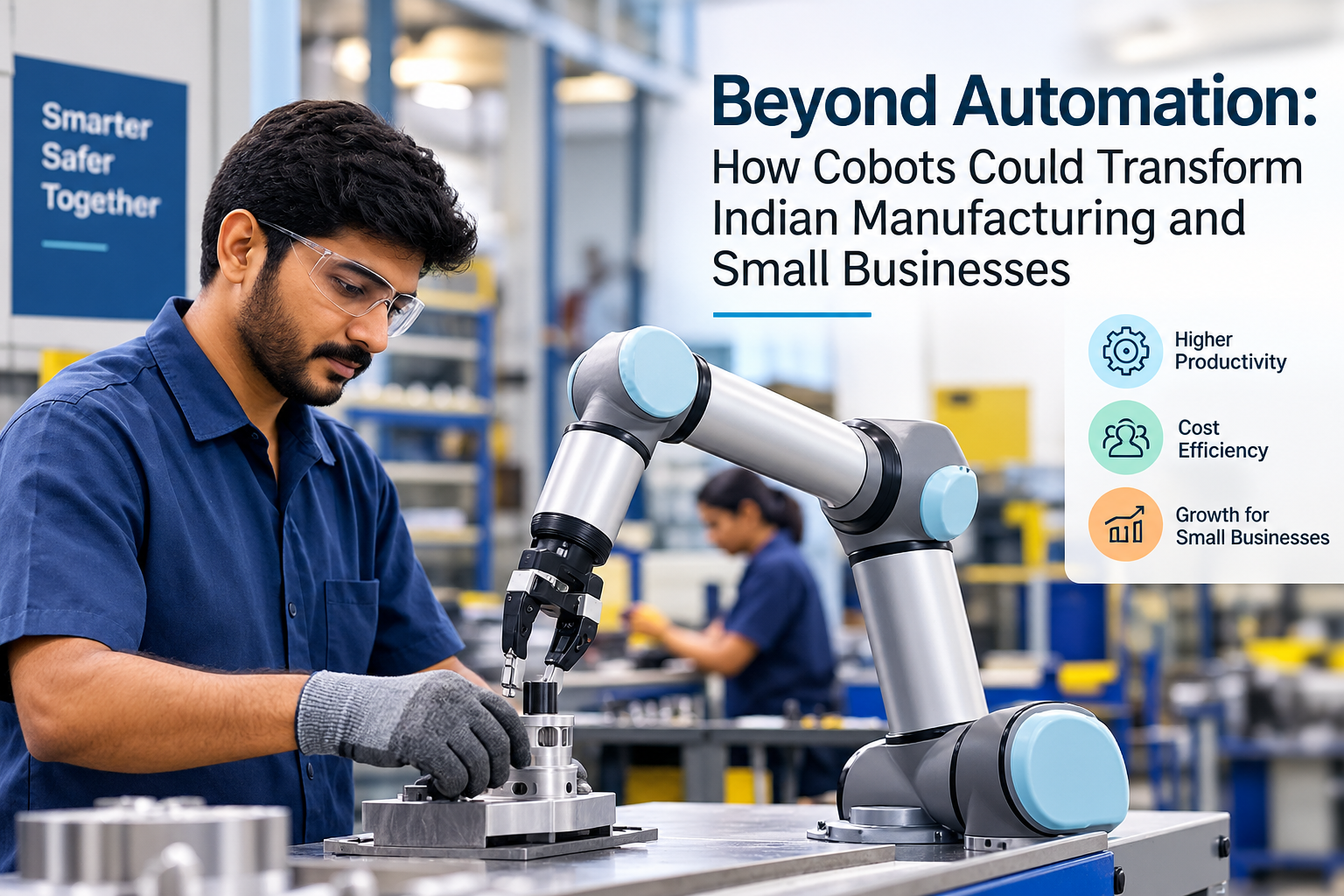
Automation is no longer just a conversation for large factories with substantial budgets. Across India’s manufacturing units, warehouses and small businesses, a more practical question is emerging: can robots take over repetitive work while people focus on tasks that require experience, judgement and problem-solving?
Collaborative robots, commonly known as cobots, could help businesses explore that possibility. Designed for specific applications where people and machines can work in close proximity with appropriate safeguards, cobots offer an alternative to automating an entire production line at once.
From assembling components to packing online orders, these robots could help businesses improve consistency, manage repetitive workloads and make better use of their workforce. The real opportunity, however, lies in choosing the right tasks and ensuring that automation delivers measurable business value.
What Makes Collaborative Robots Different?
Cobots are designed to support tasks that may involve working near human employees. Unlike many conventional industrial robots, which operate in dedicated, safeguarded workspaces, some cobots can be integrated into existing work areas with suitable safety measures.
Depending on their capabilities, they can assist with assembling products, picking and placing components, loading machines, packaging goods and carrying out selected inspection tasks. Some models can also be reprogrammed for different applications, making them useful for businesses that manufacture several products or handle smaller production batches.
For a small manufacturer, this flexibility can be particularly appealing. Instead of investing in a fully automated facility, the company could start with one repetitive task, evaluate the results and expand only when the investment makes commercial sense.
However, cobots are not automatically safe simply because they are designed for collaborative applications. Each installation requires an appropriate risk assessment, suitable safeguards and employee training.
Manufacturing: Helping Workers Focus on Skilled Tasks
Manufacturing is one of the clearest areas where cobots could make a difference. Production facilities often depend on employees to repeat the same movements throughout a shift, whether loading machines, fastening screws or moving components between workstations.
These activities are essential, but they can also be physically demanding and time-consuming.
Cobots can support repetitive assembly, machine tending, material handling and selected quality-control processes. Once properly configured, they can repeat defined tasks consistently while employees concentrate on checking finished products, resolving production issues and managing exceptions.
For India’s small and medium-sized manufacturers, this could offer a practical route towards modernisation. A company producing automotive components or engineering goods, for example, might introduce a cobot at a workstation where repetitive handling slows production.
The goal is not necessarily to remove people from the process. It is to reduce routine work and help the production line operate more smoothly.
Warehousing: Keeping Up With Growing Order Volumes
As e-commerce and organised retail expand, warehouses face pressure to process orders quickly and accurately. During busy periods, routine activities such as sorting parcels, packing boxes and moving products can become bottlenecks.
Cobots could help take some of that pressure off employees. Depending on the setup, they can assist with picking and placing items, packaging, sorting and repetitive material handling. Mobile robots can complement these systems by transporting goods between workstations.
Consider a warehouse preparing hundreds of orders a day. Employees may spend a considerable amount of time repeating the same packing movements. Automating part of that process could free them to manage inventory discrepancies, inspect damaged products and coordinate urgent orders.
The technology does have limitations. Irregularly shaped products, fragile materials and changing package sizes can complicate automated handling. Businesses should assess their actual workflows before deciding whether cobots are the right solution.
Small Businesses: Is Automation Becoming More Accessible?
For many small businesses, automation can sound expensive, complicated and difficult to maintain. Cobots could make the first step more manageable by allowing companies to address a specific operational problem rather than overhaul their entire facility.
A small engineering business might use a cobot to load a machine while an employee handles inspection. A packaging unit could automate repetitive box handling, while a suitable food-processing operation might explore robotic sorting or packing.
Potential benefits include:
- Reduced repetitive work: Employees spend less time on routine, physically demanding activities.
- Consistent performance: Properly programmed robots can repeat defined tasks with a high degree of consistency.
- Flexible production: Some models can be adapted to different products and applications.
- Incremental investment: Businesses can test one application before committing to additional systems.
- Better use of employee skills: Workers can devote more attention to quality checks, supervision and problem-solving.
However, a relatively affordable robot does not automatically make automation economical. Grippers, sensors, installation, integration, training, maintenance and safety measures can add significantly to the total investment.
Businesses need to evaluate the complete cost rather than focus only on the purchase price.
India’s Industrial Robotics Adoption Is Growing
India’s expanding use of industrial robots provides useful context for businesses considering collaborative automation.
According to the International Federation of Robotics (IFR), India installed a record 9,120 industrial robots in 2024, an increase of 7% over 2023, ranking sixth globally in annual installations. The automotive industry accounted for approximately 45% of installations. These figures were published in the IFR’s World Robotics 2025 report.
The broader global trend is also relevant. In its December 2024 position paper, the IFR reported that collaborative robots accounted for 10.5% of industrial robots installed worldwide in 2023.
These figures measure different things: the Indian figure covers industrial robots overall, while the cobot percentage reflects the global market. Neither establishes India’s specific cobot adoption rate.
Nevertheless, the data highlights the growing role of robotics in industrial operations and the potential for businesses to explore more flexible automation solutions.
Calculating the Business Case: Will Cobots Pay Off?
For business owners, the decision to invest in a cobot ultimately comes down to whether it solves a genuine operational problem.
A company should begin by identifying a task that consumes considerable time, involves repetitive movements or creates production bottlenecks. It can then compare the existing process with the expected performance after automation.
Important considerations include:
- Time saved: How much productive time could be recovered each day?
- Quality and waste: Could the system reduce handling errors, defects or material wastage?
- Utilisation: Will the robot be used regularly enough to justify its cost?
- Integration expenses: What additional equipment, software or modifications are required?
- Ongoing support: How much will maintenance, training and servicing cost?
For example, if a packaging operation frequently falls behind because employees spend hours on repetitive handling, a cobot could help improve throughput. But the financial benefit would depend on how much additional output the business can actually process and sell.
A pilot project is often a sensible starting point. By measuring performance before and after implementation, businesses can make decisions based on results rather than assumptions.
The Human Side of Collaborative Automation
Introducing robots into a workplace also changes the skills employees need. Workers may require training in equipment setup, programming, monitoring, troubleshooting and maintenance.
This transition deserves attention from the beginning. Employees who understand the technology can help identify practical improvements and recognise situations where human intervention is necessary.
Safety is equally important. Businesses must evaluate the robot, its tools, the materials it handles and the people working nearby. Depending on the application, safeguards, restricted operating zones and additional protective systems may be necessary.
Involving employees in the process can also make implementation more effective. The people who perform a task every day often understand its challenges better than anyone else. Their input can help businesses identify where automation will genuinely make work easier.
What Could Slow Down Cobot Adoption?
Despite their potential, cobots are not the right answer for every business.
High-speed production lines, heavy lifting and certain hazardous applications may be better suited to conventional industrial robots or specialised equipment. Older machinery can also present integration challenges.
Smaller businesses may face additional hurdles, including limited technical expertise, access to maintenance support and uncertainty about how quickly an investment will pay off.
The practical approach is to start with a clearly defined task, assess the risks and calculate the expected return. Businesses should also check whether their existing systems, workforce and production volumes can support the new technology.
The Road Ahead: People and Robots Working Together
Collaborative robots could become an important part of India’s industrial development as businesses look for ways to improve productivity while retaining the flexibility that human workers bring.
Manufacturers may use them to support consistent production, warehouses could explore them for repetitive handling and packaging, and small businesses may find opportunities to automate selected tasks without transforming their entire operations.
But the real measure of success will not be how many robots a company installs. It will be whether those robots help the business operate more efficiently, improve working conditions and serve customers better.
For Indian businesses exploring automation, the most useful starting point may be a simple question: which repetitive task takes up valuable time that could be spent elsewhere?
Finding the answer could be the first step towards a more productive workplace, where human experience and robotic precision work together.
