Bengaluru, Nov 13: At IVCA Circles – Bangalore Edition today, Shri Satya Prakash Singh, Nodal Officer in Charge, Research, Development and Innovation Fund, joined a panel discussion on the expanding role of domestic capital in supporting India’s alternative investment ecosystem, sharing insights on how initiatives like RDIF are supporting the research-led innovation ecosystem.
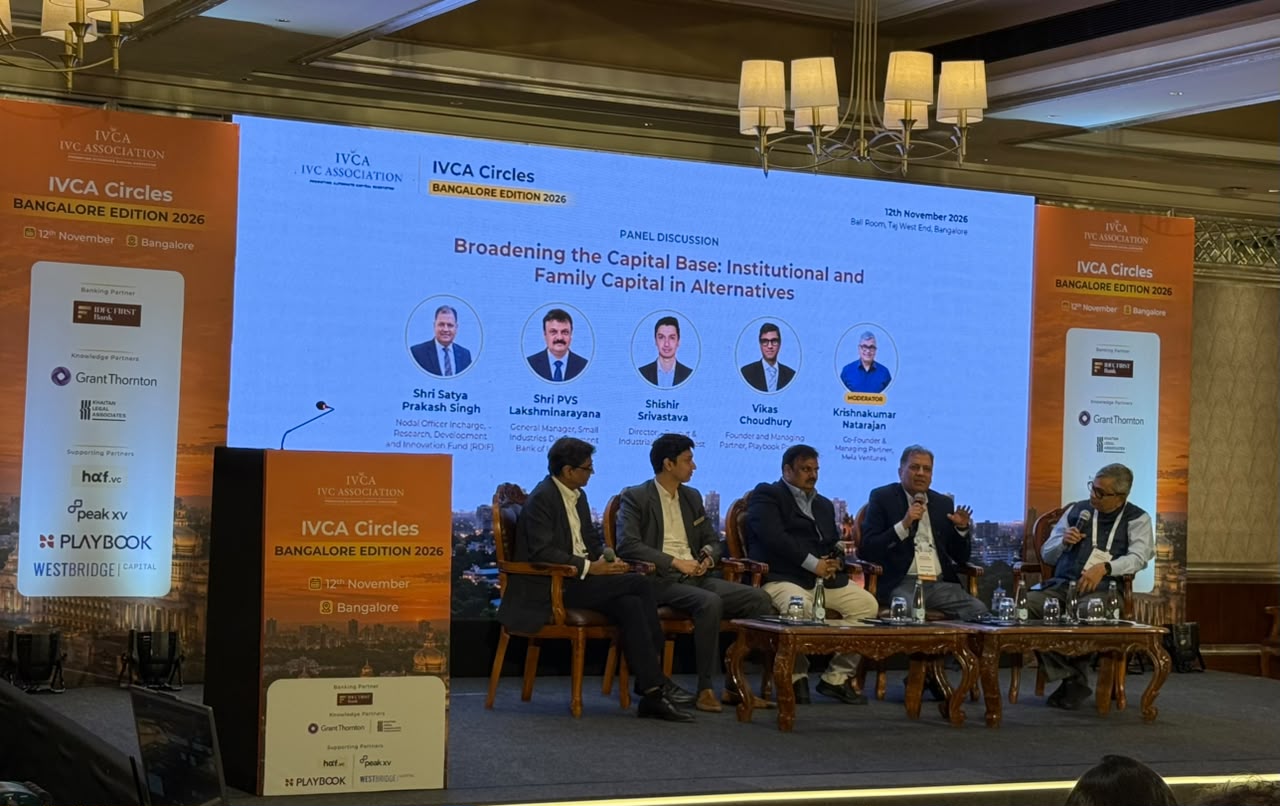
Titled “Broadening the Capital Base: Institutional and Family Capital in Alternatives”, the session was part of a day-long forum organised by the Indian Venture and Alternate Capital Association (IVCA) at Taj West End, Bengaluru. The panel also featured Shri P. V. S. Lakshminarayana, General Manager, Small Industries Development Bank of India; Shishir Srivastava, Director – Buyout & Industrials, Premji Invest; and Vikas Choudhury, Founder and Managing Partner, Playbook Partners. The discussion was moderated by Krishnakumar Natarajan, Co-Founder, Mela Ventures.
While the growing participation of domestic institutional investors, family offices, and high-net-worth individuals in alternative investments was a key focus, the discussion also touched upon how the sector could attract pension funds, insurance companies, and other institutional investors. In addition, the panellists examined the role family offices could play with regard to private markets, direct investments, and co-investment opportunities.
Sharing his perspective on the role of the RDI Fund in strengthening India’s deeptech ecosystem, Shri Satya Prakash Singh said,
“For the first time in the history of independent India, the Research, Development and Innovation (RDI) Fund has been designed to channel government capital directly to the private sector. The entire ₹1 lakh crore corpus is earmarked only for the private sector, investments. Recognising the longer gestation periods of deeptech businesses and the challenges they face in attracting private capital, the Fund provides both debt and equity options, with focus on debt financing. This includes a debt tenure of up to 20 years, with adequate moratorium on both principal and interest, providing companies with greater flexibility to develop and scale their technologies.
“We have also introduced three financing models under the RDI Fund to encourage private capital participation. Under the first model, the government can participate on pari passu basis or on equal terms, with private investors. Under the second, it can take a higher position in the distribution waterfall at a lower IRR, while under the third, it can take a subordinate position at a higher IRR. Through these structures, sovereign capital can take on higher risks to attract private investment into deeptech. Our objective is to support genuine research-led innovation and enable India to establish leadership in critical technology segments. I urge fund managers and innovators to think big and work collectively towards making India self-reliant in technology.”
The panellists highlighted the need to broaden India’s domestic capital base, adding that greater participation from institutional investors and family offices will be key to building deeper pools of capital, strengthening investment institutions, and creating more durable pathways for the growth of India’s private capital ecosystem.
The Bangalore Edition of IVCA Circles featured a series of such insightful discussions, serving as a platform for policymakers, investors, and industry leaders to share perspectives on how stakeholders could leverage the emerging sources of capital and deepen India’s venture and alternate capital ecosystem. With “The Next Wave of Indian Capital: Where Capital, Innovation and Opportunity Converge” as its theme, the invite-only forum saw participation from founders, incubators, regulatory leaders, and private players such as Grant Thornton, Peak XV, and Playbook Partners, among others.
