Nov 27: An AI system that answers a question is useful. One that can plan a sequence of actions, use tools, retrieve information and execute tasks towards a defined goal could fundamentally change how work gets done. This is the promise of Agentic AI, and it is shifting enterprise conversations from experimenting with AI tools to exploring how autonomous systems can be integrated into business operations.
But as organisations explore this next phase of AI adoption, a challenge is emerging: building effective AI agents and deploying them responsibly require different capabilities from those needed to identify business opportunities and lead AI-driven transformation. The engineer developing an agent and the business leader redesigning a workflow around it may work towards the same organisational objective, but their learning requirements are unlikely to be identical.
As AI roles evolve, professionals need learning opportunities that combine a strong technical foundation with the flexibility to develop skills relevant to their responsibilities. This is bringing greater relevance to programmes that recognise the different ways professionals will contribute to an agentic future.
Beyond AI Literacy: Building Skills for an Agentic Future
Moving from generative AI experimentation to functional agentic systems involves more than prompt engineering or familiarity with AI tools. Agents must be designed to reason through tasks, access relevant information, coordinate actions and operate within appropriate security and governance frameworks. Taking these systems into production also calls for reliable evaluation, monitoring and deployment practices.
These demands translate into distinct learning priorities across professional roles:
- Technical professionals need expertise in agent development, multi-agent orchestration, retrieval-augmented generation (RAG), model fine-tuning, evaluation and production deployment.
- Business and transformation professionals need to understand enterprise workflow redesign, AI strategy, automation, governance, adoption and business value assessment.
Both groups benefit from understanding how Agentic AI works, but they may need to apply that knowledge differently. A learning approach that accommodates these differences can help professionals move beyond general AI awareness towards capabilities suited to their career goals.
A Common Foundation for Different Career Goals
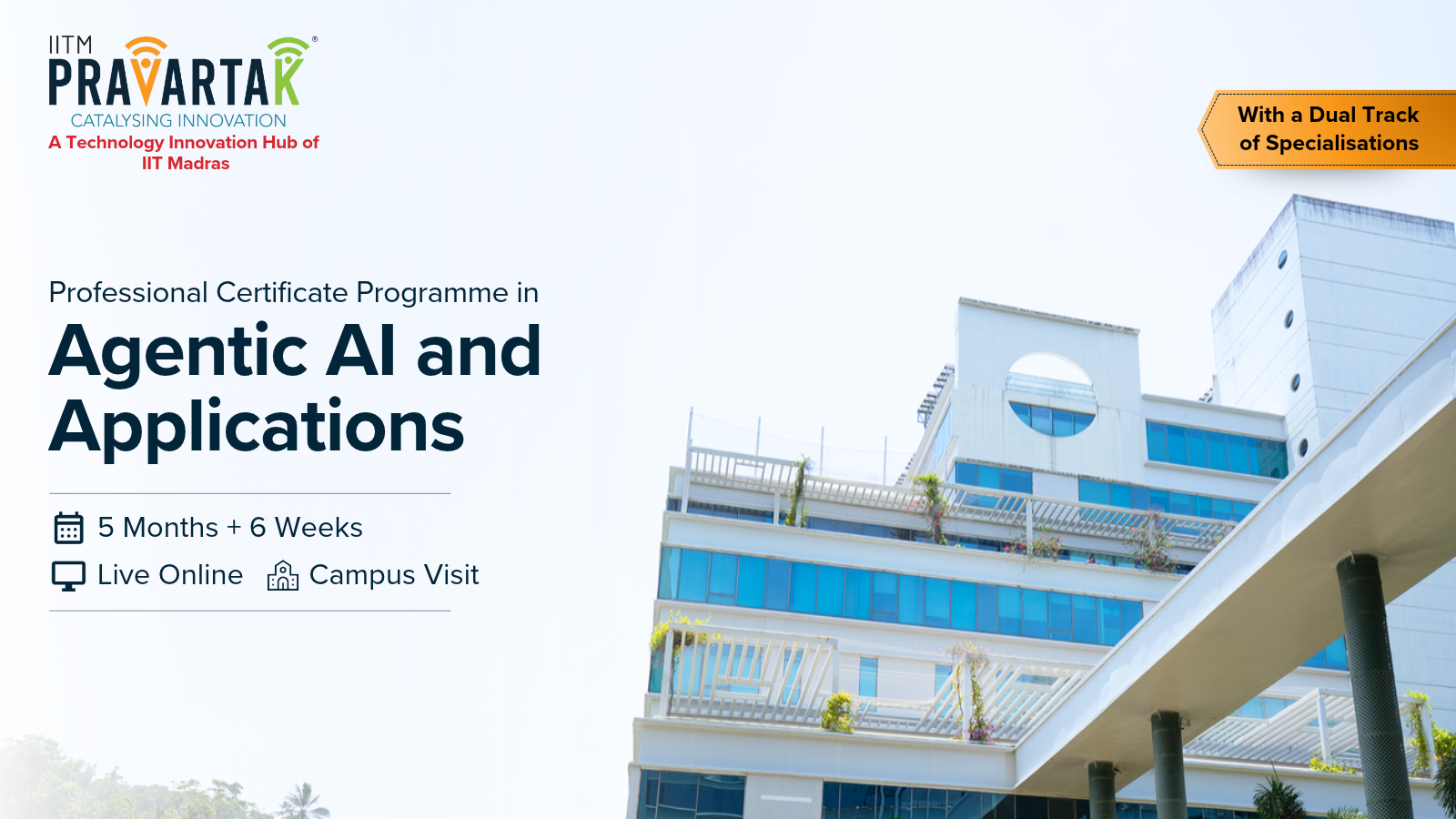
The IITM Pravartak Professional Certificate Programme in Agentic AI and Applications addresses these evolving requirements through a five-month core curriculum followed by an additional six-week specialisation. Learners first develop a foundation in Agentic AI before choosing between two pathways: Advanced Agentic AI Engineering or Agentic AI Strategy and Enterprise Workflows.
The core curriculum combines foundational concepts with practical exposure to the tools and frameworks used to develop, operate and govern agentic systems.
Key areas of learning include:
- Agent development: Python fundamentals, AI-assisted development, large language models, prompting, embeddings, LangChain, CrewAI, AutoGen Studio and LangGraph.
- Memory and retrieval: ChromaDB, FAISS vector search, hybrid retrieval, reranking, RAG architecture and the Model Context Protocol (MCP).
- Deployment and evaluation: FastAPI, Docker, LangSmith tracing and observability, agent evaluation, hallucination detection, security and AI governance.
- Applied learning: Hands-on assignments and capstone projects that connect concepts with practical applications.
Weekly live sessions are led by domain expert. Separately, IITM Pravartak lead faculty conduct weekly live masterclasses, providing additional opportunities to explore Agentic AI beyond the core curriculum.
After completing the core, learners can pursue the pathway that best matches their professional interests, with the six-week specialisation included at no additional fee.
- Advanced Agentic AI Engineering: Focuses on building and deploying agentic systems, covering LangGraph, OpenAI Agents SDK, Google ADK, LoRA/QLoRA fine-tuning and production deployment.
- Agentic AI Strategy and Enterprise Workflows: Explores how Agentic AI can be applied to business processes and organisational transformation through no-code automation platforms such as n8n, Zapier and Make, alongside enterprise workflows, governance and return on investment.
Each pathway includes a dedicated capstone in addition to the core curriculum capstone. These projects allow learners to apply their knowledge to challenges aligned with their chosen area, from developing a production-oriented multi-agent system to designing an end-to-end enterprise workflow.
From Learning to Practical Application
As enterprises explore increasingly autonomous workflows, understanding AI concepts is only one part of professional readiness. Applying those concepts, evaluating system performance and addressing implementation challenges are equally important.
To support this learning journey, the programme offers:
- Credentials: An IITM Pravartak certificate upon successful programme completion, a certificate for the chosen specialisation and three IBM industry credentials.
- Career preparation: Support covering resume development, LinkedIn profiles and interview preparation.
- Campus immersion: An optional two-day immersion at IIT Madras Research Park.
The growing adoption of Agentic AI is likely to bring technical and business functions closer together, even as their responsibilities remain distinct. Professionals who understand the technology and can apply it within their area of expertise will be better equipped to engage with this changing landscape.
By combining foundational Agentic AI learning, practical projects and a choice between engineering and business-focused pathways, the IITM Pravartak Professional Certificate Programme in Agentic AI and Applications offers professionals a structured way to build skills relevant to the evolving demands of enterprise AI adoption. For more information about the programme, visit: https://iitmpravartak.emeritus.org/professional-certificate-programme-in-agentic-ai-and-applications
