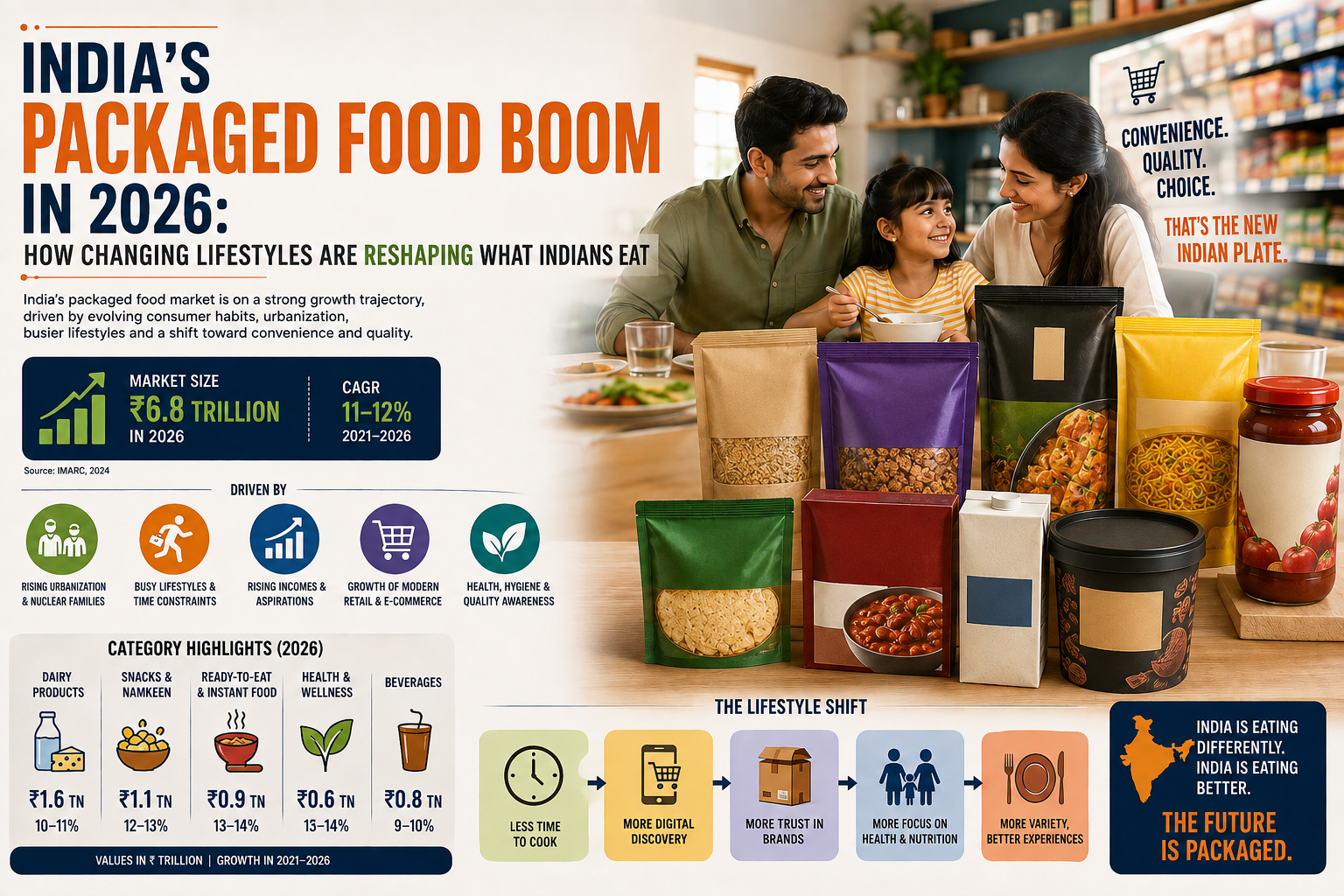
Sept 22: The way Indians eat is changing.
Busy work schedules, longer commutes, smaller households, growing health awareness and the rise of online shopping are changing how people think about food. One of the biggest beneficiaries of this shift is India’s packaged food industry.
From ready-to-cook meals and packaged snacks to protein-rich foods, breakfast products and functional beverages, packaged food is becoming part of everyday life.
But this is not simply a story about people eating more packaged food. It is about how lifestyle changes are creating new food habits and new business opportunities.
A Ministry of Food Processing Industries assessment found that India’s organised consumer food industry grew 14% between fiscal 2018 and 2024 and another 13% in fiscal 2025. The report expects another 13–15% growth in fiscal 2026, with snacks and ready-to-eat and ready-to-cook products among the important growth segments.
The bigger question is: what is driving this growth?
Lifestyle Is Changing the Indian Food Basket
Traditional Indian food habits are not disappearing, but the circumstances around them are changing.
A working professional may not have the time to prepare breakfast every morning. A young couple may prefer smaller food packs instead of buying in bulk. A student may look for an affordable snack that can be ordered quickly. A fitness-conscious consumer may want a convenient source of protein.
These everyday situations are creating demand for different kinds of food products.
Convenience has therefore become an important part of the food-buying decision.
The Ministry of Food Processing Industries has identified urbanisation, rising incomes, changing consumer preferences and the growing demand for convenience as important factors supporting the consumer food sector.
5 Packaged Food Trends to Watch in 2026
1. Convenience Will Remain Central
Consumers increasingly want food that fits around their schedules.
Ready-to-eat meals, ready-to-cook products, instant breakfast options and convenient snacks are designed around this reality.
The question for food brands is no longer simply whether a product tastes good.
It is also whether the product makes life easier.
2. Health Will Move Further Into the Mainstream
Health-conscious consumption is moving beyond specialist fitness products.
Protein, fibre, lower-sugar options, functional ingredients and nutritional transparency are becoming more important to mainstream consumers.
PwC India’s Voice of the Consumer 2025 survey found that 84% of Indian consumers surveyed were seeking safer, healthier food choices.
For food companies, this creates opportunities to develop products that combine convenience with nutritional value.
3. Quick Commerce Will Influence Food Discovery
The way consumers buy packaged food is changing rapidly.
The Ministry of Food Processing Industries found that online sales accounted for more than 5% of organised consumer food sales in fiscal 2024, compared with around 1% in fiscal 2019.
Quick commerce is taking this convenience further by making snacks, beverages, breakfast products and other food items available within short delivery windows in many urban markets.
This means food brands increasingly need to think about digital shelf visibility alongside physical shelf visibility.
4. Premium and Affordable Products Will Coexist
India’s packaged food market is unlikely to move entirely in one direction.
Some consumers will prioritise affordability, while others will pay more for nutrition, ingredients, convenience or a differentiated experience.
NIQ’s India FMCG Quarterly Snapshot for Q1 2026 highlights changing demand patterns and the continuing importance of affordability within India’s FMCG market.
For brands, this creates space for multiple formats and price points.
5. Regional Food Will Get a Modern Packaging
India’s regional food traditions offer an enormous opportunity.
Traditional snacks, breakfast foods, spice blends and regional recipes can be adapted into convenient packaged formats without losing their cultural identity.
This creates an attractive combination:
Traditional flavour + modern packaging + convenient consumption.
For emerging brands, regional identity can also provide differentiation in an increasingly crowded market.
Convenience Is Becoming a Consumer Currency
Time is becoming a valuable commodity.
For someone returning home after a long working day, a ready-to-cook meal can save considerable preparation time. For someone rushing to work, a packaged breakfast product can offer a quick alternative.
This is why categories such as ready-to-eat, ready-to-cook and packaged snacks are attracting attention.
The product is no longer competing only on taste or price.
It is also competing on a simple question:
How much easier can you make the consumer’s day?
For food companies, this changes the way products need to be developed and marketed.
Health Is Changing Packaged Food
Convenience alone is not enough anymore.
Consumers are becoming more interested in what is inside the packet.
Protein, fibre, lower-sugar products, functional ingredients and nutritional information are increasingly part of the conversation around packaged food.
PwC India’s consumer research reinforces this shift, with health and food safety emerging as important considerations among Indian consumers.
This is creating a new opportunity for food companies.
The packaged food industry is moving from a simple “tasty and convenient” proposition towards one that increasingly combines taste, convenience and nutrition.
Protein Is Moving Beyond the Gym
Protein is a good example of how food habits are changing.
Protein-rich products were once strongly associated with athletes and fitness enthusiasts. Today, protein is increasingly being marketed to ordinary consumers looking for convenient nutrition.
Protein bars, shakes, high-protein snacks and other nutrition-focused products are finding space in mainstream shopping.
This opens up a much wider market for food companies.
The opportunity is not necessarily to convince consumers to completely change what they eat. It is to make better nutritional choices easier to incorporate into existing routines.
Quick Commerce Is Changing Food Shopping
The packaged food industry is also benefiting from a major change in how Indians shop.
Consumers increasingly discover and purchase products online rather than only in supermarkets or neighbourhood stores.
Quick-commerce platforms have pushed this convenience even further.
A consumer can remember they need breakfast cereal, snacks or a beverage and order it from a phone.
This has changed the consumer journey:
Discover → Search → Compare → Order → Consume
For food brands, this means digital visibility is becoming as important as shelf visibility.
A product needs attractive packaging, but it also needs a strong digital presence, clear product information, reviews and compelling online content.
Smaller Households, Smaller Packs
Indian households are changing too.
Single-person households, young couples and smaller families are creating demand for products that can be consumed without buying large quantities.
Smaller packs and single-serve formats can make products more convenient and accessible.
This also gives food companies another way to reach consumers who may be interested in trying a product but are unwilling to commit to a larger pack.
In this sense, packaging is becoming part of the marketing strategy.
Affordability Still Matters
Health and convenience may be growing priorities, but price remains important.
Not every consumer is willing or able to pay a premium for specialised food products.
NIQ’s Q1 2026 India FMCG data points to affordability remaining an important consideration in the FMCG market.
This creates an interesting challenge for food companies.
Brands need to offer innovation while keeping products accessible.
Smaller packs, different price points and products designed for specific consumption occasions can help companies reach different sections of the market.
Premium Food Is Also Finding Its Place
At the same time, another group of consumers is willing to spend more on products they perceive as better.
Premium snacks, speciality ingredients, healthier alternatives, functional beverages and high-quality regional foods are finding space in the market.
Premiumisation does not necessarily mean luxury.
It could simply mean choosing a product because it offers better ingredients, higher nutritional value, a more interesting flavour or a more convenient experience.
This gives food brands room to develop products across multiple price and value segments.
Regional Food Meets Modern Convenience
India’s regional food traditions offer another major opportunity.
Consumers may want convenience, but they do not necessarily want generic flavours.
Regional snacks, traditional breakfast foods, spice blends and local recipes can be adapted into packaged formats for modern consumers.
For emerging food businesses, this can be particularly valuable.
A regional product with a strong story, distinctive flavour and modern packaging can potentially find customers far beyond its original market.
Packaging Is No Longer Just Packaging
A food packet has a lot of work to do.
It needs to protect the product, attract attention, communicate information and increasingly address consumer concerns about sustainability.
PwC’s consumer research found that sustainability and eco-friendly packaging are also considerations for Indian consumers.
At the same time, consumers want clearer information about ingredients and nutrition.
That means packaging needs to communicate quickly.
The consumer should be able to understand what the product is, what it contains and why it may be relevant without having to search extensively for the information.
The Packaged Food Opportunity Is Much Bigger Than Snacks
When people think about packaged food, snacks, biscuits and instant noodles often come to mind first.
But the market is much broader.
It includes:
- Ready-to-eat meals
- Ready-to-cook products
- Protein-rich foods
- Functional beverages
- Healthy snacks
- Frozen foods
- Breakfast products
- Regional foods
- Plant-based products
- Packaged staples
- Nutrition-focused products
The broader food-processing sector is also expanding. Government data released in 2026 showed that food-processing GVA increased from ₹1.34 lakh crore in 2014–15 to ₹2.24 lakh crore in 2023–24.
This shows that the opportunity extends well beyond individual packaged-food categories.
What Food Businesses Need to Understand
For food companies, the biggest question is no longer simply:
“What product can we sell?”
It is:
“What problem are we solving for the consumer?”
A product could save time.
It could provide convenient nutrition.
It could offer portion control.
It could make a traditional food easier to prepare.
Or it could give consumers a healthier alternative without forcing them to completely change their lifestyle.
This shift in thinking can influence everything from product development to packaging and marketing.
Why This Matters for SMEs and Emerging Food Brands
The packaged food opportunity is not limited to large FMCG companies.
Smaller food businesses can also use changing consumer preferences to build focused products around specific needs.
An SME could specialise in a regional snack, a high-protein product, a ready-to-cook breakfast, a healthier snack or a traditional recipe presented in a convenient format.
The advantage for smaller brands can come from being more focused.
Instead of trying to appeal to everyone, a business can identify a specific consumer group and build its product, packaging and marketing around that audience.
Digital channels can make this approach even more practical.
A smaller brand can test demand through social media, marketplaces and targeted digital campaigns before investing heavily in physical distribution.
Digital Visibility Is Becoming Part of the Food Business
A packaged food product may sit on a supermarket shelf, but its first interaction with a consumer could happen online.
Someone might discover it through Instagram, search for reviews on Google, see it on a quick-commerce platform or encounter it through a food creator.
That means food companies need to think beyond traditional distribution.
Content, search visibility, social media, online reviews and product storytelling are becoming important parts of the customer journey.
For emerging food brands in particular, digital marketing can help build awareness before a product achieves widespread physical distribution.
The New Indian Food Consumer
The Indian food consumer is becoming more complex.
People want convenience, but many also want healthier options.
They want affordable products, but some are willing to pay more for quality.
They want traditional flavours, but they are also willing to experiment.
They want quick solutions, but they increasingly want transparency about what they are consuming.
This means there is unlikely to be one single formula for success in packaged food.
Different consumers will want different things — sometimes from the same brand.
The Future of India’s Packaged Food Sector
India’s packaged food sector is being reshaped by changing lifestyles.
Urbanisation is changing eating patterns. Work schedules are increasing the value of convenience. Smaller households are influencing pack sizes. Health awareness is creating demand for nutrition-focused products. Digital commerce is changing how food is discovered and purchased.
The latest industry and consumer reports reinforce this broader shift.
For food companies, the opportunity is not simply to put more products on shelves.
It is to understand how Indians are living and build products around those lifestyles.
The next generation of packaged food brands will need to balance taste, convenience, nutrition, affordability and trust.
For SMEs and established companies alike, the question is becoming:
What can we make easier, healthier or more convenient for the consumer?
Shreyas Webmedia Solutions can help food and FMCG businesses strengthen their digital visibility through content, online presence and strategic digital marketing.
Because in India’s changing food market, having a good product is only the beginning. Consumers also need to discover it, understand it and trust it.
