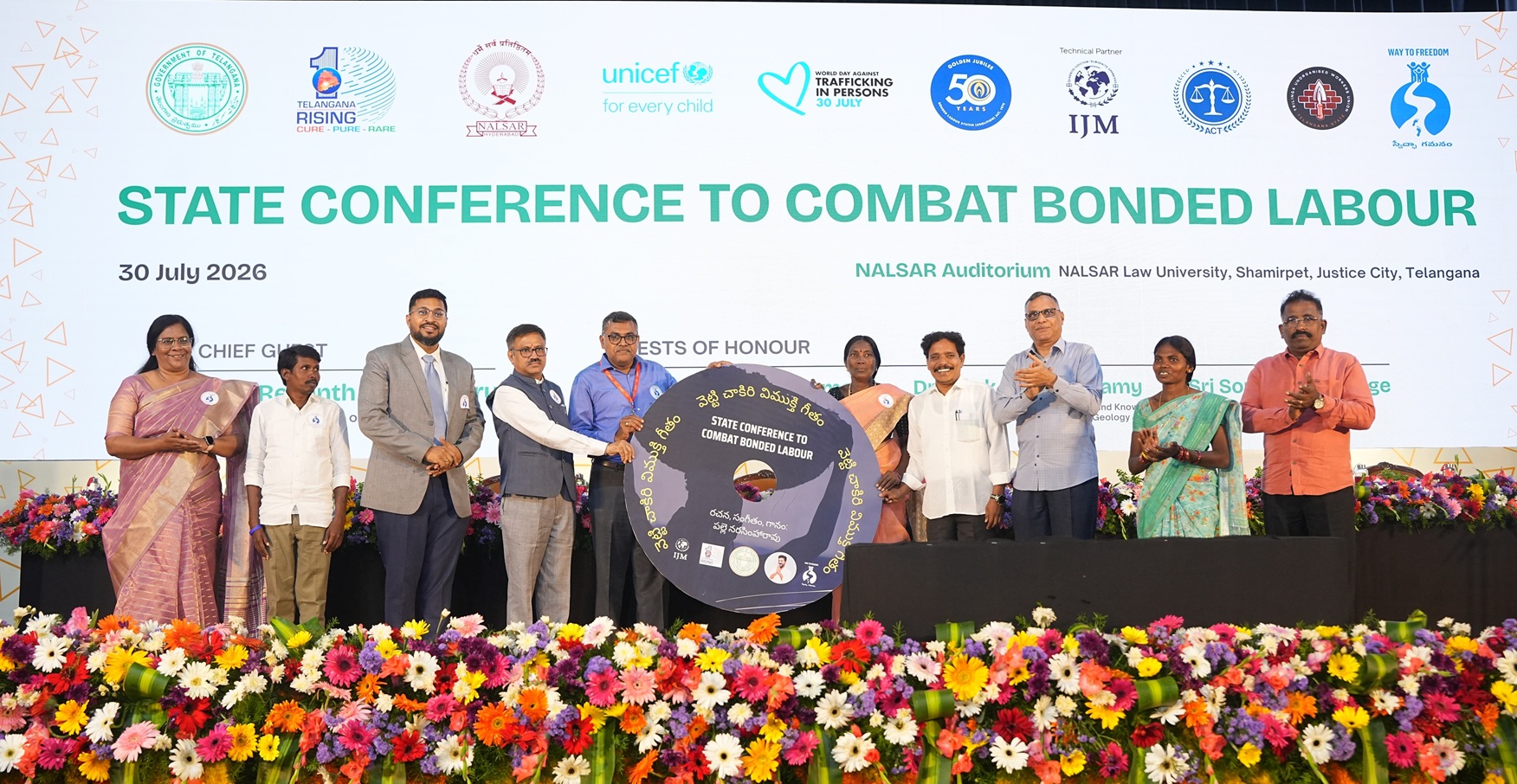
Hyderabad, Telangana, July 30: On July 30, commemorated as ‘World Day Against Trafficking in Persons’, and as a part of the Golden Jubilee of the Bonded Labour System (Abolition) (BLSA) Act, the Government of Telangana, in collaboration with NALSAR University of Law and IJM, convened a state conference to strengthen collective efforts to eradicate bonded labour. Bringing together government officials, legal experts, civil society representatives, bonded labour survivors, media and law students, the conference served as a platform to reflect on progress, share expertise and experiences, and reaffirm a shared commitment to protecting vulnerable communities from exploitation.
As a part of the same, Shri Ch Panchakshari, Member Secretary of the Telangana State Legal Services Authority (TSLSA) and Shri Krishna Deva Rao,Vice Chancellor of NALSAR University of Law, flagged off ‘Swechaa Ratham’, a bonded labour awareness van, which will travel across 33 districts in Telangana to disseminate information, engage communities, and strengthen awareness at the grassroots level.
This awareness campaign aligns with the vision articulated by the Hon’ble Chief Minister Shri Revanth Reddy, under Telangana Rising 2047, which affirms that bonded labour and modern-day slavery have no place in Telangana’s future. The initiative seeks to strengthen prevention, increase public confidence in government systems and encourage workers facing exploitation to seek timely assistance.
With over 380 survivorous, the conference opened with welcome remarks, followed by addresses from distinguished guests who underscored the importance of sustained collaboration, effective implementation of the BLSA Act, and survivor-centred approaches to prevention, rescue, rehabilitation, and access to justice. Speakers highlighted the critical role of partnerships between government institutions, academia, and civil society in addressing bonded labour across Telangana.
Shri Ch Panchakshari shared, ‘Even after 50 years of the BLSA Act, bonded labour continues to exist, which is a matter of grave concern. Human trafficking and bonded labour are not merely legal issues but issues of human dignity, social justice and constitutional values. Eradication of bonded labour requires coordinated efforts from the Police, Revenue, Labour, Women & Child Welfare Departments and civil society organisations. The Telangana State Legal Services Authority (TSLSA) is conducting legal awareness campaigns across villages and has deployed mobile legal awareness vans screening short films to educate rural communities on bonded labour and other legal rights.’
‘The way forward begins with reporting, followed by rescue, release, and rehabilitation. District Vigilance Committees must become more active and effective. Rescue without sustainable livelihoods will push survivors back into exploitation. Rehabilitation must continue beyond rescue. District Vigilance Committees, lawyers, teachers, civil society organisations, civil servants, Panchayati Raj institutions, the SLSA, and every stakeholder must work together,’ shared Shri Krishna Deva Rao, highlighting the need for coordinated action.
‘In her address, Smt. Merlin Freeda, National Programme Director, IJM, shared: ‘Fifty years ago, India made a landmark commitment through the BLSA Act. It declared that no person’s freedom can be bought, sold, inherited, or controlled through debt. That law affirmed a simple but powerful truth: every worker has the right to live and work in freedom, with dignity, and in safety. And yet, even today, we see vulnerable workers being exploited in different places. They are in rock quarries, brick kilns, rice mills, and several other workplaces. That’s why, today is the beginning of a broader movement, a movement to transform awareness into action, and to convert commitment into sustained collective effort.’
A key highlight of the event was the launch of the ‘Bonded Labour Awareness Song’, which was performed by Singer-Songwriter and Advisory Committee Member, Cultural and Tourism, Government of Telangana, Palle Narasimha. The song was developed to increase public awareness about bonded labour and encourage communities to recognise and report cases of exploitation. It calls on citizens to report suspected cases of bonded labour to the Labour Department’s helpline so that victims can be rescued and rehabilitated.
The conference also featured the launch of a booklet commemorating ‘50 years of the BLSA Act’ and a poster showcasing the bonded labour toll-free helpline number, which will be used across all government offices.
At the heart of the conference were the voices of survivors, who shared their lived experiences of exploitation, rescue, recovery, and resilience. Their testimonies served as powerful reminders of both the devastating impact of bonded labour and the transformative outcomes that are possible through timely intervention and long-term support.
Panchayat President of Amaragiri and bonded labour survivor, P Lingamma reflected on her past bondage and her present circumstances, sharing her optimistic view of a hopeful future: ‘In my life, wherever I find people still suffering under bonded labour, or facing hardship or injustice, I will stand with them. The officers have supported us, and I too will support the poor. Whatever difficulty or challenge comes, I am ready to face it. I have the courage to rescue people from bonded labour and help them become free.’
The event also featured a drama performance by Gajuwelli Pratap Cultural Group depicting the realities of bonded labour and the journey from exploitation to freedom. Through storytelling and performance, the production highlighted the human cost of bonded labour while reinforcing the importance of collective action to prevent exploitation and support survivors.
The state conference was a renewed commitment from participating stakeholders to continue working together to strengthen systems, raise public awareness, and advance efforts towards a future free from bonded labour. The event reaffirmed that ending bonded labour requires coordinated action across institutions, communities, and society, through dialogue, survivor leadership, and creative public engagement.
