• Bhubaneswar India
  • Contact+ 91-9938772605
  • Mon - Sat : 10:00AM - 6:00PM

Category: news

All India Seishinkai Shitoryu Karate Do Federation Breaks Age Barriers at Black Belt Ceremony, Honours Senior Citizens and Women Karatekas

Kolkata, Jan 15: Challenging age-related stereotypes and redefining the boundaries of martial arts, the All India Seishinkai Shitoryu Karate Do Federation organised a prestigious Black Belt Award Ceremony on Sunday, January 11, celebrating karate as a lifelong discipline that transcends age and gender.

In a powerful display of dedication and perseverance, the federation honoured several senior citizens, including women above 60 years of age, by awarding them black belts — a rare and inspiring sight that underscored the belief that karate is not restricted to youth alone. The ceremony witnessed the participation of over 500 practitioners, including more than 200 women and numerous senior karatekas, reflecting the growing importance of karate in today’s society and its acceptance as a holistic path to physical and mental well-being.

Speaking on the occasion, Hanshi Premjit Sen said, “Karate truly has no age limit. It is not about how young or strong you are, but about discipline, consistency, and the will to improve oneself. Seeing senior citizens—especially women above 60—earning their black belts proves that karate is a lifelong journey. For older practitioners, karate helps maintain physical fitness, balance, flexibility, and mental alertness, while also instilling confidence and a renewed sense of purpose. When seniors train alongside younger generations, it creates mutual respect, motivation, and a powerful learning environment. Martial arts offer dignity, strength, and self-belief at every stage of life.”

The event strongly highlighted the idea that karate is a lifelong journey, offering benefits such as improved fitness, balance, flexibility, mental alertness, and self-confidence for practitioners of all ages. The participation of senior citizens training alongside younger generations sent a powerful message of inclusivity, mutual respect, and inspiration.

A major focus of the ceremony was women’s empowerment through karate. The federation emphasised martial arts as a vital tool for self-defence, confidence-building, self-reliance, and mental resilience. In an era where personal safety and empowerment are increasingly important, the event reinforced the role of karate in shaping confident, independent, and fearless individuals.

Adding to the impact of the programme was a special masterclass on practical self-defence for women, conducted by renowned martial arts expert Hanshi Premjit Sen, Referee and Judge, World Karate Federation and Asian Karate Federation. The session focused on real-life applications of karate techniques aimed at enhancing personal safety, awareness, and confidence.

The ceremony concluded with a strong reaffirmation of the federation’s mission to take karate beyond age barriers, promoting inclusivity, empowerment, and holistic development. By recognising practitioners across generations, the All India Seishinkai Shitoryu Karate Do Federation continues to set an inspiring example of how martial arts can transform lives — at any age. 

From Ayodhya to Bengaluru: Cultural Initiative Advances Construction of Shri Salasar Balaji (Hanuman) Temple in Bengaluru

Bengaluru, Jan 13: The Shri Salasar Balaji Seva Samiti is advancing the construction of the Shri Salasar Balaji (Hanuman) Temple in Bengaluru, a shrine envisioned as a spiritual bridge between Ayodhya and Kishkindha, two sacred geographies central to the Ramayana. A cultural fundraising initiative held on Sunday at the Prestige Centre for Performing Arts, Kanakapura Road, marked a key milestone in this journey. 

The event forms part of a multi-city outreach programme supporting the construction of the temple at Ranka Colony, Bannerghatta Road, Bengaluru – 560075. 

*A Sacred Alignment of Faith and Time* 

The temple is devoted to Shri Salasar Balaji, a revered manifestation of Lord Hanuman (Anjaneya Swamy), uniquely depicted with a beard and moustache, a form rarely represented in South India. Rooted in the spiritual lineage of Salasar Dham in Rajasthan, the temple seeks to extend this distinct tradition of devotion to the southern region.

According to the Trust, the project carries a deeper spiritual symbolism. The Bhoomi Soudhan Yagya for the Bengaluru temple was performed on the same day as the inauguration of the Ram Temple in Ayodhya. Bengaluru lies close to Kishkindha, believed to be the birthplace of Lord Hanuman and the site where he met Shri Ram and pledged lifelong devotion. The Trust views this alignment as a divine indication, affirming a spiritual continuum linking Ayodhya, the birthplace of Shri Ram, with Kishkindha, the land of Hanuman’s unwavering service. 

*Architecture Anchored in Tradition 

The temple is being constructed using Bansi Paharpur stone, the same material used in the Ram Temple in Ayodhya. The architectural design is guided by an architect from the Somapura (Sompura) family, the lineage of master temple architects associated with the Ayodhya project. 

According to the Trust, the use of traditional materials and classical design principles ensures adherence to shilpa shastra, preserving architectural sanctity while creating a timeless spiritual space.

A Collective Effort of Devotion

The Shri Salasar Balaji Temple project is being undertaken by the Shri Salasar Balaji Seva Samiti, comprising trustees, life members, devotees, and contributors from across India. Participation includes initiatives such as Shila Seva, Rangamandap Seva, Bhoomi Sahyog, devotional offerings including Amrit Bhog and Sundarkand, and the flagship annual Anjaneya Mahotsav, alongside CSR-supported cultural programmes. 

Several key milestones have already been completed, including the Bhoomi Soudhan Yagya, Shila Pujan, Garbh Griha Pujan, and successive editions of the Anjaneya Mahotsav. 

Construction is currently underway, and the temple is expected to be completed by 2028. The Pran Pratishtha ceremony is envisaged around the same period, marking the formal consecration of the deity. 

Culture as a Medium of Engagement 

As part of its outreach efforts, the Trust hosted the Hindi theatrical production “Chakravyuh,” written and performed by Dr. Nitish Bharadwaj and directed by Atul Satya Koushik. The play, depicting the Abhimanyu episode from the Mahabharata, is being staged across multiple cities in support of the temple initiative. 

While the performance was well received, organisers emphasised that its primary purpose was to create awareness about the temple’s spiritual and cultural vision. 

Voices from the Initiative 

Pramod Murarka, President of Shri Salasar Balaji Seva Samiti, said:

“The construction of this temple is a collective expression of faith and service. We invite devotees to participate through devotion, time, and contributions to help bring this spiritual mission to completion.” 

Sanjay Shah, Chairperson of the Temple Construction Committee, added:

“`“The work is progressing with dedication and care. With continued support, the temple will stand as a centre of devotion and spiritual inspiration for generations.”` 

Reflecting on the initiative, Dr. Nitish Bharadwaj said:

“Through Chakravyuh, we are contributing to a cause that carries enduring cultural and spiritual significance. It is art in service of a larger dharmic vision.” 

The event was attended by devotees, trustees, life members and invited guests, with Karnataka’s Minister for Transport and Muzrai, Shri Ramalinga Reddy, present as the chief guest. 

The Shri Salasar Balaji Seva Samiti will continue its outreach through further cultural, devotional, and fundraising initiatives as the temple project progresses toward completion. 

Addressing the gathering after inaugurating the play, Shri Ramalinga Reddy, Hon’ble Minister of Transport and Muzrai said, “Karnataka is home to around 1.8 lakh temples, with approximately 34,000 under the state government. Among the most famous are Kukke Subramanya, which attracts nearly 1 crore devotees, and the Renuka Yellamma Temple in Belgaum. Just as these temples are renowned, I hope Shri Salasar Balaji Temple becomes equally popular and successful. The construction of Shri Salasar Balaji Temple is currently underway in BTM Layout and today, a beautiful drama titled “Chakravyuha” is being performed to raise funds for it. I hope the drama is a great success and that the temple construction is completed soon.”

ITC Sunrise Pujor Saatkahon Brings Bengal’s Durga Puja Stories to Apeejay Kolkata Literary Festival 2026

Jan 12: ITC Sunrise Spices participated in the Apeejay Kolkata Literary Festival 2026, bringing its one of the largest grassroots initiative, ‘Sunrise Pujor Saatkahon’ to one of India’s most respected literary platforms. Launched during Durga Puja 2025, the initiative celebrated Bengal’s biggest festival not merely as a spectacle, but as a living tapestry of stories, emotions and community spirit, capturing and preserving 250 unique Puja narratives from across West Bengal, moving beyond Kolkata to reflect the diverse regional voices and grassroots celebrations that define Durga Puja across the state.

Recognised for celebrating literature, heritage and contemporary cultural conversations, the Apeejay Kolkata Literary Festival brought together writers, artists, thinkers and cultural voices on one platform. Within this setting, Durga Puja was explored as a powerful cultural story through the lens of Sunrise Pujor Saatkahon.

As part of the festival, a special panel discussion titled “Pujo Special: Celebrating the Durga Pujos of Bengal” was held on 11th January 2026 at the Alipore Museum. The session explored how Durga Puja has evolved as a powerful cultural narrative shaped by neighbourhoods, artistry, social themes and collective memory along with the stories documented in the Sunrise Pujor Saatkahon coffee table book. The discussion highlighted how each para, idol and theme carried a unique narrative, reflecting Bengal’s creativity, social consciousness and collective pride.

The panel featured an eminent line-up of speakers from Bengal’s cultural and creative landscape:

  •  Sayantan Maitra, VP – Mass Art, curator, cultural entrepreneur, architect and scenographer
  •  Ushoshi Sengupta, Actress
  •  Moon Moon Sen, Actress
  •  Tonmoy Roychoudhury, Voice-over artist, presenter and former radio jockey

During the discussion, the Sunrise Pujor Saatkahon initiative was acknowledged as one of the most extensive grassroots cultural movements around Durga Puja in recent times, noted for documenting the festival beyond visual grandeur and capturing it as a rich archive of community-led stories from across the state.

Launched during Durga Puja 2025, the initiative brought together over 1,500 Durga Puja committees through multiple phases of storytelling, community participation, voting, on-ground audits and celebrations, culminating in the launch of the ‘Sunrise Pujor Saatkahon’ cultural coffee table book, a tribute to 250 Puja stories that continue to preserve the memories and cultural significance of the festival long after the pandal lights dimmed and the idols returned home.

Mr. Piyush Mishra, Business Head, ITC Spices, said, “Through Sunrise Pujor Saatkahon, we aimed to capture the spirit of Bengal’s Durga Puja – its creativity, emotion and community pride. Our participation at Kolkata Literary Festival 2026 reinforces the brand’s long-standing relationship with Bengal, celebrating not just flavours, but heritage, creativity and community while further catapulting Durga Puja as a living narrative to be preserved, discussed and celebrated on literary platforms.”

In addition to the panel discussion, Sunrise Spices also hosted a dedicated Sunrise Stall at the festival, where visitors engaged with the initiative and accessed hard and soft copies of the ‘Sunrise Pujor Saatkahon’ book, further extending the reach of the stories captured during Durga Puja.

Chinmaya Mission Creates a Landmark Spiritual Moment as Over 5,000 plus Unite for Delhi’s Largest Hanuman Chalisa Chanting at Yashobhoomi

New Delhi, Jan 12:  Chinmaya Mission marked a historic spiritual milestone for the Capital with Dilli Gao Jai Hanuman, a large-scale Hanuman Chalisa power chanting that brought together over 5,000 plus participants at Yashobhoomi, India’s largest convention centre.

Conceived as Delhi’s collective offering to the Chinmaya Amrit Mahotsav 2026, commemorating 75 years of the Chinmaya Movement, it was not merely a large gathering but a living expression of bhakti, seva and collective sadhana where thousands of hearts and voices aligned in one rhythmic invocation of Lord Hanuman’s grace and strength.

Held at the Brahmakamal Hall, the event transformed the vast architectural space into an immersive field of chanting and vibration. As thousands gathered in unison, the hall resonated with the rhythmic cadence of the Hanuman Chalisa, allowing the sound to rise, expand and settle into a palpable stillness. Participants from all across described the experience as deeply energising, grounding and uplifting.

The collective chanting was a means of reinforcing Chinmaya Mission’s timeless message that inner transformation begins when seekers come together in shared spiritual practice.

At the heart of the gathering was the Hanuman Chalisa, chanted 14 times through 11 distinct musical tunes, carefully designed to move from invocation to intensity and finally into deep absorption. The chanting was led by Br. Soham Chaitanya, with music by Shriyansh Mani and ensemble, supported by chanting groups from Chinmaya Mission. Complementing the chanting was Kala Aradhana, an artistic offering by students of Chinmaya Vidyalaya New Delhi, where devotion found expression through visual art and creative form, adding another layer to the spiritual experience.

The collective chanting reinforced the Mission’s belief that collective chanting is most powerful when experienced fully and physically, through presence and participation.

The gathering was graced by Pujya Swami Swaroopananda, Global Head of Chinmaya Mission, along with other revered spiritual luminaries.

“The Hanuman Chalisa is a sacred sadhana that awakens within us the spirit of devotion, courage and selfless service. As Chinmaya Mission completes 75 years of service to humanity, this collective chanting stands as a spiritual yajna, a divine offering of gratitude for Pujya Gurudev – Swami Chinmayananda’s life and vision. In this gathering, we did not merely recite verses, we offered our hearts at the feet of Lord Hanuman allowing the sound to lift and transform us from within.” said Pujya Swami Swaroopananda, Global Head, Chinmaya Mission.

For centuries, the Hanuman Chalisa has been a spiritual instrument for strengthening the mind, invoking courage and unwavering devotion.The collective chanting at Dilli Gao Jai Hanuman amplified this effect through sound vibrations and shared intent.

For the first time in Delhi, Chinmaya Mission also hosted a Hanuman Mela, creating a welcoming space for families to linger and engage. The mela featured curated spiritual literature, cultural installations, children’s engagement zones, festive offerings, and the Iccha Puran Hanuman Sankalpa Vedi, where devotees placed their sankalpas and intentions for 2026.

“The Groundbreaker” a book authored by Kanwal Rekhi Co-founder of TiE and a renowned Silicon Valley pioneer. launched at TiE Hyderabad

Hyderabad, Jan 12: TiE Hyderabad hosted an inspiring and exclusive session titled “Entrepreneurship, Leadership, Impact!” on Saturday morning, featuring Kanwal Rekhi, Co-founder of TiE and a renowned Silicon Valley pioneer. The event marked the launch of his much-anticipated book, The Groundbreaker, and was held at The Quorum, Sattva Knowledge City, Hyderabad.

The book was formally unveiled by Murali Kakarla, the newly sworn-in President of TiE Hyderabad. Following the launch, Kanwal Rekhi signed copies of the book and interacted informally with the guests, offering personal reflections and insights from his journey.

 The event reaffirmed TiE Hyderabad’s commitment to fostering entrepreneurship and leadership by connecting the ecosystem with global visionaries and thought leaders, shared Murali Kakarla, President of TiE Hyderabad

 Organised by TiE Hyderabad, the session brought together entrepreneurs, business leaders, and ecosystem enablers for an engaging dialogue on innovation, leadership, and long-term impact. During the conversation, Rekhi shared stories and lessons from his extraordinary entrepreneurial career, as chronicled in The Groundbreaker.

 Speaking at the event, Rekhi revealed that he had recently inaugurated the Kanwal Rekhi Rural Entrepreneurship and Startup (KREST) Centre in Nizamabad.

 KREST is a dedicated startup vertical under Kakatiya Sandbox, a non-profit organisation working towards the economic transformation of North Telangana. Kakatiya Sandbox is co-founded by Raju Reddy, Founder of Sierra Atlantic, and Phanindra Sama, Founder of redBus.

 Sharing his experience from Nizamabad, Rekhi said, “I met many young rural entrepreneurs there. They are in no way less in ideas or implementation capability. India lives in its villages, and talent is abundant in rural India.” He emphasised the urgent need to build robust entrepreneurial ecosystems beyond urban centres.

 During the interaction, Rekhi also reflected on a pivotal policy moment from India’s past. He recalled that when former Prime Minister Atal Bihari Vajpayee described Information Technology as India’s future, Rekhi had respectfully differed, arguing that telecommunications infrastructure needed to be built first. Though the idea initially met resistance from sections of the bureaucracy, Vajpayee later accepted the proposal in toto, a decision that Rekhi noted proved transformative for the country.

 Commenting on India’s current economic trajectory, Rekhi said the country is on a strong growth path, with GDP growth consistently estimated at around 7–8%, making it the world’s fastest-growing major economy. He added that to sustain this momentum, entrepreneurs must be given greater freedom to bring in capital and scale globally.

 The Groundbreaker captures the risks taken, rewards earned, and timeless lessons from Rekhi’s life as a pioneering entrepreneur who has played a pivotal role in shaping the global startup ecosystem and mentoring generations of founders.

 Rekhi’s life spans extraordinary historical and technological shifts. He was born into a family displaced during Partition. He grew up in India. He was inspired by the then Prime Minister Jawaharlal Nehru’s call for scientific temper and has lived long enough to witness modern India navigating the complex intersections of power, technology, and artificial intelligence.

 His formal journey into technology began at IIT Bombay, where he earned his B.Tech at a time when computers were absent from campus and programming involved punched cards and mainframes.

 Rekhi later shifted to the USA and studied his MS in Electrical Engineering from Michigan Technological University. This formative era shaped his systems-oriented thinking, a recurring theme in the book that underscores how tools may change, but the mindset required to build enduring systems remains constant.

 Rekhi built Excelan, the company that would define much of his professional legacy. At a time when proprietary networking technologies dominated the market, Excelan championed open standards, helping popularise TCP/IP and laying crucial groundwork for the internet and networking revolution.

Hyderabad Runners Society & Hyderabad Literary Festival Host Treasure Hunt 2026 Celebrating Culture, Inclusion, and City Spirit

Hyderabad, Jan 12: Hyderabad Runners Society, in collaboration with the Hyderabad Literary Festival (HLF), successfully organised Treasure Hunt 2026, an engaging city-based experiential event that brought together fitness, culture, learning, and teamwork.

The event witnessed enthusiastic participation from 30 teams, each consisting of four members, with a total of 120 participants taking part in the hunt. In keeping with the spirit of inclusivity, every team was mandated to include at least one woman and one child aged between 14 and 18 years, encouraging intergenerational bonding and gender balance.

Participants navigated through five carefully curated clues spread across a 4.5 km route in the heart of the city. The challenge required teams to identify each location, take a selfie as proof, and return to the finish point within 90 minutes. The clues were thoughtfully designed around key themes that reflect Hyderabad’s vibrant identity — cinema, food, currency, education, and politics.

At the conclusion of the event, three teams emerged as prize winners and were awarded book vouchers worth ₹5,000, ₹4,000, and ₹3,000, respectively, reinforcing the event’s strong alignment with the literary spirit of the Hyderabad Literary Festival.

Hyderabad Runners Society extended its sincere gratitude to Prasads IMAX, Paradise Biryani, and Vidyaranya School for generously granting access to their premises and supporting the smooth conduct of the event.

Treasure Hunt 2026 stood as a celebration of exploration, learning, teamwork, and community engagement, successfully blending physical activity with cultural discovery — values that both Hyderabad Runners Society and the Hyderabad Literary Festival strongly advocate.

The Treasure Hunt is a wonderful example of how literature can step beyond books and connect with people through movement, curiosity, and shared experiences. Collaborations like this truly celebrate the spirit of Hyderabad, Amita Desai, Festival Director

Humanity first, delivery later—City salutes the humane thinking of a Gig Worker

Hyderabad, January 11, 2026….The delivery boy refused to deliver death—instead delivered life—and Hyderabadis saluted this Chennai-based delivery executive for his thoughtfulness and saving a life in a workshop held at Media Junction on Sunday, and gave him a standing ovation.


In a powerful reminder that humanity can prevail even in the most routine of transactions, a Blinkit delivery executive from Tamil Nadu was applauded for his extraordinary presence of mind after he reportedly refused to deliver poison to a distressed woman and instead counselled her—saving her life.


The incident was highlighted by Vijaya Saradhi, a participant at a four-day public speaking workshop currently underway at Media Junction in the city, as part of an assignment where participants were asked to choose and speak on impactful news items.


As Saradhi narrated the incident, the hall fell into pin-drop silence, visibly moved by the courage and compassion shown by the delivery executive. Moments later, the entire audience rose in unison and gave a standing ovation, acknowledging the young man’s act of humanity.


“Thank God for his presence of mind. Had he delivered the poison, the outcome could have been fatal,” said D. Ramchandram, who was felicitating the workshop.


“Hats off to the delivery boy. He deserves to be honoured,” said N. P. Rajashekhar.


“He chose humanity over transaction. He is a true hero,” remarked Abdul Ghani, another participant.


Calling it a deeply emotional moment, Radheyshyam Tiwari said the incident touched every heart in the room.


“This was a powerful moment of humanity. It shows that ethics and empathy still matter,” observed D. Kalpana, Director of Media Junction.


“With his presence of mind, he refused to deliver death. That single decision saved a life,” noted Sheikh Zaheeruddin, Advocate and workshop participant.


“True humanity can sometimes come in the form of a delivery. Not all heroes wear capes,” said Dr. Venkat


Echoing similar sentiments, Srujana, another participant, added,


“The real heroes sometimes come in the guise of delivery boys. They are human beings first. Hats off to him.”


The session concluded with another spontaneous standing ovation, symbolising collective gratitude for an unsung hero whose courage reaffirmed faith in humanity.


The participants urged that such individuals be publicly recognised and honoured, stating that stories like these deserve wide media attention to inspire society at large.


“This incident reminds us that gig workers are human beings first. They feel, they think, and they care. His humane choice has earned long-overdue respect for delivery executives,” added D. Ramchandram.

World Hindi Day at Institute of Physics Highlights Hindi’s Growing Role in Scientific Research

Bhubaneswar, Jan 10 — On the occasion of World Hindi Day, the Institute of Physics, Bhubaneswar, hosted a grand and inspiring celebration that showcased a remarkable confluence of science and literature. Organized under the aegis of the Rajbhasha Division of the Department of Atomic Energy (DAE), the event highlighted the growing significance of Hindi as a language of knowledge, research and administration in scientific institutions.

The programme commenced at 9:30 a.m. with registration, followed by the inaugural session held at Prof. T. Pradhan Lecture Hall. The inaugural session was conducted by Shri Dinesh Bahadur Singh (NISER). The distinguished dignitaries present on the dais included Prof. Karunakar Nanda, Director, Institute of Physics; Shri C.V.R. Murthy, General Manager, IREL (India) Limited, OSCOM; Shri Pradeep Kumar Ray, Registrar, IISER Berhampur; Dr. Arun Kumar, Scientific Officer, NISER; along with other eminent guests and participants.

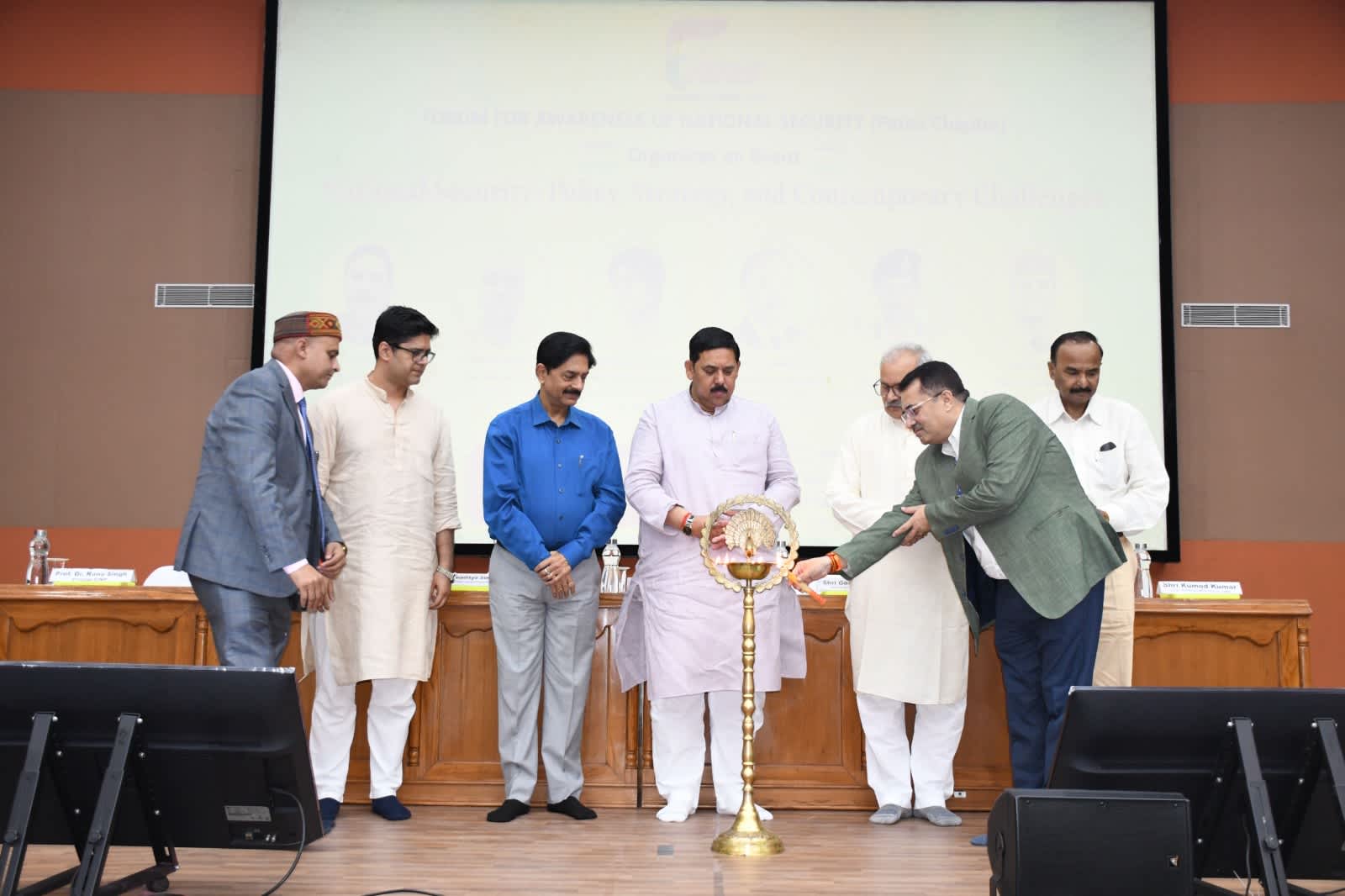
After the traditional lamp-lighting ceremony, welcome address, inaugural remarks by the guests and vote of thanks, the most significant moment of the morning was the graceful release of the new Hindi poetry collection “Ankahe Ki Antardhvani” by Shri Abinash Das (Librarian, Institute of Hotel Management, Bhubaneswar). The book launch symbolized the Institute’s deep commitment to Hindi literature and the broader cause of Rajbhasha awareness in academic and research spaces.

In the technical session, renowned speakers delivered insightful lectures on diverse and contemporary themes. Prof. Karunakar Nanda spoke on the “Importance of Science and Language”, underlining the role of Indian languages in disseminating scientific temper. Dr. Rajeev Kumar Rawat (IIT Kharagpur) discussed the implementation of Rajbhasha in scientific institutions and the role of modern information technology in strengthening Hindi usage. Shri Chandra Bhushan Singh (IREL) highlighted “The Role of IREL Products in Viksit Bharat”, emphasizing the organisation’s contribution to national development. Other scholarly talks covered subjects such as the role of heads of offices in Rajbhasha implementation (by Shri Pradeep Kumar Ray), structural biology (by Dr. Shanti Swaroop Srivastava, IISER) and big data in scientific research (by Dr. Arun Kumar), enriching the audience with both scientific and linguistic perspectives.

The ceremony was further graced by the illustrious presence of Smt. Sharada Ghosh, Principal, Institute of Hotel Management, Bhubaneswar, whose attendance added to the dignity and significance of the occasion. The overall programme was conducted with exemplary poise and coordination: the effective anchoring and session conduction were carried out by Shri Dinesh Bahadur Singh (NISER) and Shri Bhagban Behera (Institute of Physics), whose adept handling ensured that the entire event proceeded smoothly, with decorum, discipline and enthusiasm.

Hansraj College’s Stellar Display Leads to Mahatma Hansraj Memorial T20 Glory

Hansraj College Clinches Mahatma Hansraj Memorial T20 Title

NEW DELHI – Hansraj College delivered a clinical performance today to lift the Mahatma Hansraj Memorial T20 Cricket Tournament trophy, defeating Miranda House by a massive 127 runs in a one-sided final.

​Tarun’s Century Powers Hansraj to 225

​Electing to bat first, Hansraj College set the stage on fire by posting a daunting total of 225 runs. The highlight of the innings was a sensational century by Tarun, who dismantled the opposition bowling attack. He smashed 130 runs off just 57 deliveries, a knock decorated with 19 boundaries and 6 towering sixes.

​Supporting the onslaught, Mohit Tyagi contributed a solid 41 runs, while Captain Satish Pathak added a crucial 20 runs to ensure the team reached a formidable score.

Miranda House Collapses Under Pressure

​Faced with a mountain to climb, the Miranda House batting lineup crumbled early. They failed to find any momentum and were eventually bowled out for 98 runs in 19 overs. Captain Sonu Giri was the top scorer for the side, though he managed only 13 runs as wickets fell at regular intervals.

​Award Ceremony

​The match concluded with a grand presentation ceremony. The Chief Guest, Professor Vijay Lakshmi, Principal of Miranda House, lauded the spirit of the game and presented the championship trophy to the winning captain, Satish Pathak.