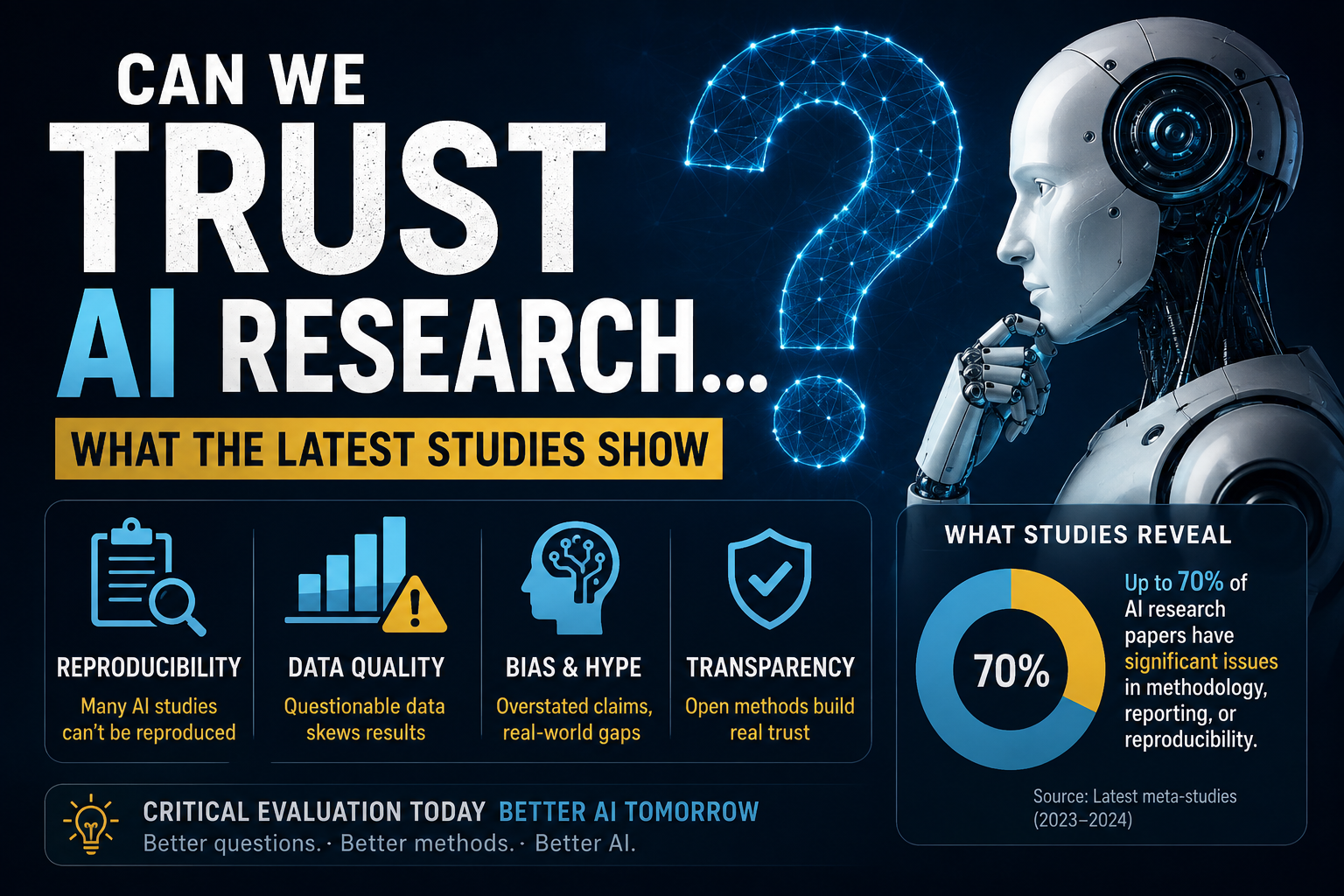
AI can find information in seconds. It can summarise research papers, compare studies, identify patterns and even produce a report that looks remarkably convincing. But there is a question businesses, researchers and professionals increasingly need to ask: Can we actually trust the research AI gives us?
The answer is more complicated than simply saying yes or no. AI has become a powerful research tool, but the quality of its output depends on the information it accesses, how it interprets that information and whether its claims can be independently verified.
AI Can Be Helpful Without Always Being Right
AI has changed how people search for information. Instead of opening dozens of webpages or academic papers, users can ask an AI system to explain a subject, identify relevant studies or summarise a large body of research. That speed can save considerable time, particularly when dealing with large volumes of information.
But speed does not automatically mean accuracy. AI systems can sometimes generate incorrect information, misunderstand a study or provide references that do not properly support the claims being made. In some cases, the answer can sound highly confident even when the underlying information is wrong.
This is why there is an important difference between using AI to help with research and treating AI itself as the final source of truth.
What Research Says About AI-Generated References
The concerns are not just theoretical. A 2025 study published in Simulation in Healthcare examined references generated by AI and found significant problems with accuracy and relevance. Of 303 references assessed for accuracy, 60.4% were found to be accurate. The study also reported that only 22.2% of 451 citations examined were considered highly relevant to the claims they accompanied.
The findings highlight an important problem: an AI-generated citation is not automatically a verified citation. A reference may exist but still fail to support the specific statement for which it has been provided.
Other research has also found that AI systems can produce references that are difficult to verify or do not accurately represent the source they cite. For anyone using AI for professional or academic research, this makes checking the original source an essential step.
But AI Research Is Improving
That does not mean AI is unsuitable for serious research. In fact, newer systems are being designed specifically to address some of these weaknesses.
A 2026 study published in Nature examined retrieval-augmented AI systems designed to search and synthesise information from a large collection of scientific literature. The research evaluated OpenScholar-8B against systems including GPT-4o on a multi-paper synthesis benchmark, with OpenScholar-8B achieving higher correctness on the reported evaluation.
The significance is not simply that one AI model performed better than another. It demonstrates the potential value of connecting AI systems to relevant research databases and giving them access to supporting evidence before generating an answer.
This approach is different from asking a general chatbot to answer a research question purely from its existing model knowledge. Retrieval and source verification can provide an additional layer of evidence, although they do not eliminate the need for human review.
AI Research Is Not One Thing
This distinction matters because the phrase “AI research” can describe very different processes.
There is a major difference between asking a general-purpose chatbot, “What does research say about this?” and using an AI research system that retrieves academic papers, provides citations and allows the user to inspect the underlying sources.
The first approach can be useful for understanding a subject or identifying possible directions for further research. The second can provide a stronger evidence trail, particularly when the sources are accessible and relevant.
However, even sophisticated research systems can make mistakes. The quality of the result depends on the quality of the sources retrieved, how those sources are interpreted and whether the final claims accurately reflect the evidence.
The Biggest Trap Is Confidence
Perhaps the most important issue is not that AI can make mistakes. Humans make mistakes too.
The bigger problem is that AI can present an incorrect answer in a polished and confident way. A poorly researched paragraph may look obviously weak, but an AI-generated paragraph containing technical language, statistics and citations can appear authoritative even when some of those details require verification.
That makes source checking more important, not less, in the age of AI.
The ability to question an AI-generated answer, open the original source and determine whether the evidence actually supports the claim is becoming an important research skill.
What Should We Do When AI Gives Us Research?
The practical approach is to treat AI as a research assistant rather than the final authority. AI can help identify possible sources, explain unfamiliar concepts, summarise lengthy material, compare information and develop research questions. But important claims should be checked against the original papers, reports, government data or institutional sources.
For businesses, this becomes particularly important. A marketing team researching consumer behaviour could use AI to identify trends quickly. But before changing a campaign based on those findings, the underlying market report, methodology and data should be examined.
The same principle applies to financial research, healthcare information, technology decisions and strategic planning. The higher the consequences of a decision, the more important independent verification becomes.
The Business Lesson
For businesses, AI can dramatically reduce the time required to gather and organise information. But faster research does not necessarily mean better decisions.
Companies using AI for research will increasingly need processes for checking sources, validating statistics and distinguishing between established evidence and AI-generated interpretation.
The competitive advantage may therefore come not simply from using AI, but from knowing how to use it responsibly. A business that can combine AI’s speed with human verification can potentially make research processes faster without treating every AI-generated answer as established fact.
The Future May Be Faster—and More Carefully Checked
AI is changing how research is conducted. The next stage is likely to focus less on simply generating answers and more on retrieving evidence, connecting information and showing users where that information came from.
That could make research significantly faster. But human judgment still has an important role, particularly when research is being used to support important business, scientific or professional decisions.
The question may no longer be whether AI can do research. Clearly, it can assist with many parts of the research process.
The more important question is whether we are willing to check what it finds.
Because in the age of AI, the most valuable research skill may not be finding an answer.
It may be knowing when to ask:
“Where’s the proof?”
