Long before social media turned actors into brands, Nana Patekar had already built something more difficult to achieve — a presence that audiences could recognise within seconds.
Oct 08: Sometimes it was his voice. Sometimes it was a stare. Sometimes it was a pause before delivering a line.
He did not need to shout to own a scene, although when a character demanded intensity, few could match him.
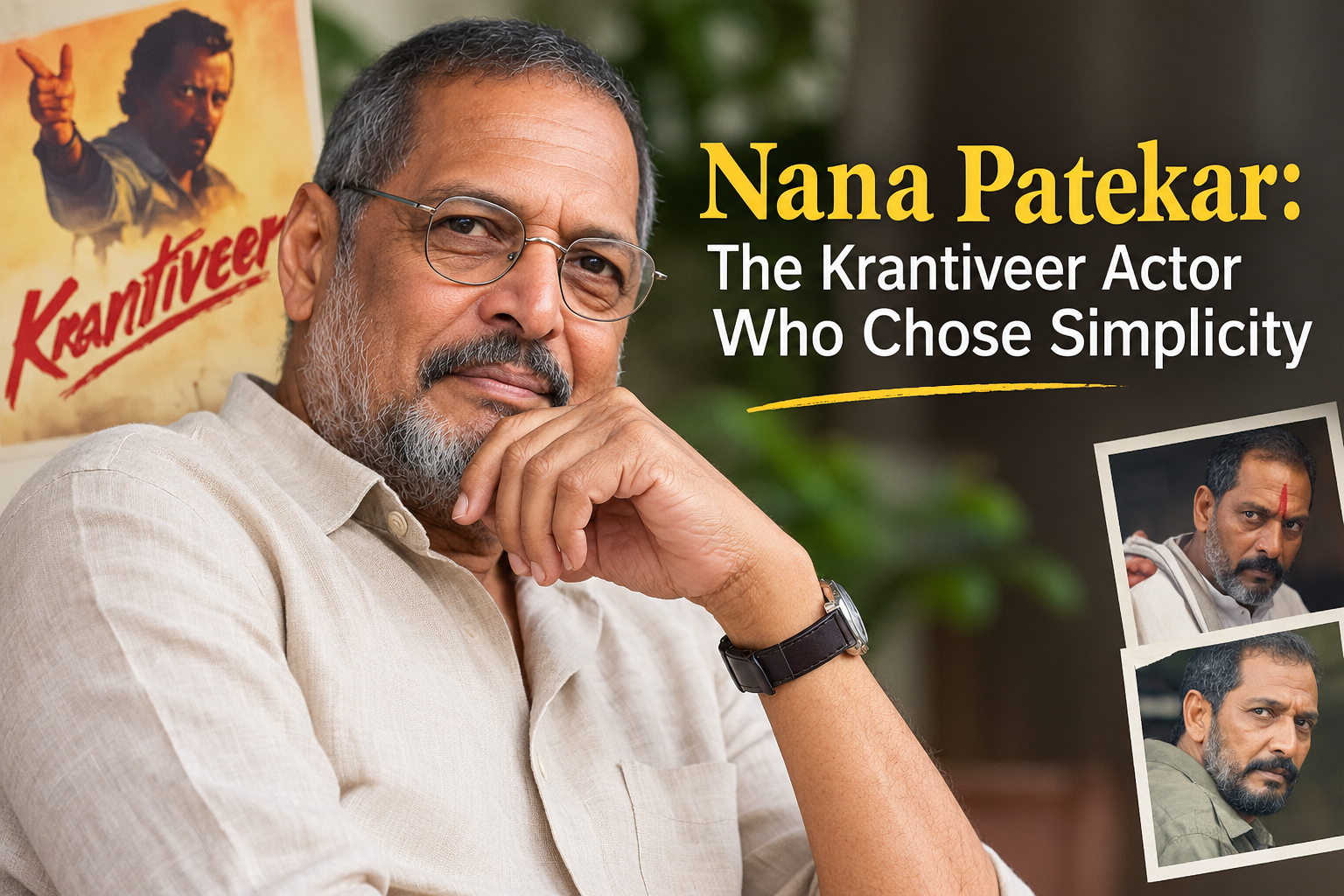
For generations of Indian audiences, Nana Patekar was never simply a familiar face from Hindi cinema. He was the angry man in Krantiveer, the complex figure in Parinda, the policeman in Ab Tak Chhappan, the emotional performer in Natsamrat and the hilariously unpredictable Uday Shetty in Welcome.
But there was another side to Nana Patekar that made his journey particularly interesting — the simplicity he maintained away from the spotlight and his decision to use his public influence for social causes.
Krantiveer And The Performance That Defined An Era
For many viewers, Nana Patekar will always be associated with Krantiveer.
Released in 1994, the film gave him the role of Pratap Narayan Tilak, a man carrying anger, frustration and disappointment with the world around him.
Patekar did not play the character as a conventional cinematic hero.
There was roughness in his performance, but there was also vulnerability. His anger appeared to come from somewhere personal, making the character feel less like a larger-than-life film creation and more like a man who had been pushed to his limits.
The performance earned him the National Film Award for Best Actor and became one of the defining performances of his career.
Even decades later, Krantiveer remains an important part of conversations around Patekar’s acting because it captured what he did exceptionally well: make emotion feel immediate and real.
He Could Be Intense, And Then Completely Funny
The easiest way to understand Nana Patekar’s talent is to look at how different his characters could be.
Parinda revealed his ability to handle darkness and complexity. Khamoshi: The Musical brought out a quieter emotional side. Ab Tak Chhappan presented a morally complicated police officer.
And then there was Welcome.
Uday Shetty could not have been further removed from the intense characters that had established Patekar’s reputation. The gangster was impatient, comic, intimidating and completely unpredictable.
It was a reminder that great actors do not necessarily belong to one genre.
They can make an audience fear them in one film and laugh with them in another.
Patekar could do both.
The Actor Who Did Not Need To Look Like A Star
Nana Patekar’s screen image was powerful. His off-screen persona was considerably simpler.
He was known for his connection with rural life and farming and for staying relatively removed from the more extravagant side of celebrity culture.
That contrast became part of his appeal.
He could dominate a cinema screen and still appear comfortable with a life far removed from the usual expectations of stardom.
Perhaps that is why his simplicity never felt like a marketing image.
It seemed to be part of who he was.
When Cinema Was No Longer Enough
One of the most significant chapters in Patekar’s life began in 2015, when he and fellow Marathi actor Makarand Anaspure helped establish NAAM Foundation.
The organisation emerged during a period of severe farmer distress and drought in Maharashtra.
Its work subsequently expanded into areas such as water conservation, rural development and support for farming communities.
According to NAAM Foundation, its initiatives have included restoring water sources, rejuvenating rivers and canals and working with rural communities on longer-term solutions to water and livelihood challenges.
That work added an entirely different dimension to Patekar’s public life.
On a film set, he had a script.
With NAAM Foundation, there was no script.
There were real people, real problems and the difficult task of trying to make a difference.
Using Fame For Something Beyond Fame
Celebrity can provide visibility.
But visibility becomes meaningful when it draws attention to something larger than the celebrity.
Patekar’s involvement with NAAM Foundation brought public attention to issues affecting farmers and rural communities. It also reflected his long-standing connection with rural India.
His social work did not replace his identity as an actor. Instead, it became another part of the story.
The same man who portrayed anger and social frustration in Krantiveer was also using his influence away from the screen to engage with real challenges faced by communities.
That connection makes his journey particularly compelling.
Why Nana Patekar’s Characters Stayed With Us
Perhaps the reason Patekar’s performances continue to be remembered is that his characters were rarely perfect.
They could be angry.
They could be flawed.
They could be vulnerable.
They could be funny.
Most importantly, they felt human.
He did not always make audiences comfortable, and perhaps that was part of his strength. His performances invited viewers to look at characters with contradictions rather than simple heroes and villains.
That quality gave his work a staying power that goes beyond the release date of a film.
A Legacy Bigger Than A Filmography
It would be easy to remember Nana Patekar simply by listing his best movies.
Krantiveer.
Parinda.
Khamoshi: The Musical.
Ab Tak Chhappan.
Welcome.
Natsamrat.
But a filmography tells only part of the story.
There was also the actor’s refusal to be confined to one image. There was the simplicity associated with his life away from cinema. And there was his involvement with NAAM Foundation and the issues affecting rural communities.
Together, these different chapters create a more complete picture of the man.
Remembering Nana Patekar
Nana Patekar leaves behind characters that will continue to be rediscovered by new audiences.
Some will remember the fire of Pratap Narayan Tilak in Krantiveer. Some will remember Uday Shetty making them laugh. Others will remember the emotional weight of Natsamrat.
But perhaps the most fitting way to remember him is to look beyond the screen.
He showed that an actor could achieve immense recognition without allowing celebrity to become his entire identity.
He showed that simplicity could coexist with success.
And through his association with NAAM Foundation, he demonstrated that public recognition could also be directed towards people and problems far removed from the film industry.
Nana Patekar gave Indian cinema some unforgettable characters. Beyond cinema, he left behind something equally meaningful — a reminder that a life in the spotlight can still be lived with simplicity, purpose and a sense of service.
