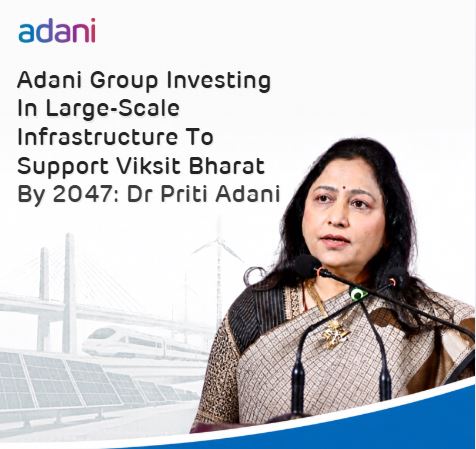
Varanasi, Nov 2: Adani Group is undertaking large-scale infrastructure projects aimed at addressing India’s key developmental challenges and supporting the country’s ambition of becoming a developed nation by 2047, Adani Foundation Chairperson Dr Priti Adani said on Monday.
Speaking at the World Symposium on ‘Ancient Wisdom for Modern Challenges’ in Varanasi, Dr Adani emphasised that the private sector has an important responsibility in India’s development journey.
She pointed out that despite significant progress, the country continues to face challenges such as poverty, malnutrition, illiteracy and inadequate last-mile access to essential services, including electricity.
According to her, businesses must look beyond commercial objectives and contribute meaningfully towards addressing these issues.
“At the Adani Group, we have implemented large-scale infrastructure projects to address India’s challenges and contribute towards the vision of a developed nation by 2047,” she said.
Ancient Indian Wisdom Offers Lessons For Modern Businesses
Highlighting the relevance of India’s traditional knowledge systems, Dr Priti Adani called upon businesses to incorporate sustainability, social responsibility and a sense of duty into their operations.
Drawing an analogy with yoga, she said India’s ancient practices offer valuable lessons for addressing contemporary challenges.
She observed that yoga, once rooted in Indian tradition, has gained global recognition for promoting a balance between the mind and body.
Similarly, millets, which were traditionally an important part of Indian diets, are now receiving renewed attention for their nutritional benefits, climate resilience and contribution to food security.
Dr Adani stressed that these examples demonstrate how traditional knowledge can provide practical solutions to modern-day problems.
Adani Group Commits Over $100 Billion To Energy Transition
Outlining the group’s sustainability agenda, Dr Priti Adani highlighted its commitment of more than $100 billion towards energy-transition infrastructure.
She pointed to the renewable energy development at Khavda in Gujarat, which is being developed as the world’s largest renewable energy park, with a planned capacity of 30 GW through solar and wind power generation.
The project, she said, reflects the scale of infrastructure development required to support India’s transition towards cleaner energy sources.
Emphasising the need to translate sustainability commitments into measurable action, she said environmental responsibility should not remain confined to corporate reports but must become an integral part of business operations.
“We believe sustainability cannot simply remain a chapter in the annual report. Sustainability must be put into practice,” she said.
Businesses Have A Bigger Role In India’s Development Journey
Dr Priti Adani’s address highlighted the growing importance of private-sector participation in India’s efforts to achieve its development goals.
From expanding infrastructure and improving energy access to strengthening food security and promoting sustainable practices, she said businesses have an opportunity to contribute to long-term national progress.
Her remarks at the Varanasi symposium placed particular emphasis on combining India’s traditional wisdom with modern innovation to address emerging economic, social and environmental challenges.
As India moves towards its 2047 development target, large-scale infrastructure investment, sustainable business practices and stronger corporate participation are expected to remain important elements of the country’s growth strategy.
