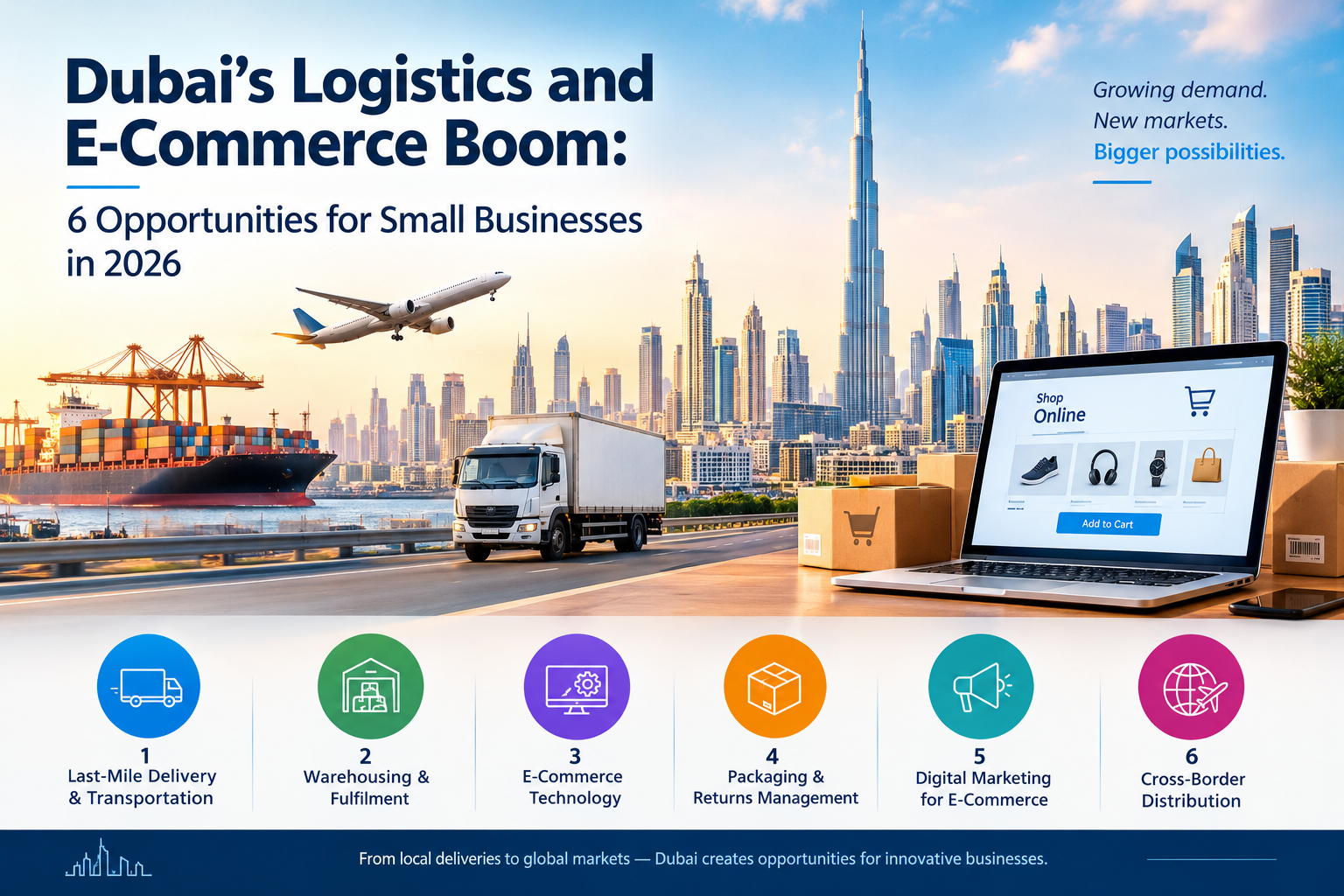
Oct 27: Dubai’s growing role in international trade is opening new avenues for small businesses across logistics, online retail and digital services. As consumers increasingly shop online and companies seek faster ways to move goods, demand is creating opportunities for businesses that can improve deliveries, manage inventory, support online sellers and connect brands with customers.
For small and medium-sized enterprises (SMEs), entering this market does not necessarily mean competing with established retailers or building a large transportation network. Businesses can focus on specialised services, technology solutions or marketing support that help existing companies operate more efficiently.
Understanding the market, identifying a clear customer need and controlling operating costs will be essential for entrepreneurs looking to benefit from Dubai’s expanding commercial ecosystem.
UAE E-Commerce Growth Opens New Markets for SMEs
The UAE’s e-commerce market was valued at AED 42.2 billion in 2025, approximately US$11.5 billion, according to a report released by EZDubai in partnership with Euromonitor International in September 2026. The report recorded growth from AED 17.6 billion in 2020 and projected the market to reach AED 67.2 billion by 2030.
Apparel and footwear, consumer electronics and home care were among the leading online retail categories in 2025. These segments reflect the growing importance of digital shopping in the UAE’s retail economy.
For smaller companies, the opportunity lies in identifying specific needs within this expanding market. An entrepreneur might develop a specialist online store, provide order-processing support to independent retailers or offer technology that helps merchants manage sales and inventory.
Rather than attempting to match the scale of major marketplaces, SMEs can build their businesses around specialised products, dependable service and a clearly defined customer base.
Dubai’s Logistics Network Creates Opportunities Beyond Retail
Dubai’s established connections to international shipping routes, air cargo facilities and regional distribution networks make it an important location for businesses moving goods between markets.
The scale of activity is reflected in Dubai Customs’ reported performance during the first half of 2026. Its Air Cargo Centers Management processed approximately 18.2 million customs transactions, representing a 53% increase compared with the same period in 2025. The authority also reported handling more than 6.2 million postal parcels through its Free Zone Department within the air cargo sector during those six months.
These figures demonstrate the volume of activity passing through Dubai’s logistics ecosystem. They also highlight the importance of services that help businesses coordinate shipments, manage stock and maintain reliable delivery operations.
SMEs can explore opportunities in specialist transportation, freight coordination, inventory technology and returns management. Their success will depend on finding a commercially viable niche rather than assuming that growth across the wider sector guarantees demand for every new business.
Six Business Opportunities in Dubai’s Logistics and E-Commerce Sector
1. Specialised Delivery Services
Customers expect online purchases to arrive reliably, with clear delivery updates and convenient arrangements. Retailers must meet these expectations while controlling the cost of transporting individual orders.
Smaller delivery operators can focus on particular neighbourhoods, retail categories or business customers. Scheduled deliveries, local distribution, business-to-business transport and the collection of returned products are potential areas to explore.
A specialised service may offer a more practical starting point than attempting to compete with large delivery networks across the entire city.
Before launching, business owners should calculate fuel, vehicle maintenance, driver wages, insurance, technology expenses and the cost of unsuccessful deliveries. They must also establish which transport licences and permissions apply to their intended operations.
2. Flexible Warehousing and Fulfilment
Online sellers need more than a website to operate successfully. They must store products, monitor stock levels, prepare orders and coordinate shipments without creating unnecessary delays.
This creates scope for small businesses offering shared storage, inventory monitoring, order packing and fulfilment coordination. Such services may appeal to retailers that cannot justify maintaining their own warehouse or employing a dedicated logistics team.
Specialisation can help providers stand out. A company might focus on a particular type of merchandise or offer flexible arrangements for sellers experiencing seasonal changes in demand.
However, warehouse rental, staffing, insurance, handling procedures and stock-management systems can increase costs quickly. Entrepreneurs should assess demand before investing in premises and equipment. Partnering with an established fulfilment provider may offer a lower-commitment way to test the market.
3. Technology Solutions for Online Sellers
As e-commerce operations become more complex, businesses need tools that connect sales, inventory, customer service and delivery information.
Software developers and IT consultants can help smaller retailers introduce order-management systems, stock-tracking tools, automated notifications and dashboards that bring business information together.
Artificial intelligence may also support customer enquiries, sales analysis and demand forecasting. The value of these tools depends on whether they solve a genuine operational problem, such as frequent stock shortages or time-consuming manual order processing.
Technology providers can begin with a defined customer group, including independent retailers, wholesalers or businesses selling across borders. Understanding the daily challenges of that group can help them develop more useful and commercially relevant services.
4. Product Packaging and Returns Support
Packaging influences product protection, shipping expenses and the experience customers have when receiving an order. Retailers need solutions that balance durability, cost and presentation.
Small businesses can explore customised packaging, protective materials, labelling, packaging design and order-preparation services. Businesses interested in sustainability can also investigate reusable packaging and ways to reduce unnecessary materials.
Product returns offer another potential source of demand. Retailers may need help collecting returned goods, checking their condition, updating stock records and preparing suitable products for resale.
Service providers should focus on accuracy, turnaround time and consistent quality. Companies handling regulated merchandise must also understand the relevant storage, packaging and labelling requirements.
5. Digital Marketing for E-Commerce Brands
Opening an online store does not automatically attract customers. Retailers must compete for attention, explain why their products are valuable and encourage visitors to complete purchases.
This creates opportunities for marketing agencies and independent specialists offering search engine optimisation (SEO), content creation, paid advertising, email campaigns and social media management.
Product descriptions, buying guides and informative articles can help shoppers understand what a business offers. Search optimisation can improve the chances of appearing for relevant queries, while targeted campaigns can introduce products to specific audiences.
Marketing providers can strengthen their offering by tracking outcomes rather than focusing only on impressions or website visits. Measures such as qualified enquiries, conversion rates, customer acquisition costs and repeat purchases provide a clearer picture of campaign performance.
For SMEs, a well-planned marketing strategy can help build a more consistent route to customers as competition increases.
6. Cross-Border Product Distribution
Dubai’s international trade connections can provide a starting point for companies seeking customers across the Middle East, Africa and other overseas markets.
Smaller businesses can investigate product sourcing, wholesale distribution and online marketplace sales in categories where they have a clear advantage. Apparel, household products and consumer accessories are examples of segments worth researching, although actual demand and competition will vary.
Cross-border expansion requires more than identifying a potential buyer. Businesses must understand shipping costs, customs documentation, import duties, VAT treatment, product standards and any registration requirements in their destination markets.
Testing a limited range of products before expanding can help entrepreneurs understand customer preferences and operating expenses. Experienced logistics and compliance partners can also help businesses navigate unfamiliar procedures.
How Dubai Traders Can Help Eligible E-Commerce Businesses
Access to online marketplaces is another consideration for entrepreneurs entering the UAE’s digital retail sector.
Dubai Traders, an initiative launched by Dubai’s Department of Economy and Tourism in collaboration with Dubai Chambers, reported onboarding more than 2,400 new e-commerce sellers during its first 12 months. The programme works with marketplaces including Amazon and noon and has offered participating businesses support such as onboarding assistance, licensing guidance, advertising credits and increased product visibility.
For eligible businesses, such initiatives can provide assistance when exploring online selling channels. Entrepreneurs should check the latest eligibility criteria, available benefits and licensing conditions directly with the programme.
Marketplace participation alone does not ensure commercial success. Product quality, pricing, fulfilment, customer service and the ability to attract repeat buyers remain important considerations.
Choosing the Right Business Model Before Investing
The cost of entering Dubai’s logistics and e-commerce sector varies significantly by business model. A digital service provider may be able to begin with a computer, relevant expertise and a small client base. A delivery operator or warehouse business may need substantial investment in equipment, premises, staff and insurance.
Entrepreneurs should compare their options before committing funds.
Service-based models: Digital marketing, content development and technology consulting can be suitable for businesses that already possess the required skills and can build a reliable client base.
Partnership-based models: Working with established delivery companies, fulfilment providers or online marketplaces may allow businesses to test demand without developing every operational capability themselves.
Asset-intensive models: Transportation and warehousing require detailed cost estimates, demand assessment and sufficient working capital to cover ongoing expenses.
Regardless of the model, businesses should verify licensing requirements, assess cash-flow needs and establish realistic revenue expectations before launching.
Why Digital Visibility Matters in a Competitive Market
A business may have a strong product and an efficient delivery arrangement, but customers still need to find it. Digital visibility is therefore an important part of building an e-commerce operation.
Search-friendly websites, informative content and useful product pages can help potential customers understand a company’s offering. Social media and paid campaigns can introduce products to relevant audiences, while market-specific content can support businesses targeting customers in different countries.
Digital marketing is particularly relevant to SMEs that cannot rely on the brand recognition enjoyed by larger competitors. Consistent communication, clear product information and a trustworthy online presence can help businesses establish credibility over time.
Shreyas Webmedia Solutions provides digital marketing, content development, online publishing and related communication services. Businesses seeking to strengthen their online presence can explore how these services fit into their wider customer acquisition and brand-building strategies.
Challenges Small Businesses Need to Assess
Dubai’s expanding commercial ecosystem offers opportunities, but SMEs should approach the market with realistic expectations.
Operating expenses can put pressure on margins, particularly in transportation and warehousing. Customers may expect fast deliveries and responsive support, while established competitors can benefit from larger networks and purchasing power.
Regulatory requirements also vary by business activity. Licensing, customs procedures, taxation, consumer protection and product-specific rules should be reviewed before operations begin.
Cash flow deserves equal attention. Inventory purchases, delayed customer payments and returns can create financial pressure even when sales appear promising.
Businesses can manage these risks by starting with a clearly defined market, building reliable supplier relationships and reviewing their financial performance regularly. A smaller operation with a sustainable customer base may be more valuable than rapid expansion without sufficient demand.
Conclusion
Dubai’s logistics and e-commerce ecosystem offers several possible routes for SMEs, from delivery and fulfilment to packaging, technology, product distribution and digital marketing. The UAE’s expanding online retail market and Dubai’s substantial cargo activity provide useful context for businesses considering these sectors.
However, long-term success depends on more than market growth. Entrepreneurs need to identify a specific customer problem, understand the costs of serving that customer and comply with the requirements applicable to their business.
For companies already operating in the market, improving operational efficiency and online visibility can help them compete more effectively. For new entrants, researching demand and starting with a manageable business model can provide a more measured route into Dubai’s evolving commercial landscape.
