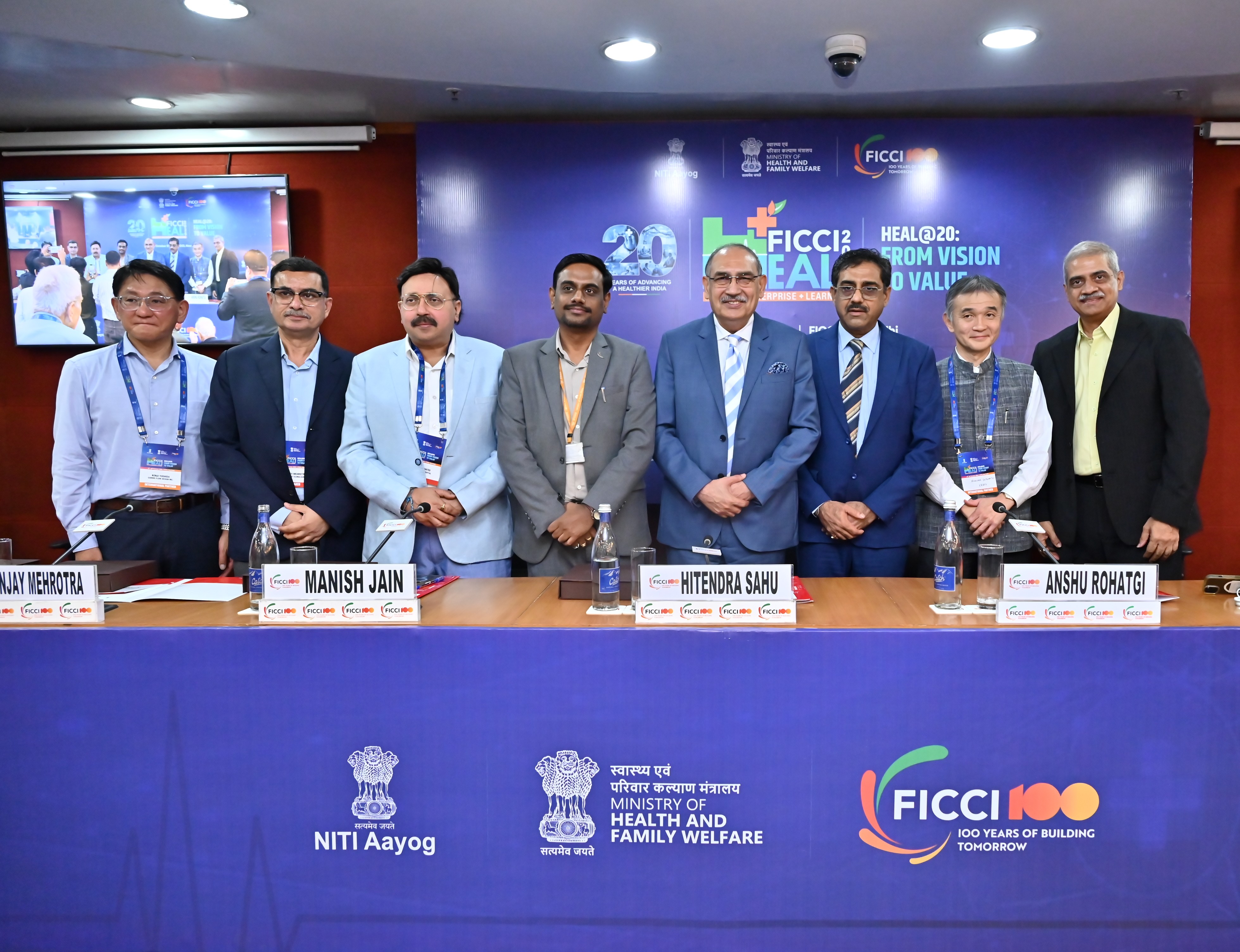
NEW DELHI, 29 October 2026: The 20th edition of FICCI HEAL concluded yesterday with a renewed call to translate healthcare innovation into measurable patient outcomes, enhancing quality, strengthening collaboration between government and industry, and building a healthcare system that is accessible, affordable, technology-enabled and sustainable. Held on 27–28 October 2026 at FICCI Federation House, New Delhi, under the theme “HEAL@20 – From Vision to Value,” the two-day conference- supported by NITI Aayog and Ministry of Health and Family Welfare- brought together policymakers, healthcare providers, medical professionals, technology companies, researchers and industry leaders to deliberate on the future of India’s healthcare ecosystem.
Across the conference, a common message emerged: the true value of healthcare lies not merely in the availability of infrastructure, medicines or advanced technology, but in whether these translate into better outcomes for patients.
The conference that opened with an inaugural session with Prof (Dr) M Srinivas, Hon’ble Member, NITI Aayog, Government of India turned its attention to the practical challenge of translating healthcare innovation into system-wide impact.
Scaling digital health beyond pilot projects
The session “Digital Health at Scale: From Innovation Pilots to Nationwide Impact” examined how India can move from promising digital health experiments to solutions that work across the healthcare system. Discussions covered interoperability, digital infrastructure, data governance, cybersecurity, integration into clinical workflows and the importance of validating technologies in real-world settings.
The panel highlighted that digital health must deliver measurable benefits beyond the pilot stage. This requires reliable data, sustainable implementation models, collaboration between clinicians and technology developers, and solutions that respond to the needs of both healthcare institutions and underserved communities.
The discussion also addressed the importance of designing digital health interventions around patients and healthcare workers, ensuring that technology improves clinical decision-making and care delivery rather than adding complexity to existing systems.
Redefining value through quality, affordability and outcomes
The dialogue “Redefining Value in Indian Healthcare: Policy, Pricing, and Outcomes” examined the need to move beyond measuring healthcare primarily through cost or volume, towards models that reward quality, clinical effectiveness, patient experience and outcomes.
Mr. Varun Khanna, Co-Chair, FICCI Health Services Committee and MD & Group CEO, Aster DM Quality Care Ltd, highlighted the people’s expectations of assurance of quality over cost. He said, “we can deliver value in healthcare when we have both- affordable cost and high quality.” He also said that we need to discuss quality of care not just in metro cities but for 1.4 billion people across the entire country.
Participants discussed the role of reliable Indian healthcare data, transparent outcome reporting, accreditation, insurance coverage and procurement policies that recognise clinical value. The discussion also highlighted the challenges faced by smaller hospitals in meeting quality standards, as well as the importance of making advanced treatments affordable without compromising the sustainability of healthcare providers.
The session emphasised that the price of treatment alone cannot determine its value. Better healthcare requires measurable outcomes, informed patient choices, effective rehabilitation, appropriate insurance protection and accountability across the care pathway.
Building a continuum of care through partnerships
The session “Health Across a Lifetime: Building a Continuum of Care and Scaling Impact through Partnerships” focused on the need to connect prevention, screening, diagnosis, treatment, rehabilitation, follow-up and long-term care.
Mr Gautam Khanna, CEO, PD Hinduja Hospital and MRC opened the session by expressing, “Healthcare has been looked at in isolation in most discussions, it is important to talk about managing life across your lifetime and how to ensure the continuum of care”.
The session highlighted that there will be 347 million Indians aged 60+ by 2050, deaths due to NCDs have already risen to 60% from 52.8% in 2015-17. Hence, it is critical to bridge the gaps that can arise when screening is not followed by diagnosis, chronic disease management remains fragmented or patients lack support after hospital discharge. The discussion explored how public-private partnerships can combine public health priorities with private-sector expertise, investment, technology and infrastructure to expand access, particularly in underserved regions.
Panelists also examined the growing need for elderly care, home-based support, specialized services in smaller cities, sustainable dialysis services and stronger referral systems. The discussions reinforced that partnerships must have clearly defined responsibilities, sustainable financing, measurable outcomes and continuity of care at their core.
Technology that makes a difference to patients
The final dialogue of the conference, “Reimagining Care: How Technology is Transforming Medicine, Medicines & Healthcare,” explored how artificial intelligence, advanced diagnostics, precision medicine, genomics, medical devices and digital health are reshaping healthcare- from disease detection and drug discovery to treatment, monitoring and prevention.
Mr. Hitendra Sahu, Director, Department of Pharmaceuticals, Ministry of Chemicals and Fertilizers, Government of India, outlined the role of policy support, research funding and Centres of Excellence in strengthening India’s medical technology ecosystem. He emphasized the need to help innovations progress from research and development to commercialization while improving affordability and access.
Together, these perspectives highlighted a central imperative for India’s healthcare innovation ecosystem: technology must be supported by skilled professionals, reliable infrastructure, evidence-based practice and delivery models that enable patients to benefit from it.
A shared agenda for the next phase of healthcare
Across two days, FICCI HEAL 2026 brought together policymakers, healthcare providers, industry and innovators around a shared vision of delivering better health outcomes. Discussions underscored the need to strengthen public-private partnerships, invest in research, medical technology and workforce development, leverage data and digital solutions, expand financial protection, and improve access beyond urban centres.
As FICCI HEAL celebrates its 20th edition, “From Vision to Value” reflects a continued commitment to translating healthcare advances into accessible services, better patient experiences and measurable improvements in people’s lives.
The conference concluded with certificates being presented to the winners of the poster competition on “Delivering Value in Healthcare: Innovations, Outcomes, and Scalable Models for India, recognizing promising ideas and research with potential for scalable impact.
FICCI HEAL 2026 reaffirmed that sustained collaboration across government, healthcare providers, industry and academia is essential to building a future-ready healthcare ecosystem where progress is measured by its impact on people’s lives.
