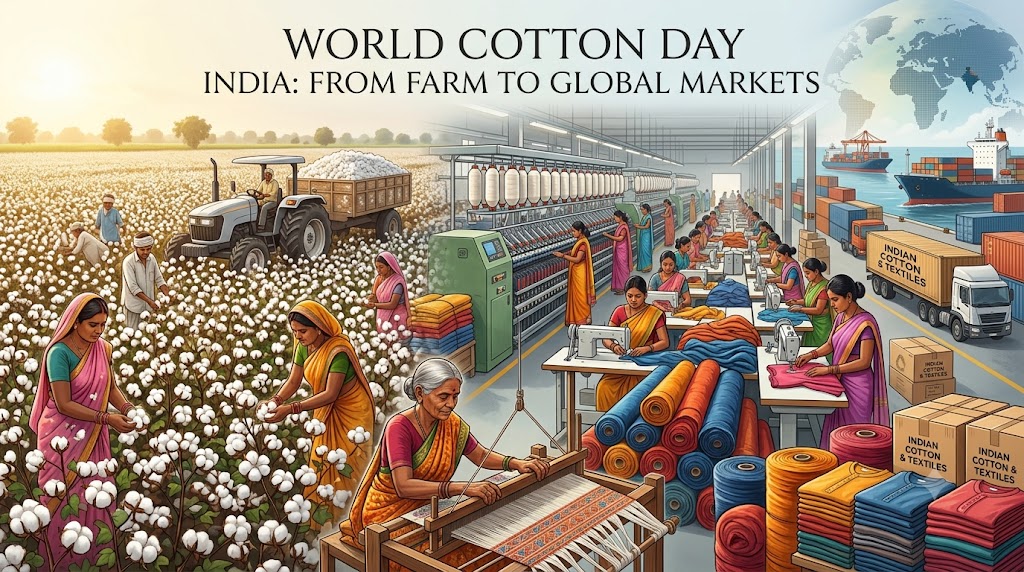
India’s cotton industry continues to play a vital role in connecting agriculture with manufacturing, employment and international trade. From cotton farmers and traditional weavers to modern textile mills and garment exporters, the sector supports millions of livelihoods while strengthening the country’s position in the global textile market.
Observed annually on October 7, World Cotton Day highlights the importance of cotton in supporting rural incomes, industrial development and international cooperation. For India, the occasion also underscores the need to improve farm productivity, expand domestic processing and increase the production of high-value textile goods.
India is among the world’s largest cotton-producing countries and is the only country that cultivates all four recognised cotton species. Provisional figures for the 2025–26 cotton season put domestic production at 290.91 lakh bales, while consumption stood at 328 lakh bales. These figures underline the scale of India’s textile manufacturing base and the importance of ensuring a reliable supply of raw cotton.
Cotton Industry Creates Opportunities Across the Economy
Cotton contributes to a broad industrial ecosystem covering ginning, spinning, weaving, knitting, dyeing, processing and garment manufacturing. Each stage adds value to the raw material and creates opportunities for businesses, skilled workers and entrepreneurs.
India’s textile and apparel industry, one of the country’s largest employment-generating sectors, provides direct employment to more than 45 million people, according to government estimates. Its extensive network of small businesses, manufacturing units and traditional craft enterprises makes it particularly important for rural and semi-urban economies.
The industry also creates opportunities for women through garment production, weaving, textile processing and home-based enterprises. Greater access to training, finance, technology and markets can help these businesses expand and generate more sustainable incomes.
Value Addition Can Strengthen India’s Global Position
A major opportunity for India lies in moving further up the value chain, from producing raw cotton to manufacturing finished fabrics, garments, home furnishings and specialised textile products.
Processing cotton domestically can create additional employment, support small and medium-sized enterprises and increase the value generated from agricultural output. Investment in modern machinery, product design, quality control and efficient manufacturing can help Indian companies compete more effectively in international markets.
India’s textile and apparel exports, including handicrafts, reached ₹3.25 lakh crore in 2025–26, registering growth of 1.8 per cent over the previous financial year. Exports increased across more than 100 destinations, demonstrating the sector’s broad international reach despite fluctuations in global demand and input costs.
Strengthening export competitiveness will require consistent product quality, reliable delivery, innovative designs and compliance with international standards. Developing branded products and specialised textiles can also help manufacturers capture greater value than raw-material sales alone.
Sustainability and Technology Take Centre Stage
The industry’s future will depend on improving productivity while using natural resources more efficiently. Cotton cultivation can be affected by irregular rainfall, pests, water availability and changing input costs, while textile processing requires careful management of water, energy and waste.
Efficient irrigation, improved farming practices, integrated pest management and better access to agricultural advice can help farmers strengthen productivity. In manufacturing, water recycling, energy-efficient machinery and responsible waste management can reduce operating costs and environmental pressure.
Digital traceability, improved quality testing and recycling technologies can further strengthen the industry’s competitiveness as buyers increasingly focus on responsible sourcing and supply-chain transparency.
Government Support and International Partnerships
Government initiatives aimed at improving cotton productivity and developing integrated textile infrastructure seek to strengthen the connection between farmers, manufacturers and exporters. The Mission for Cotton Productivity, for example, targets production of 498 lakh bales by 2031, with a focus on improving productivity and quality.
International cooperation can also open new avenues for growth. India and Mali have opportunities to explore collaboration in cotton cultivation, processing, technology exchange and value-chain development. Such partnerships could support local manufacturing capabilities, encourage trade and create opportunities for investment.
Building a Stronger Cotton Economy
Despite its strengths, the industry faces challenges from weather uncertainty, fluctuating cotton prices, production costs and international competition. Addressing these concerns will require better coordination between farmers, processors, textile manufacturers and policymakers.
India’s long-term opportunity is to build a cotton economy that delivers more than higher production volumes. Greater domestic value addition, stronger export performance, modern technology and sustainable practices can help create jobs, improve rural incomes and strengthen manufacturing.
From the farm to the factory and from Indian textile clusters to global markets, cotton remains an important link in the country’s economic development. By investing in productivity, innovation and value-added manufacturing, India can turn its agricultural strength into a more competitive, resilient and sustainable textile industry.
