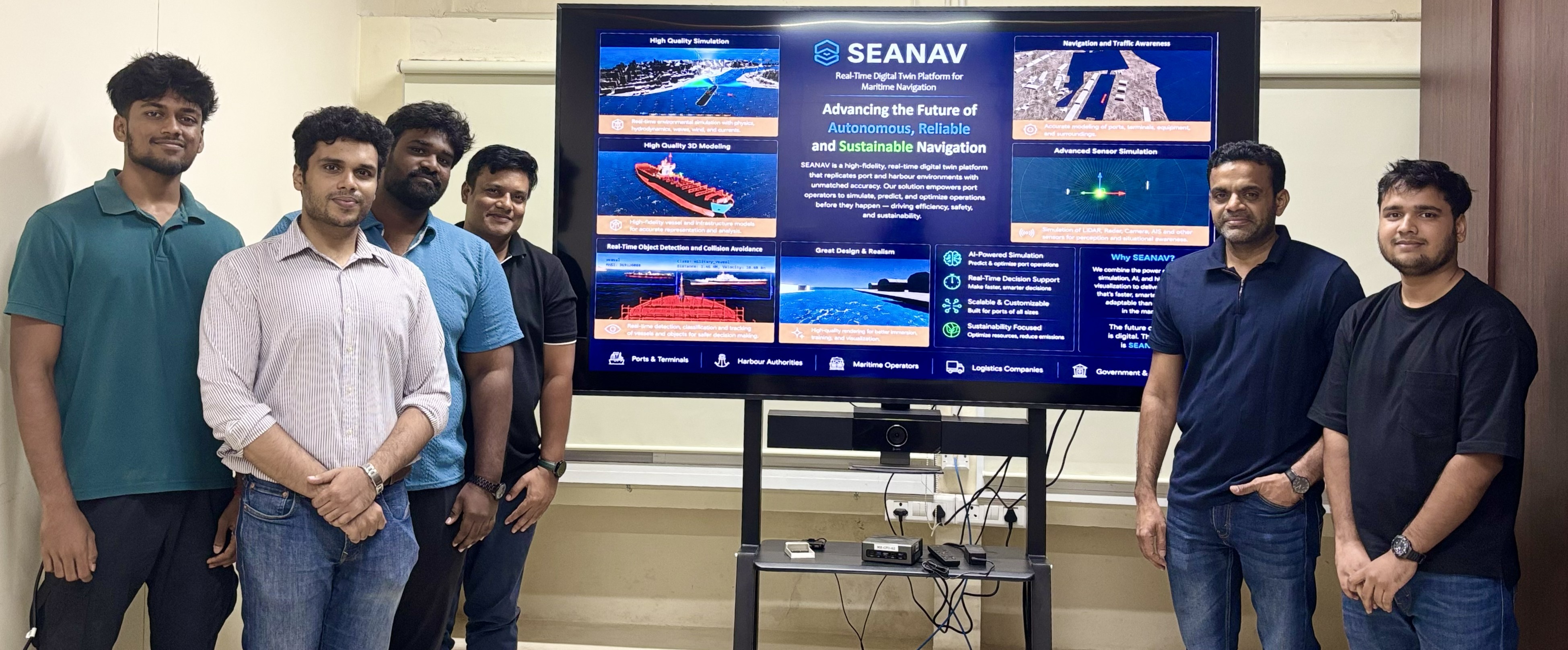
Chennai, 12 November 2026: Indian Institute of Technology Madras (IIT Madras) researchers have developed ‘SEANAV’ (Sea Navigation), a real-time digital twin platform that enables testing, validation, and training of autonomous maritime navigation systems in realistic virtual environments.
The research team has already demonstrated autonomous path-following and AI-driven collision avoidance under realistic sensing and wave conditions.
A Demo Video and a Byte of Prof. Suresh Rajendran explaining this system can be viewed and downloaded from – https://drive.google.com/file/d/1mkA_cSUsmtk3Alj2NhxA2qxIhhnRJOwr/view?usp=sharing
Developed by the Department of Ocean Engineering at IIT Madras, SEANAV addresses a major challenge facing the global shipping industry, which carries more than 80 percent of world trade.
While autonomous vessels promise safer and more efficient maritime transportation, testing navigation algorithms in real-world conditions is expensive, complex, and potentially hazardous. SEANAV tackles this issue through a realistic, high-fidelity virtual maritime environment where ships, sensors, ocean conditions and vessel traffic can be simulated in real time.
SEANAV also aligns with the Government of India’s Sagarmala Program and Maritime India Vision 2030, which emphasise smart ports, digital technologies and autonomous maritime systems. In addition, its multi-vessel simulation capabilities have potential applications in coastal surveillance, search-and-rescue operations and maritime defence.
Dr. Suresh Rajendran from IIT Madras headed this research with Dr. Athira M. Nambiar, from SRM Institute of Science and Technology, along with researchers and students from the Department of Ocean Engineering, IIT Madras, including Aniket Malviya, Jothish S, Mukesh S K, Thirunavukarasu P and Vaidesh.
The findings were published in Journal of Offshore Mechanics and Arctic Engineering (https://doi.org/10.1115/1.
Highlighting the significance of the research, Dr. Suresh Rajendran, Associate Professor, Department of Ocean Engineering, IIT Madras, said, “SEANAV provides a realistic and scalable platform for developing and validating autonomous maritime navigation technologies. By combining digital twins, AI, advanced sensor fusion, and virtual reality, we are creating an environment where both autonomous systems and human operators can be trained safely and efficiently before deployment in real-world maritime settings.”
Elaborating on the current status of SEANAV and the pathway for real-world implementation, Dr. Suresh Rajendran added, “The platform can also strengthen safety at major Indian ports, including Chennai, Mumbai, Visakhapatnam and Kochi, by supporting the development of AI-assisted navigation systems capable of reducing collision and grounding risks. Smarter navigation strategies can further help reduce fuel consumption, lower carbon emissions and minimise the risk of environmental accidents such as oil spills.”
One of the platform’s distinguishing capabilities is its support for multi-agent Artificial Intelligence. In busy shipping lanes and harbour environments, vessels must comply with the International Regulations for Preventing Collisions at Sea (COLREGs) while simultaneously responding to multiple nearby ships. SEANAV enables multiple autonomous vessels to learn and operate together, developing navigation strategies that account for complex interactions across crowded waterways.
Built on the Unity3D engine, SEANAV creates a digital twin of the maritime world that accurately replicates ocean waves, vessel movements and navigation environments. The simulator has been calibrated using a benchmark tanker vessel approximately 320 meters in length, enabling results generated in the virtual environment to closely reflect real-world commercial shipping operations.
The platform incorporates a sophisticated multi-sensor fusion framework that combines inputs from LiDAR, marine radar, and stereo vision cameras. Unlike conventional simulators that assume perfect sensor information, SEANAV models realistic sensor limitations, including noise and delays, allowing navigation systems to operate effectively in challenging conditions such as fog, rain, and low visibility.
SEANAV also includes an immersive Virtual Reality interface powered by Meta Quest headsets. Researchers, trainees, and maritime professionals can experience the simulation environment from the perspective of a ship’s bridge, enabling realistic training for emergency response, collision avoidance, port approaches, and vessel manoeuvring.
The technology could have a lot of impact on maritime training, port operations, shipping safety, and environmental sustainability. Replacing sea trials with virtual testing will empower SEANAV to significantly reduce development costs and enable thousands of hours of navigation testing within a short period.
Future work will focus on developing digital twins of major Indian ports, enabling certified VR-based pilot training and validating the technology using physical scale models.
