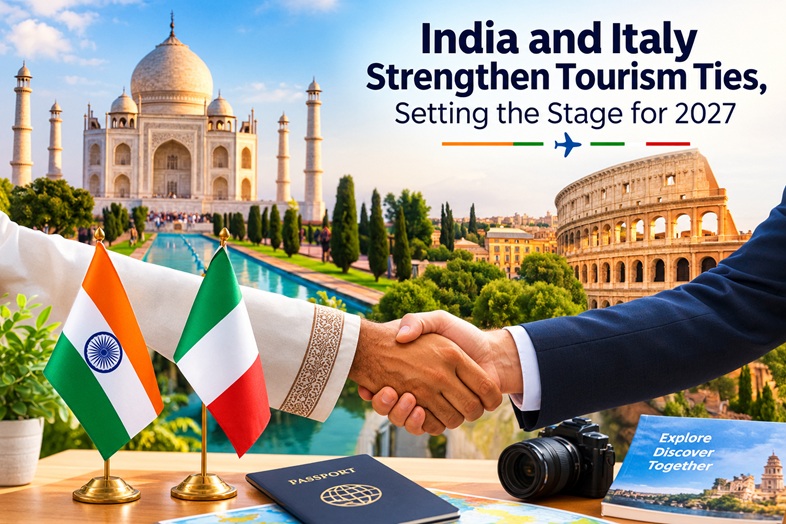
Oct 03: India and Italy are moving towards deeper cooperation in tourism, culture and people-to-people exchanges, with both countries exploring ways to increase travel, promote destinations and create stronger links between their tourism industries. The latest discussions took place on 29 September 2026, when officials from the two countries met for the 2nd India–Italy Joint Working Group on Tourism.
A More Focused Tourism Partnership
The meeting was co-chaired by Bhuvnesh Kumar, Secretary, Ministry of Tourism, Government of India, and Emanuela Tripi, Secretary-General, Ministry of Tourism, Italy. The discussions covered tourism data exchange, promotion of lesser-known destinations, cine-tourism, destination twinning, skilling and capacity building, and stronger business-to-business engagement.
Rather than limiting cooperation to broad tourism promotion, both sides agreed to establish focused technical groups and designate points of contact to take the identified areas forward. This provides a mechanism for continued engagement between tourism authorities and industry stakeholders.
The Road to 2027
The latest discussions come as India and Italy prepare for 2027, which has been designated as the Year of Culture and Tourism between the two countries.
The initiative was agreed during Prime Minister Narendra Modi’s meeting with Italian Prime Minister Giorgia Meloni in Rome on 20 May 2026. During the visit, the two countries also elevated their relationship to a Special Strategic Partnership, adding a broader strategic dimension to their cooperation.
The 2027 initiative is expected to provide a platform for cultural programmes, tourism activities and exchanges designed to bring the people of the two countries closer.
Modi and Meloni Put Culture at the Centre
The importance of culture and people-to-people ties was highlighted by both leaders during their May meeting. Prime Minister Modi pointed to the depth of cultural connections between India and Italy, while Meloni emphasised the opportunity to bring the two peoples closer through culture and tourism.
Meloni described the planned 2027 initiative as an opportunity to strengthen dialogue between the two ancient cultures. Their comments established the broader direction that the September tourism discussions are now seeking to translate into practical cooperation.
An Opportunity to Showcase More of India
For India, stronger tourism cooperation with Italy could provide an opportunity to present a wider range of destinations to international travellers.
India is already known among overseas visitors for destinations such as Rajasthan, Kerala, Goa, Delhi and Agra. However, the Joint Working Group’s focus on lesser-known destinations could help bring attention to regions with distinctive heritage, landscapes, traditions and cultural experiences that have comparatively less international visibility.
For local tourism businesses, greater visitor interest could create opportunities across accommodation, transport, food services, handicrafts, guided experiences and destination management.
Destination Twinning and Heritage
Destination twinning is another area that could create lasting connections between Indian and Italian tourism organisations. Partnerships between destinations can support cooperation in tourism promotion, cultural exchange, heritage management and visitor experiences.
For India, this could also provide opportunities to exchange knowledge with Italian institutions in areas related to cultural heritage and destination management, while giving Indian destinations an additional international platform.
Cinema as a Tourism Connector
The inclusion of cine-tourism in the discussions adds another dimension to destination promotion. Films and audiovisual productions can introduce locations to audiences who may never have previously considered visiting them.
Greater India–Italy cooperation in this area could create opportunities for filmmakers, tourism boards, production companies and local businesses. Indian destinations could potentially use international audiovisual exposure to reach new audiences, while Italian locations could similarly benefit from India’s large film and entertainment market.
Opportunities for Tourism Businesses
The strengthening of business-to-business engagement could be particularly relevant for India’s private tourism sector.
Indian tour operators, hotels, travel companies and destination-management organisations could gain opportunities to connect with Italian counterparts and explore joint travel products, destination packages and promotional initiatives.
The relationship could also encourage greater cooperation between tourism associations and private-sector organisations, helping businesses understand changing traveller preferences in each market.
Skills and Knowledge Exchange
Tourism is heavily dependent on the quality of services and the people delivering them. This makes skilling and capacity building an important component of the India–Italy discussions.
Knowledge exchange between tourism professionals could support learning in areas such as hospitality, destination management, visitor services, heritage tourism and tourism planning. Such cooperation can complement India’s broader efforts to develop a skilled tourism workforce.
A Platform for Indian Culture
The 2027 Year of Culture and Tourism could give India a dedicated platform to showcase the diversity of its cultural offerings to Italian audiences.
Indian cuisine, handicrafts, performing arts, festivals, yoga, wellness traditions and heritage sites can all contribute to a broader tourism narrative. The initiative can also work in the other direction by giving Italian cultural and tourism experiences greater visibility among Indian travellers.
This two-way approach is important because the objective is not simply to attract visitors to one country, but to encourage greater movement and cultural understanding between both.
Tourism Within a Wider Partnership
Tourism is part of a much broader India–Italy relationship. The two countries have been expanding cooperation across areas including culture, education, trade, technology and other sectors.
The India–Italy Joint Strategic Action Plan 2025–2029 also provides a wider framework for bilateral cooperation, including efforts to encourage tourist flows in both directions. The latest Joint Working Group gives tourism a more specific mechanism through which some of these objectives can be pursued.
From Discussions to Implementation
The key question now is how the areas identified during the September meeting develop into practical initiatives. The planned technical groups and designated points of contact are intended to maintain coordination and provide follow-up after the high-level discussions.
For India, the opportunity extends beyond increasing the number of Italian visitors. Stronger cooperation can help Indian destinations gain international visibility, provide new avenues for tourism businesses, encourage professional knowledge exchange and create additional platforms for promoting the country’s cultural heritage.
Looking Ahead to 2027
The Year of Culture and Tourism 2027 gives India and Italy a defined period in which these ambitions can be developed through cultural events, destination promotion, business engagement and tourism initiatives.
Its longer-term value will depend on how effectively the plans are implemented and whether the cooperation creates sustained links between tourism organisations, businesses, destinations and travellers.
For India, the partnership offers an opportunity to strengthen its presence in the Italian tourism market while showcasing a wider and more diverse range of destinations. For Italy, it provides a platform to deepen engagement with India’s growing travel market.
The September discussions therefore represent more than another bilateral tourism meeting. They point towards a more structured approach to India–Italy tourism cooperation, with culture, destinations, businesses and people-to-people connections at its centre. As both countries look towards 2027, the emphasis will increasingly shift from announcing cooperation to turning it into experiences that travellers, tourism businesses and local communities can see and benefit from.
