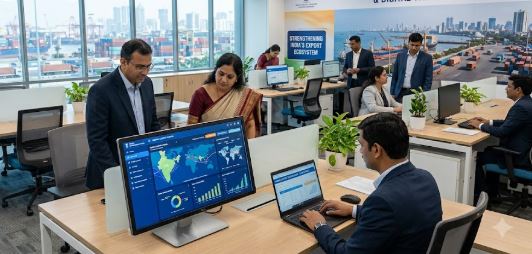
India is stepping up efforts to make international trade easier for businesses by strengthening export facilitation through a combination of integrated physical offices, local support networks and digital technology.
Commerce and Industry Minister Piyush Goyal, during a stakeholder interaction on Ease of Doing Business, Free Trade Agreements and trade reforms, outlined measures aimed at reducing procedural hurdles and giving exporters easier access to government services, market information and trade-related support.
Single-Point Access to Government Services
A key proposal is to establish integrated Commerce and Industry offices in major cities, allowing businesses to access services from multiple departments and agencies through a common point rather than dealing with separate offices.
The approach is intended to reduce administrative complexity, improve coordination among government agencies and make regulatory processes more convenient for businesses. For exporters, smoother interaction with authorities can help reduce delays and improve the overall efficiency of the trade process.
Local Support to Expand the Export Base
The government is also proposing a network of around 1,000 trained personnel with regional-language expertise to assist existing and potential exporters at the district and state levels.
The local support system is particularly significant for MSMEs, first-time exporters and businesses located outside major commercial centres. By providing guidance closer to the businesses themselves, the initiative could help enterprises better understand documentation, regulations, international markets and opportunities available through trade agreements.
Trade Connect to Make Global Markets More Accessible
Digitalisation is another major component of the proposed export facilitation framework. The Trade Connect platform is being developed to provide product-wise and HSN-code-wise information on destination-country tariffs, Free Trade Agreement opportunities and procedures for claiming FTA benefits.
The platform is also expected to use digital and AI-enabled tools to help businesses identify potential export markets and understand infrastructure requirements. This could make market research more accessible and help companies take better-informed decisions before entering overseas markets.
Stronger Support for MSMEs and Emerging Exporters
The measures could have a wider impact on India’s business ecosystem by lowering some of the information and compliance barriers that often discourage smaller enterprises from entering international trade.
For MSMEs, easier access to market intelligence, local handholding and digital trade services could support export diversification, new customer acquisition and integration into global supply chains. It could also encourage more businesses from smaller cities and districts to explore international markets.
Manufacturing, Investment and Employment Impact
The government-industry interaction also highlighted the connection between trade reforms and domestic manufacturing. The roller-chain and industrial-components sector reported that recent policy measures, including Quality Control Orders, Minimum Import Price provisions and higher import duties, had contributed to a 15-fold expansion, around ₹500 crore in fresh investment and nearly 5,000 jobs in the sector.
The developments underline how stronger domestic manufacturing capacity can complement export expansion by creating greater production capability, investment opportunities and employment across related industries.
Building a More Competitive Export Ecosystem
Industry representatives also raised the need for better coordination between government systems and foreign-trade platforms, including digital transmission and verification of Certificates of Origin under FTAs. Other concerns included logistics costs, documentation delays, testing and certification, rules of origin and regulatory certainty for MSMEs.
Addressing these bottlenecks could make the export process more predictable and reduce the time and cost involved in reaching overseas markets.
Impact on India’s Global Trade Growth
The broader objective is to create an export ecosystem where businesses can access government services, market information, trade agreements and regulatory support through a more connected system.
A combination of physical facilitation, local expertise and digital platforms could help widen India’s exporter base, strengthen MSME participation, improve utilisation of FTAs and encourage domestic manufacturers to compete more effectively in global markets.
As international trade becomes increasingly competitive, simplifying procedures and improving access to market intelligence could play an important role in helping Indian businesses move from domestic operations to larger regional and global markets.
