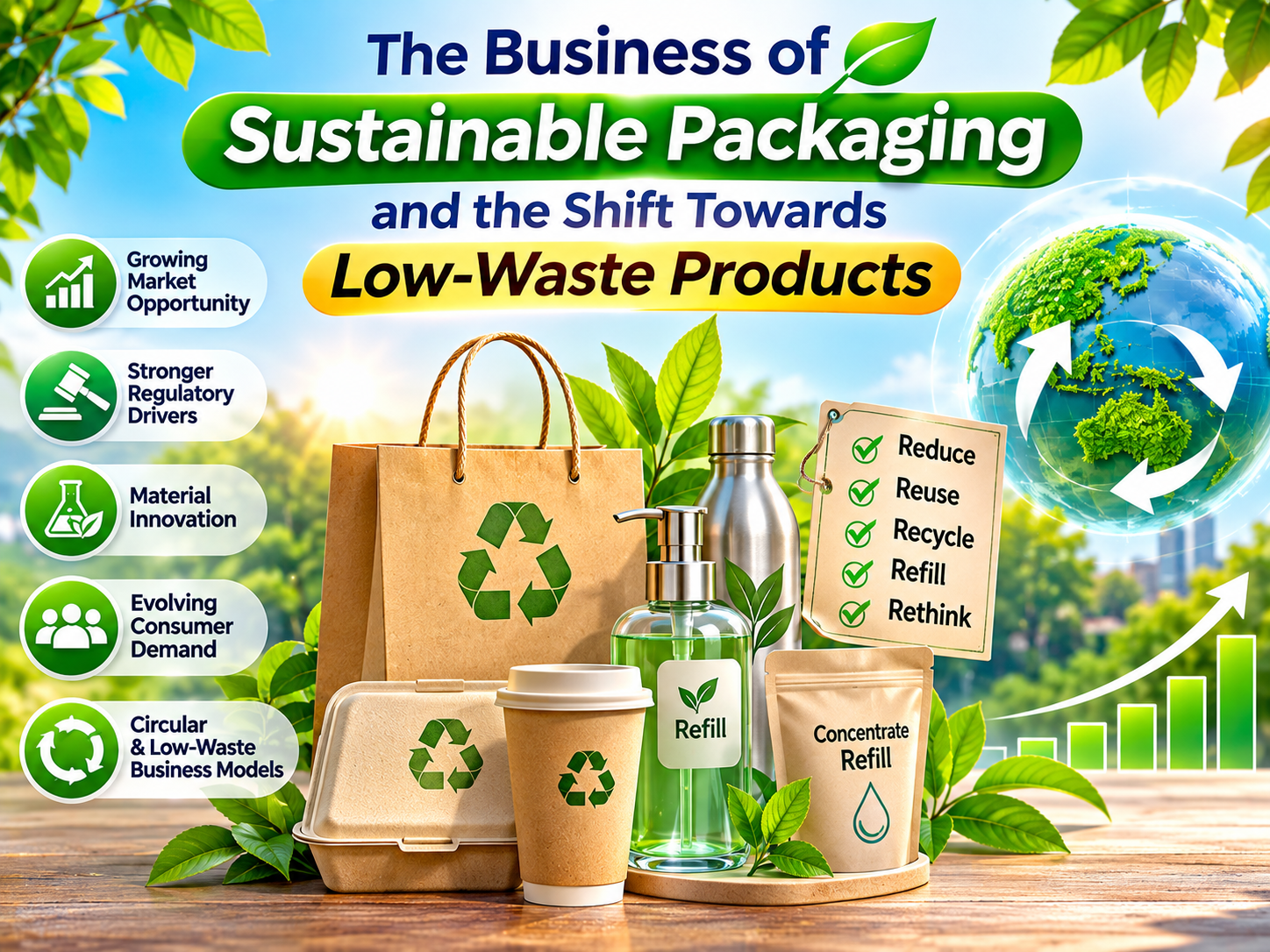
Nov 12: The future of packaging is no longer just about protecting products; it is about transforming how businesses manufacture, distribute, sell, and recover them. As environmental concerns intensify and governments introduce stricter waste-management regulations, sustainable packaging has moved from a voluntary corporate responsibility initiative to a major business priority. From recyclable paper containers and biodegradable films to reusable delivery systems and refillable product formats, companies are rethinking traditional packaging models to remain competitive in an increasingly sustainability-conscious economy.
This transformation is creating a powerful commercial opportunity. Businesses are discovering that reducing packaging waste can improve supply-chain efficiency, strengthen brand reputation, reduce regulatory exposure, and unlock new revenue streams. However, the transition also presents challenges involving material costs, manufacturing technology, infrastructure limitations, and consumer affordability. The real competitive advantage will belong to companies that can combine environmental performance with operational efficiency and commercial profitability.
The Economics of Sustainable Packaging: A Rapidly Expanding Market
The sustainable packaging industry has evolved into a significant global market, supported by changing consumer preferences, environmental legislation, and corporate commitments to reduce plastic waste. According to Fortune Business Insights, the global sustainable packaging market was valued at approximately USD 374.86 billion in 2025 and is projected to reach USD 399.97 billion in 2026, eventually growing to USD 671.97 billion by 2034.
This expansion reflects a fundamental shift in business economics. Conventional plastic packaging may offer relatively low initial manufacturing costs, but businesses increasingly face additional expenses associated with waste management, regulatory compliance, recycling obligations, and environmental accountability.
Several commercial developments are accelerating market growth:
- Recyclable packaging dominance: Paper, cardboard, and recyclable plastic formats remain important because established collection and recycling systems make them commercially viable.
- Compostable material expansion: Biodegradable films, plant-based containers, and compostable food packaging are gaining attention, particularly in food service and fresh-produce markets.
- E-commerce demand: Online retail is increasing demand for lightweight, protective, recyclable packaging that reduces transportation costs and unnecessary material consumption.
- Corporate sustainability investment: Large manufacturers and retailers are increasingly incorporating packaging redesign into their environmental, social, and governance (ESG) strategies.
For businesses, sustainable packaging is therefore becoming more than a product-design decision. It is an investment in long-term cost management, regulatory preparedness, and market positioning.
Regulatory Pressure: Turning Sustainability Commitments into Business Requirements
One of the strongest forces transforming the packaging industry is the introduction of stricter environmental regulations. Governments are increasingly moving away from voluntary sustainability commitments towards enforceable requirements that make manufacturers responsible for the environmental impact of their packaging.
Extended Producer Responsibility (EPR) is particularly important in this transition. Under EPR frameworks, businesses may be required to finance or organise the collection, recycling, and responsible disposal of packaging waste.
Major regulatory developments include:
- European Union Packaging and Packaging Waste Regulation (PPWR): The regulation introduces requirements concerning packaging recyclability, waste reduction, reuse, and recycled content, with most provisions applying from August 2026.
- North American EPR programmes: Several US states are implementing producer-responsibility frameworks that require companies to report packaging materials and contribute towards waste-management systems.
- Chemical restrictions: Increasing restrictions on substances such as per- and polyfluoroalkyl substances (PFAS) are encouraging manufacturers to develop safer alternatives for grease-resistant food packaging.
- Recycled-content requirements: Regulatory targets are encouraging companies to incorporate post-consumer recycled materials into new packaging products.
These developments have direct financial implications. Businesses that fail to adapt may face compliance expenses, penalties, redesign costs, and restricted market access. Conversely, companies that invest early in recyclable materials, accurate reporting, and responsible packaging design can improve regulatory resilience and strengthen relationships with institutional buyers.
Material Innovation: Beyond Conventional Plastic and Cardboard
The transition towards sustainable packaging is creating significant opportunities in material science and manufacturing technology. However, replacing conventional plastic is not simply a matter of switching to paper. Packaging must continue to protect products against moisture, oxygen, contamination, and physical damage.
An unsuitable alternative may increase product spoilage, transportation losses, and overall environmental impact. Consequently, manufacturers are investing in materials that balance environmental performance with durability and functionality.
Three important areas of innovation are emerging:
- Paperization and moulded fibre: Manufacturers are replacing selected plastic containers, protective inserts, and packaging components with paperboard, cellulose, and moulded fibre. Advances in dry-forming technology are also helping reduce water and energy requirements in certain manufacturing processes.
- Agricultural waste utilisation: Materials derived from sugarcane bagasse, banana stems, agricultural residues, seaweed, and mushroom mycelium are creating opportunities to convert waste into commercially useful packaging materials.
- Advanced recycling technologies: Artificial intelligence, machine vision, and near-infrared spectroscopy are improving the identification and separation of different packaging materials, potentially increasing the quality and value of recovered resources.
For manufacturers and investors, these developments represent opportunities across the entire value chain, including biomaterial production, packaging machinery, recycling infrastructure, and material recovery services.
Consumer Behaviour: Sustainability Must Also Deliver Value
Consumer demand plays a critical role in determining the commercial success of sustainable packaging. Although environmental awareness is increasing, purchasing decisions remain strongly influenced by affordability, convenience, durability, and product quality.
Research highlighted by Deloitte indicates growing consumer engagement with recycling and reducing single-use plastics. However, cost remains a significant barrier to adopting more sustainable alternatives.
This creates an important consumer paradox: shoppers increasingly expect responsible packaging but are often unwilling to pay substantially more for it.
Businesses must therefore develop strategies that make sustainability economically attractive:
- Affordable alternatives: Sustainable packaging should offer competitive pricing rather than relying exclusively on environmental appeal.
- Convenience and functionality: Easy-to-open, lightweight, durable, and reusable packaging can encourage adoption.
- Transparent communication: Clear recycling instructions and verifiable environmental claims help consumers distinguish genuine sustainability efforts from greenwashing.
- Product protection: Packaging must preserve freshness, quality, and safety while reducing unnecessary material use.
The commercially successful approach is to make sustainability a practical consumer benefit rather than an expensive lifestyle choice.
Low-Waste Business Models: Redesigning the Product Lifecycle
The most significant transformation is taking place beyond packaging materials themselves. Businesses are increasingly recognising that reducing waste requires redesigning the entire product lifecycle, from manufacturing and distribution to consumption and disposal.
This shift is encouraging the development of circular business models in which packaging materials remain in productive use for longer.
Key opportunities include:
- Concentrated and waterless products: Household cleaners, personal care products, and other consumer goods are increasingly available in concentrated powders, dissolvable tablets, and refill formats. These products can reduce packaging requirements and transportation costs associated with shipping water.
- Reusable and refillable systems: Deposit-based containers, refill stations, and returnable packaging programmes offer businesses opportunities to reduce dependence on single-use materials while building repeat customer relationships.
- Packaging right-sizing: Optimising box dimensions and eliminating unnecessary internal packaging can reduce shipping volumes, material consumption, and logistics expenses.
- Digital product passports: QR codes and digital tracking systems can communicate information about material composition, sourcing, recycling instructions, and product lifecycle performance.
These approaches can also create new commercial opportunities. Subscription-based refill services, packaging recovery partnerships, and reusable-container networks can generate recurring customer engagement while improving resource efficiency.
Business Strategy: Converting Circularity into Competitive Advantage
Although sustainable packaging creates considerable opportunities, successful implementation requires careful financial and operational planning. Businesses must evaluate the total cost of ownership rather than comparing packaging materials solely on their initial purchase price.
For example, lightweight packaging may reduce freight expenses, while reusable containers may lower long-term procurement costs if collection and return systems operate efficiently.
Companies should focus on several strategic priorities:
- Supply-chain collaboration: Working with material suppliers, manufacturers, retailers, and recycling companies can improve material availability and recovery rates.
- Life-cycle assessment (LCA): Evaluating environmental impacts across production, transportation, use, and disposal helps businesses avoid shifting environmental problems from one stage to another.
- Investment in innovation: Developing recyclable, reusable, and lower-impact packaging can support differentiation and improve long-term market positioning.
- Performance measurement: Tracking packaging weight, recycled content, recovery rates, material costs, and product damage provides measurable indicators of business performance.
Ultimately, sustainability initiatives must demonstrate both environmental effectiveness and commercial viability. Companies that integrate these objectives into their core operating models will be better positioned to respond to changing market expectations.
Conclusion: Sustainability as a Competitive Edge
The transition towards sustainable packaging and low-waste products represents a fundamental restructuring of the global packaging economy. Rising regulatory pressure, material innovation, changing consumer expectations, and the expansion of circular business models are redefining how companies create and deliver value.
Businesses that continue relying on traditional single-use packaging face increasing operational and regulatory challenges. In contrast, organisations investing in recyclable materials, refill systems, efficient product design, and transparent supply chains can unlock new growth opportunities while improving resource productivity.
The next phase of industry leadership will not be determined simply by who uses the most environmentally friendly packaging, but by who can make sustainability commercially scalable. In the emerging circular economy, waste reduction is no longer just an environmental responsibility—it is a strategic investment in profitability, competitiveness, and long-term business resilience.
