Pic Credit: https://x.com/rashtrapatibhvn
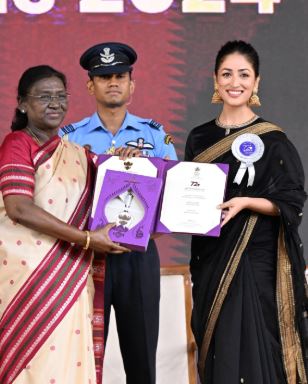
A National Award ceremony is usually about cinema, performances and the people who shape Indian storytelling. But when Yami Gautam arrived to receive the Best Actress honour for Article 370 in a black Maheshwari saree, the spotlight extended beyond the screen — towards a centuries-old textile tradition and the artisans who continue to keep it alive.
Yami’s choice was particularly significant because the saree was crafted by a seventh-generation Salvi family weaver from Maheshwar. By bringing a traditional handloom into one of the country’s most visible cultural events, her appearance offered a contemporary reminder that heritage textiles can still hold a place in modern luxury and celebrity fashion.
The 72nd National Film Awards were held at Ekta Nagar in Gujarat on September 22, where Yami received the Best Actress award for her performance in Article 370. The ceremony itself was being held outside New Delhi for the first time, adding another layer of regional and cultural visibility to the occasion.
When the saree becomes a story
The appeal of a handwoven saree lies in something that mass-produced fashion often struggles to replicate: a visible connection between the product and the person who made it.
A Maheshwari saree is not simply a garment. It carries the identity of a weaving tradition associated with Maheshwar in Madhya Pradesh, where the craft developed into an important textile culture under the patronage associated with Ahilyabai Holkar.
Yami’s decision to identify the lineage of the weaver behind her saree shifts attention from celebrity fashion alone to the craftsmanship itself. It gives the garment a provenance — a story of skill, continuity and generations.
And that story is increasingly becoming part of the value proposition of Indian fashion.
From heirloom wardrobes to contemporary fashion
For decades, handloom sarees were strongly associated with traditional occasions, family wardrobes and cultural ceremonies. Today, designers, stylists and consumers are increasingly experimenting with heritage textiles in contemporary settings.
The shift is important for the handloom economy.
A traditional weave no longer has to remain confined to the conventional saree market. Its fabric can move into contemporary blouses, dresses, jackets, dupattas, scarves, bags, home furnishings and other lifestyle products.
This creates a wider commercial ecosystem around the artisan.
The Ministry of Textiles’ 2024-25 annual report notes that India has around 28.23 lakh handlooms, highlighting the scale of the sector and its role in employment. The report also describes handloom as a relatively low-capital and energy-efficient production system, with flexibility for small-batch manufacturing and the ability to respond to changing market preferences.
Why celebrity fashion matters to artisans
Celebrity fashion does not automatically translate into higher artisan incomes. But it can create something valuable for traditional crafts: visibility.
When a recognised actor wears a regional weave at a nationally watched event, consumers who may never have encountered that textile before can discover its name, origin and aesthetic.
That can influence searches, social-media conversations, designer collaborations and eventually retail demand.
The commercial opportunity becomes even larger when the story of the artisan travels with the product.
Instead of selling only a saree, brands and retailers can communicate the weaving tradition, the region, the craft process and the lineage of the maker. This gives consumers a stronger connection with the product and can help distinguish authentic handloom from mass-produced imitations.
The next growth story could be heritage fashion
India’s handloom sector is already deeply connected with domestic and international markets. The Ministry of Textiles has highlighted the sector’s ability to produce distinctive designs in small batches and meet demand from consumers looking for authentic, environmentally conscious textiles.
That creates an interesting opportunity at the intersection of fashion, culture and commerce.
The next generation of handloom growth may not come simply from persuading consumers to wear traditional sarees more often. It could come from making heritage textiles relevant to more parts of their lifestyle.
A Maheshwari weave could become part of a modern festive wardrobe. A Sambalpuri textile could move into contemporary workwear. A Banarasi fabric could be used for evening jackets. Traditional motifs could appear in accessories and home décor.
The craft remains traditional, while the market around it evolves.
Digital fashion is changing the artisan’s reach
Another major change is the way handloom is reaching consumers.
Earlier, a weaver could be largely dependent on local traders, exhibitions or regional retail networks. Digital commerce now provides the possibility of reaching customers across India and, increasingly, international buyers.
Social media can also function as a discovery platform. A celebrity appearance can introduce a textile to millions of viewers, while digital stores can potentially convert that awareness into purchases.
For artisan communities, the challenge will be ensuring that this growing visibility is accompanied by transparent sourcing, fair pricing and stronger market access.
Preserving tradition while creating new demand
The larger question for Indian handloom is not whether traditional textiles can survive modern fashion. It is whether modern fashion can create enough new demand to make traditional craftsmanship economically sustainable for the next generation.
That requires more than celebrity endorsements.
It calls for stronger branding of regional textiles, designer-artisan partnerships, reliable digital marketplaces, contemporary product development and greater consumer awareness about authentic handloom.
It also requires recognising that every traditional textile represents a business ecosystem — from yarn and dyeing to weaving, finishing, design, logistics and retail.
Yami’s saree and the new language of Indian luxury
Yami Gautam’s Maheshwari saree moment captures a broader change taking place in Indian fashion.
Luxury is increasingly being discussed not only in terms of price or exclusivity, but also through craftsmanship, provenance, cultural identity and human skill.
That could give India’s traditional weaves a fresh position in the fashion economy.
The black Maheshwari saree may have been chosen for a single evening, but the idea behind it has a much longer life. When contemporary fashion embraces the work of generations-old artisan families, heritage stops being something preserved only in museums or archives.
It becomes something people can wear, reinterpret and build businesses around.
And that may be one of the most promising paths for India’s handloom sector — not keeping old fashion frozen in time, but giving traditional craftsmanship a new place in the modern economy.
