What if improving your everyday nutrition didn’t require expensive supplements or a complicated diet? Sometimes, the answer is already sitting on your plate.
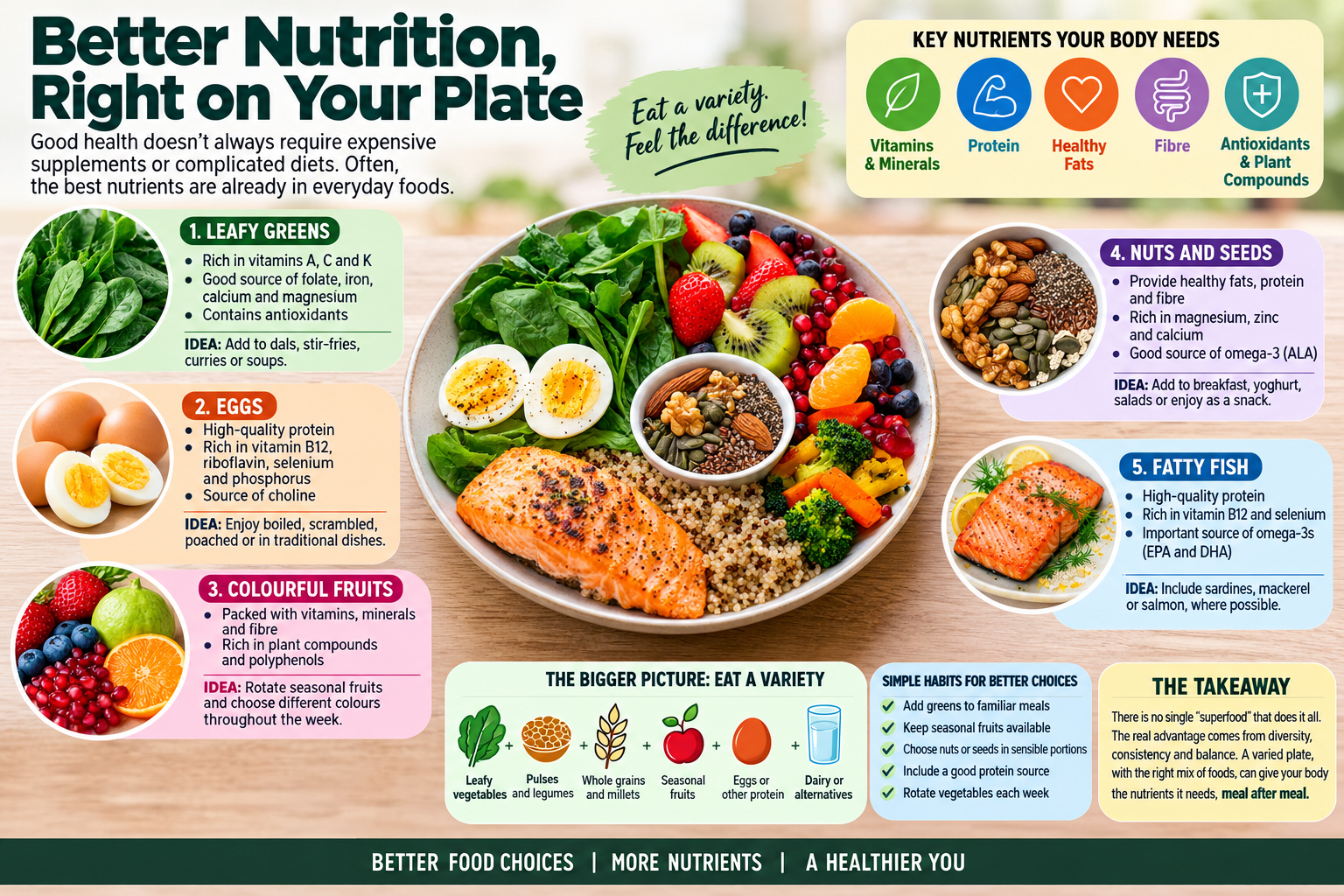
Our bodies need a wide range of nutrients to function properly. Vitamins and minerals support essential processes, protein helps maintain and repair tissues, healthy fats contribute to normal brain and heart function, while fibre supports digestive health. Antioxidants and other plant compounds add another layer of nutritional value.
The challenge is not necessarily finding one “perfect” food. It is creating enough variety in the diet to give the body access to different nutrients.
The World Health Organization (WHO) recommends a diverse diet that includes fruits, vegetables, legumes, nuts, whole grains and suitable sources of protein. For people over the age of 10, WHO recommends consuming at least 400 grams of fruits and vegetables each day.
India’s ICMR–National Institute of Nutrition (NIN) takes a similar approach. Its 2024 Dietary Guidelines for Indians encourage a varied diet containing vegetables, fruits, pulses, nuts and seeds, eggs or other protein-rich foods, cereals and millets, and dairy or suitable alternatives.
So, which foods can help make everyday meals more nutrient-dense?
1. Leafy Greens: The Everyday Nutritional Heavyweights
Spinach, amaranth, moringa leaves and other leafy vegetables are easy to overlook because they are such familiar foods. Yet they can contribute an impressive range of nutrients.
Leafy greens provide vitamins including A, C and K, as well as folate and minerals such as iron, calcium and magnesium. They also contain naturally occurring plant compounds with antioxidant properties.
They don’t need to be complicated. Add them to dal, stir-fries, curries, soups or traditional vegetable preparations.
For many Indian meals, leafy greens can be one of the simplest ways to increase the nutritional variety of the plate.
2. Eggs: A Convenient Nutrient Package
An egg is often thought of simply as a source of protein. Its nutritional profile is considerably broader.
Eggs provide high-quality protein along with vitamin B12, riboflavin, selenium and phosphorus. They are also a source of choline, a nutrient involved in normal brain and nervous-system function.
For people who eat eggs, they can be a convenient addition to breakfast or a simple protein option at lunch or dinner.
And they don’t need an elaborate preparation. Boiled, scrambled, poached or cooked into a traditional dish, eggs can easily fit into everyday meals.
3. Colourful Fruits: More Than Just Natural Sweetness
A colourful fruit bowl is not just visually appealing. Different fruits contain different combinations of vitamins, minerals, fibre and naturally occurring plant compounds.
Amla and guava are well known for their vitamin C content, while fruits such as berries and pomegranate contain a variety of polyphenols and other antioxidant compounds.
Rather than searching for one “best” fruit, variety is the better strategy. Rotate seasonal fruits and choose different colours throughout the week.
This makes the diet more interesting while increasing exposure to a wider range of nutrients and plant compounds.
4. Nuts and Seeds: Small Additions With Big Nutritional Value
Almonds, walnuts, pumpkin seeds, flaxseeds and chia seeds may occupy only a small space on the plate, but they can contribute healthy fats, protein, fibre and several minerals.
They provide nutrients such as magnesium, zinc and calcium, while walnuts, flaxseeds and chia seeds also provide the plant-based omega-3 fatty acid ALA.
A small portion can be added to breakfast, yoghurt, salads or eaten as a snack. Because nuts and seeds are energy-dense, moderation is important.
Their biggest advantage may be convenience: they require little preparation and can easily be incorporated into meals.
5. Fatty Fish: Bringing Omega-3s to the Plate
For people who eat seafood, sardines, mackerel and salmon are particularly nutrient-rich choices.
They provide high-quality protein and nutrients such as vitamin B12 and selenium, while fatty varieties are important dietary sources of the omega-3 fatty acids EPA and DHA.
These fatty acids have important roles in the body, including supporting normal heart, brain and eye function.
For those who don’t eat fish, flaxseeds, chia seeds and walnuts can provide ALA, a plant-based omega-3 fatty acid, although the body handles these different omega-3 forms differently.
The Bigger Lesson Is Variety
It can be tempting to look for a single food that contains every vitamin, mineral and antioxidant the body needs. But there is no need to put that pressure on one ingredient.
The WHO identifies diversity, along with adequacy, balance and moderation, as key principles of healthy eating. The ICMR-NIN’s 2024 dietary guidelines similarly emphasise combining different food groups.
That could mean pairing leafy vegetables with pulses, adding an egg to a meal, choosing seasonal fruit, including a modest serving of nuts or seeds and incorporating fish where appropriate.
The result is not one miraculous meal. It is a pattern of eating that brings together different sources of nutrition.
Making Better Choices Without Making Life Complicated
Healthy eating doesn’t have to mean completely changing the way you eat.
A few simple habits can help. Add greens to a familiar meal. Keep seasonal fruit available. Choose nuts or seeds in sensible portions. Include a good protein source. Rotate vegetables rather than buying the same ones every week.
Most importantly, think about what you can add to your diet rather than only what you need to remove.
The Takeaway
The search for a “superfood” may make nutrition sound more complicated than it really is.
Leafy greens, eggs, colourful fruits, nuts and seeds, and fatty fish can each contribute different nutrients. When combined with whole grains, pulses, vegetables and other foods, they can form part of a varied and balanced eating pattern.
The real nutritional advantage comes from diversity, consistency and balance.
Because when it comes to everyday nutrition, the goal isn’t to find one food that does everything. It is to build a plate that gives your body a little more of what it needs, meal after meal.
