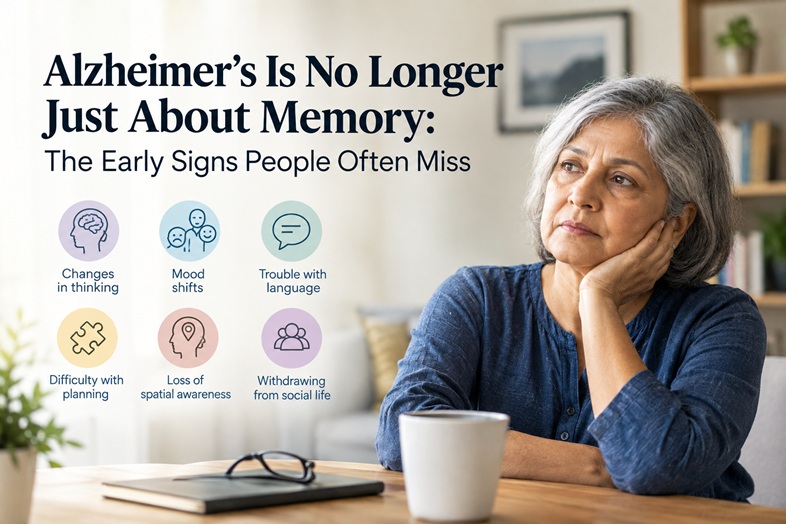
From blood-based biomarkers to a growing clinical-trial pipeline, Alzheimer’s research is moving toward earlier detection and intervention. For India, better access to diagnosis could become increasingly important as the population ages.
Forgetting a name, misplacing your keys or walking into a room and forgetting why you went there can happen to anyone. But when memory and thinking problems become persistent and start interfering with everyday life, the question becomes more serious: Is it normal ageing, or could it be an early sign of dementia?
That question is gaining renewed attention on World Alzheimer’s Day 2026, as researchers increasingly focus on detecting Alzheimer’s disease earlier rather than waiting for severe cognitive decline.
Alzheimer’s Disease International (ADI) has chosen “The Earlier You Know, The More You Can Do: A Dementia Diagnosis Matters” as the theme for its 2026 campaign, putting diagnosis at the centre of this year’s awareness efforts.
The timing is significant. On September 21, ADI also released its World Alzheimer Report 2026, which examines a new era of dementia clinical trials and the challenges involved in making research more inclusive, accessible and effective.
Why Earlier Alzheimer’s Diagnosis Matters
Dementia is not one single disease. It is an umbrella term for conditions that affect memory, thinking and the ability to perform everyday activities.
The World Health Organization estimates that 57 million people were living with dementia worldwide in 2021, with nearly 10 million new cases each year. Alzheimer’s disease is the most common form of dementia and may contribute to 60–70% of cases.
An earlier diagnosis cannot reverse the disease. But it can help people and families understand what is happening and make decisions about care, support and the future.
It can also give doctors an opportunity to investigate whether symptoms are linked to Alzheimer’s disease, another form of dementia or a different medical issue.
That distinction matters because not every memory problem is Alzheimer’s.
Alzheimer’s Diagnosis Is Becoming More Scientific
One of the biggest developments in the field is the growing interest in blood-based biomarkers.
For years, identifying Alzheimer’s-related changes could involve specialised brain imaging or analysis of cerebrospinal fluid. Blood tests are now emerging as another tool for identifying biological signs associated with the disease.
In 2025, the US Food and Drug Administration cleared the first blood test intended to aid in diagnosing Alzheimer’s disease. The test measures the ratio of p-tau217 and beta-amyloid 1-42 in plasma and is designed for adults aged 55 and older who have signs and symptoms of the disease.
More recently, the FDA’s records show an August 2026 decision involving Roche’s Elecsys Phospho-Tau (217P) Plasma test for amyloid pathology assessment.
These developments do not mean that a blood test alone can diagnose every person with Alzheimer’s.
Instead, they point toward a future in which blood-based biomarkers could become an increasingly useful part of the diagnostic process, alongside symptoms, medical history and other clinical assessments.
Could Alzheimer’s Be Detected Before Major Memory Loss?
This is one of the most important questions in current Alzheimer’s research.
Biological changes associated with Alzheimer’s can occur before dementia becomes obvious. Researchers are therefore investigating whether identifying these changes earlier could provide a window for treatment or other interventions.
But detecting Alzheimer’s-related pathology is not the same as preventing the disease.
Scientists are still studying which interventions work, when they should be given and which people are most likely to benefit.
That is why clinical trials remain so important.
A New Era for Alzheimer’s Clinical Trials
The World Alzheimer Report 2026 puts clinical trials at the centre of this year’s discussion.
According to ADI, there are currently 158 drugs in 192 trials in the pipeline. The organisation describes clinical trials as essential to turning emerging discoveries in dementia research into potential treatments and diagnostics.
But scientific progress is not only about the number of drugs being tested.
Clinical trials need participants. They also need to address questions around accessibility, diversity, ethics and whether research findings can be applied across different populations.
That makes clinical-trial participation an important part of the future of Alzheimer’s research.
Why This Matters for India
The issue has particular relevance for India, where the population is ageing and healthcare systems are facing growing demand for services for older adults.
WHO notes that India’s older population already represents a significant share of the country’s population. Its India ageing profile, based on Census 2011, recorded 104 million people aged 60 and above, representing 8.6% of the population at that time.
As life expectancy increases, the need for accessible assessment of cognitive decline is likely to become increasingly important.
For India, however, earlier diagnosis is not simply a question of developing better technology.
Access to specialists, affordability, awareness, caregiver support and availability of diagnostic services can all influence whether a person receives timely evaluation.
This is where simpler diagnostic technologies, if validated and made accessible, could potentially have an important role.
Not Every Memory Lapse Is Alzheimer’s
The growing focus on early diagnosis should not turn ordinary forgetfulness into a reason for alarm.
Occasionally forgetting a name or misplacing an object is common.
More concerning are persistent or worsening changes that interfere with everyday life. These might include repeatedly forgetting recent conversations, struggling with familiar tasks, becoming confused in familiar surroundings or experiencing increasing difficulty communicating.
Such symptoms can have many causes, and only a healthcare professional can determine whether further assessment is needed.
The important point is not to diagnose yourself from a single symptom.
It is to recognise when a change is persistent enough to deserve attention.
Can Lifestyle Help Reduce Dementia Risk?
Diagnosis is only one side of the Alzheimer’s conversation.
In July 2026, WHO released its second edition of guidelines on reducing the risk of cognitive decline and dementia. The guidance covers physical activity, tobacco cessation, reducing harmful alcohol use, healthy diets and management of conditions such as hypertension, diabetes and high cholesterol. It also addresses hearing loss, social and cognitive engagement and reducing exposure to air pollution.
WHO estimates that up to 45% of dementia risk could potentially be prevented or delayed by addressing modifiable risk factors. That figure describes population-level risk and should not be interpreted as a guarantee that lifestyle changes will prevent Alzheimer’s disease in an individual.
Age and genetics remain important factors, and dementia can develop even in people who maintain healthy lifestyles.
The Alzheimer’s Conversation Is Changing
World Alzheimer’s Day 2026 arrives at a point when the conversation around dementia is becoming increasingly focused on what happens before severe symptoms appear.
Blood-based biomarkers are opening new possibilities for diagnosis. Clinical trials are testing potential treatments and diagnostics. Public-health guidance is placing greater emphasis on reducing modifiable risk factors.
But scientific progress will only have a meaningful impact if people can access diagnosis, treatment, research and long-term support.
For families, the message is relatively simple: persistent changes in memory or thinking should not automatically be dismissed as a normal part of ageing.
For healthcare systems, the challenge is to make timely assessment and care more accessible.
And for researchers, the next goal is even bigger — turning earlier detection into interventions that can genuinely change the course of Alzheimer’s disease.
This World Alzheimer’s Day, the message is therefore about more than remembering the disease.
It is about recognising it earlier, understanding it better and creating more opportunities for people and families to make informed decisions about what comes next.
