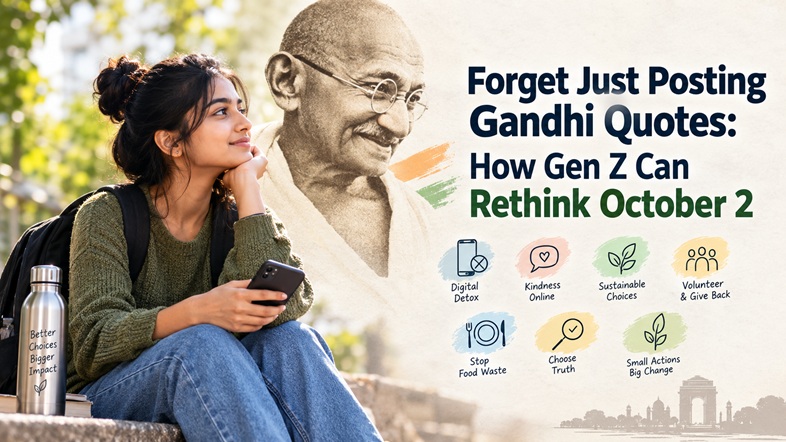
Every October 2, India observes Gandhi Jayanti with speeches, school programmes, tributes and social media posts featuring Mahatma Gandhi’s photographs and famous quotes. But in 2026, there is an opportunity to look at the day differently.
For Gen Z, Gandhi Jayanti does not necessarily have to mean simply attending a ceremony or sharing a quote online. The generation that has grown up with smartphones, social media, artificial intelligence, fast fashion and instant consumption can interpret some of Gandhi’s ideas through the realities of modern life.
From practising non-violence online to questioning unnecessary consumption, October 2 can become a day of action rather than just remembrance.
1. Practise Non-Violence On Social Media
Non-violence has a very different digital dimension today.
Online arguments can quickly turn into trolling, harassment and personal attacks. A disagreement over politics, entertainment, fashion or lifestyle can sometimes become unnecessarily hostile.
Gen Z can mark Gandhi Jayanti by adopting a simple rule: disagree without disrespecting.
That does not mean avoiding difficult conversations. It means expressing opinions without deliberately humiliating, abusing or attacking another person.
2. Make Truthfulness Matter In The AI Era
The meaning of truth is becoming increasingly important in a world of AI-generated content.
Deepfakes, manipulated photographs, synthetic voices, misleading videos and false claims can spread rapidly online. A post can reach thousands of people before anyone checks whether it is genuine.
This Gandhi Jayanti, Gen Z could make verification a habit.
Before forwarding a sensational claim, check the source. Before sharing a shocking video, look for context. Before believing an AI-generated image or statement, question its authenticity.
In today’s digital environment, thinking before sharing can be a modern expression of truthfulness.
3. Take A Social Media Break
Gandhi’s association with simplicity and self-discipline can be reinterpreted for the smartphone generation.
October 2 could be used as an opportunity to take a few hours away from social media.
Put the phone aside. Read a book. Go for a walk. Meet friends. Have a conversation without constantly checking notifications.
The purpose is not to reject technology. It is to ask an important question: Are we controlling our technology, or is it controlling our attention?
4. Buy Less And Reuse More
Gen Z is also growing up in an era of fast fashion, influencer-led shopping and constantly changing online trends.
Gandhi Jayanti could therefore become an opportunity to experiment with mindful consumption.
Instead of buying something simply because it is trending, repair an old item, reuse something already owned or donate products that are no longer needed.
Simplicity does not necessarily mean giving up modern comforts. It can mean becoming more conscious about what we buy, use and throw away.
5. Turn The Holiday Into A Volunteer Day
October 2 is a national holiday, but it can also become a day of community participation.
Young people can spend a few hours volunteering with a local organisation, helping children with their studies, supporting elderly people, participating in a neighbourhood activity or contributing to a community cleanliness initiative.
The activity does not have to be large.
Sometimes, spending a few hours helping someone can create a stronger connection with the community than attending another formal event.
6. Make Food Waste The Challenge Of The Day
Another practical way to reinterpret simplicity is by looking at everyday waste.
Gen Z can use October 2 to examine how much food is purchased, prepared and eventually discarded at home, college or the workplace.
Planning portions, using leftovers creatively and sharing excess food where appropriate are small actions, but they encourage greater awareness of consumption.
The broader message is simple: consume thoughtfully instead of automatically.
7. Replace One Gandhi Quote With One Gandhi-Inspired Action
Perhaps the simplest change is also the most meaningful.
Instead of posting an inspirational quote and forgetting about it the next day, choose one principle and turn it into a habit.
It could be verifying information before forwarding it, avoiding online bullying, reducing unnecessary purchases, volunteering regularly, cutting down waste or spending less time mindlessly scrolling.
A single action repeated for weeks can have more meaning than a social media post that disappears within hours.
Rethinking Gandhi Jayanti For A New Generation
Gandhi lived in a world without smartphones, social media, artificial intelligence or influencer culture. Yet the principles associated with his life can still prompt questions relevant to today’s generation.
What does non-violence mean when disagreements happen online? What does truth mean when AI can generate convincing falsehoods? What does simplicity mean when consumers are constantly encouraged to buy more?
These are questions Gen Z can explore on October 2.
Gandhi Jayanti does not have to lose its traditional character to become more relevant to young people. The ceremonies, tributes and remembrance can continue—but they can be accompanied by something more personal.
Post fewer quotes. Practise more ideas.
For Gen Z, that could be a different—and more contemporary—way to spend October 2.
