Artificial Intelligence (AI) is transforming the way people shop online. From personalized product recommendations to intelligent chatbots and automated customer support, AI is making e-commerce faster, smarter, and more convenient. Today, online shopping platforms use AI to understand customer preferences, predict buying behaviour, manage inventory, and improve the overall shopping experience.
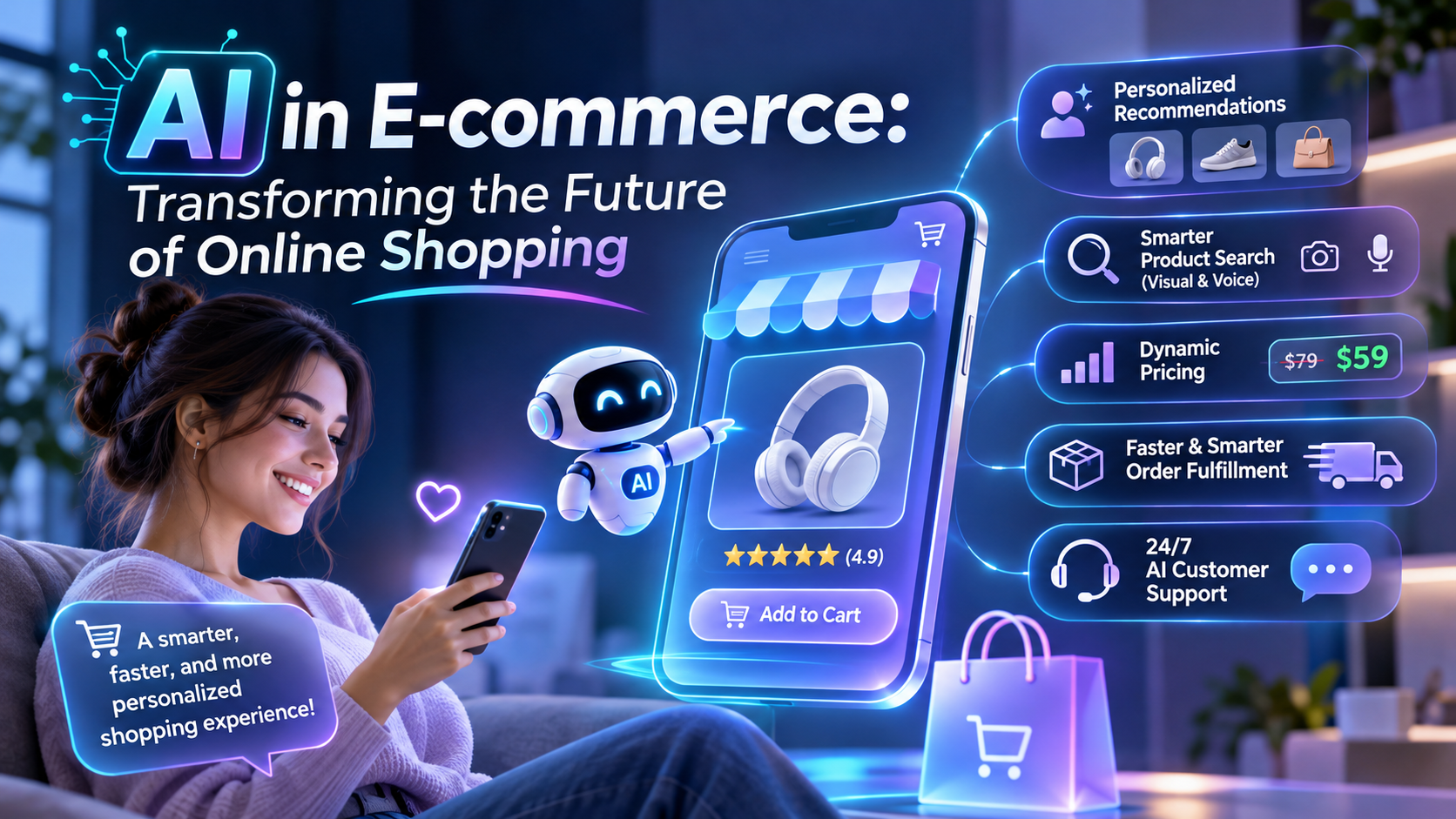
As technology continues to evolve, AI is becoming an essential part of the e-commerce industry. Businesses are adopting AI-powered solutions to attract customers, increase sales, reduce operational costs, and stay competitive in the digital marketplace.
In this article, we will explore how artificial intelligence is transforming online shopping, its major applications, benefits, challenges, and future possibilities.
AI in E-commerce: Revolutionizing the Online Shopping Experience
Artificial Intelligence (AI) is transforming e-commerce by making online shopping smarter, faster, and more personalized. From product recommendations and AI-powered chatbots to smart search tools, AI helps customers find products easily and enjoy a seamless shopping experience. It analyses customer preferences and shopping behaviour to deliver relevant suggestions and improve customer satisfaction.
AI also helps businesses automate inventory management, predict customer demand, detect online fraud, and improve marketing strategies. With emerging technologies like generative AI and virtual shopping assistants, the future of e-commerce will become more efficient, interactive, and customer-focused.
1. Personalized Shopping Experiences
One of the biggest contributions of AI to e-commerce is personalization. AI algorithms analyse customers’ browsing history, previous purchases, search patterns, and interests to recommend products that match their preferences.
For example, when a customer searches for shoes on an online shopping platform, AI can suggest similar products, recommend matching accessories, and display offers based on their interests.
This personalized experience helps customers discover relevant products quickly while encouraging them to make purchasing decisions.
Key benefits:
-
Personalized product recommendations.
-
Better customer engagement.
-
Faster product discovery.
-
Increased customer satisfaction and sales.
2. AI-Powered Chatbots and Virtual Assistants
AI-powered chatbots are changing the way e-commerce businesses communicate with customers. These intelligent virtual assistants can answer common questions, provide product information, track orders, and assist customers with returns and refunds.
Unlike traditional customer support systems, AI chatbots can operate 24/7 and handle multiple customer queries simultaneously.
For example, if a customer wants to know the delivery status of an order, an AI chatbot can instantly provide the latest information without requiring human assistance.
As AI technology advances, chatbots are becoming more conversational and capable of understanding customer needs.
3. Smart Product Search and Visual Search
Traditional product searches often depend on exact keywords. However, AI is making product discovery more intelligent through natural language processing and visual search technology.
Customers can now search for products using images, voice commands, or conversational questions.
For example, a customer can upload a picture of a handbag and use visual search to find similar products available in an online store.
AI also helps search engines understand the meaning behind customer queries rather than simply matching keywords.
This makes online shopping more convenient and improves the chances of customers finding exactly what they want.
4. Dynamic Pricing and Better Deals
AI is helping e-commerce businesses develop smarter pricing strategies. By analysing market demand, competitor prices, customer behaviour, seasonal trends, and inventory levels, AI systems can recommend suitable product prices.
Dynamic pricing allows businesses to adjust prices according to changing market conditions.
For example, during festive seasons or major shopping events, AI-powered pricing systems can help businesses analyse demand and create competitive offers.
This approach helps online retailers improve profitability while offering attractive deals to customers.
However, businesses must use dynamic pricing responsibly to maintain customer trust and avoid unfair pricing practices.
5. Inventory Management and Demand Forecasting
Managing inventory is one of the biggest challenges in e-commerce. Businesses need to ensure that popular products remain available without maintaining excessive stock.
AI helps solve this problem through demand forecasting and intelligent inventory management.
By analysing historical sales data, seasonal trends, customer behaviour, and market demand, AI can predict which products are likely to sell in the future.
This allows businesses to:
-
Reduce overstocking and product shortages.
-
Improve warehouse management.
-
Plan inventory more efficiently.
-
Reduce storage and operational costs.
-
Ensure faster product availability.
As a result, AI helps e-commerce businesses maintain smoother operations and improve customer satisfaction.
6. Fraud Detection and Secure Online Payments
Online payment fraud and cyber threats are major concerns in the e-commerce industry. AI plays an important role in identifying suspicious activities and protecting customer transactions.
AI-powered fraud detection systems analyse payment patterns, transaction history, device information, and unusual account behaviour to identify potentially fraudulent transactions.
For example, if an account suddenly makes several unusual purchases from unfamiliar locations, an AI system may flag the activity for additional verification.
These systems can help businesses detect suspicious transactions quickly and reduce financial losses.
AI also supports improved identity verification and risk assessment, making online shopping safer for customers.
7. AI in Customer Behaviour Analysis
Understanding customer behaviour is essential for e-commerce success. AI helps businesses analyse large amounts of customer data to identify shopping patterns, preferences, and purchasing trends.
By studying this information, businesses can understand:
-
Which products customers are interested in.
-
What factors influence purchasing decisions.
-
Why customers abandon shopping carts.
-
Which marketing campaigns perform better.
-
What products may become popular in the future.
These insights help businesses create effective marketing strategies and deliver more relevant shopping experiences.
8. AI-Powered Marketing and Advertising
Artificial Intelligence is transforming digital marketing by helping businesses reach the right audience with the right message at the right time.
AI tools can analyse customer interests, browsing behaviour, and purchasing history to create personalized advertisements and marketing campaigns.
For example, if a customer frequently searches for fitness products, AI can help an online retailer display relevant advertisements for sportswear, gym equipment, and fitness accessories.
AI can also assist with:
-
Personalized email marketing.
-
Automated social media campaigns.
-
Customer segmentation.
-
Advertisement optimization.
-
Content recommendations.
These technologies help businesses improve marketing efficiency and reach potential customers more effectively.
9. Benefits of AI in E-commerce
The adoption of AI offers several advantages for both online retailers and customers.
For businesses:
-
Increased sales through personalized recommendations.
-
Reduced operational costs through automation.
-
Better inventory and supply chain management.
-
Improved fraud detection.
-
More effective marketing strategies.
-
Better customer retention and engagement.
For customers:
-
Personalized shopping experiences.
-
Faster product searches.
-
24/7 customer support.
-
Relevant product recommendations.
-
Convenient and secure transactions.
-
Faster order processing and assistance.
Overall, AI helps create a more efficient and customer-focused e-commerce ecosystem.
10. Challenges of Using AI in E-commerce
Although AI offers many benefits, its implementation also comes with certain challenges.
Data privacy: AI systems often require customer information to provide personalized services. Businesses must protect this data and follow applicable privacy regulations.
Implementation costs: Developing and maintaining AI-powered systems can be expensive, particularly for small businesses.
Data quality: AI systems depend on accurate and relevant data. Poor-quality data can lead to incorrect predictions and recommendations.
Lack of human interaction: Excessive automation may reduce personal interaction, which some customers still prefer.
Algorithmic bias: AI systems can sometimes produce unfair or biased results if they are trained on incomplete or unbalanced data.
Businesses must address these challenges carefully to use AI responsibly and effectively.
11. The Future of AI in E-commerce
The future of e-commerce will become increasingly intelligent, personalized, and automated with the development of AI technologies.
Some emerging trends include:
-
Generative AI shopping assistants: AI assistants will help customers compare products, understand features, and make informed purchasing decisions through natural conversations.
-
Augmented reality shopping: AI combined with AR will allow customers to virtually try clothes, accessories, and furniture before buying.
-
Voice-based shopping: Customers will increasingly use voice assistants to search for products and place orders.
-
Predictive shopping: AI will anticipate customer needs and recommend relevant products at the right time.
-
Autonomous operations: AI-powered systems will improve warehouse automation, inventory management, and delivery planning.
-
Advanced personalization: Online stores will provide increasingly customized shopping experiences based on customer preferences and behaviour.
These innovations will make online shopping more interactive, convenient, and efficient.
Conclusion
Artificial Intelligence is transforming the e-commerce industry by changing how customers discover products, interact with businesses, and complete online purchases. From personalized recommendations and intelligent chatbots to fraud detection, dynamic pricing, and smart inventory management, AI is improving almost every aspect of online shopping.
For businesses, AI provides opportunities to increase efficiency, reduce costs, understand customers, and improve sales. For customers, it offers convenience, faster services, personalized recommendations, and a better overall shopping experience.
Although challenges such as data privacy, implementation costs, and algorithmic bias remain, the future of AI in e-commerce looks promising.
As AI technology continues to develop, businesses that adopt it strategically and responsibly will be better positioned to succeed in the competitive digital marketplace.
