New Delhi, Nov 26: India has taken another step towards strengthening its indigenous artificial intelligence capabilities with the launch of the Chariot-1 Foundation Models, developed by Chariot Artificial Intelligence Pvt. Ltd. under the IndiaAI Mission.
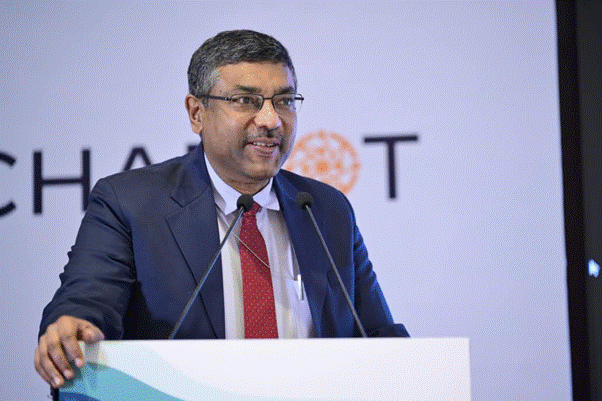
The models were unveiled by S. Krishnan, Secretary, Ministry of Electronics and Information Technology (MeitY), at Bharat Mandapam in New Delhi on Thursday. The launch showcased homegrown research aimed at advancing multilingual language processing and speech generation, with a particular focus on India’s linguistic diversity.
Chariot is among the first four teams selected under the IndiaAI Mission to develop sovereign foundation models. Its Chariot-1 suite comprises a large language model (LLM) and a text-to-speech (TTS) model, both pre-trained from scratch in India.
The initiative is aimed at building domestic expertise in advanced AI technologies and developing models suited to India’s linguistic, technological and societal requirements.
Three research innovations target AI efficiency
The Chariot team has incorporated three research innovations into the development of its models: IndicShift, Nested Training and Mixture of Vocabularies.
IndicShift, an open-source innovation, creates a shared alphabet for Indian scripts, allowing AI models to identify similarities across languages instead of processing each script independently. It covers 1,012 characters across 12 Indian scripts using 350 letters.
According to the developers, the approach reduces token usage on Indian-language text by up to 2.5 times compared with OpenAI’s GPT tokenizer. The team also reported a 5–8% improvement in model performance on Indian languages using the same computing resources, without affecting performance in English and coding tasks.
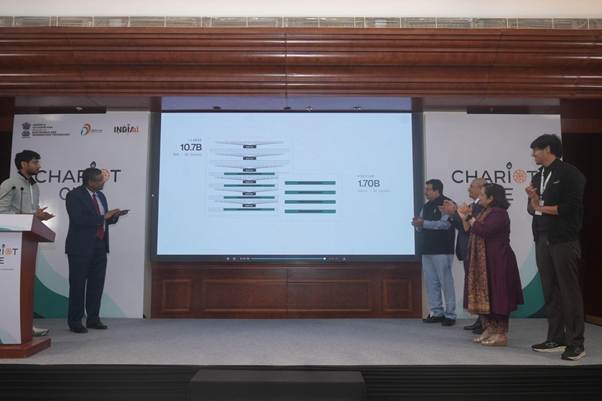
Nested Training allows three model sizes to be trained simultaneously in a single training run using one set of weights. The approach is intended to support deployment across different computing environments, from data centres to laptops, smartphones and edge devices. The developers reported a 62% improvement in training speed compared with training the three model sizes separately.
The third innovation, Mixture of Vocabularies, divides the model’s vocabulary into 11 groups and scores only the relevant group during word selection. This reduces the number of vocabulary entries evaluated per word by 5.7 times and, according to the team, improves training speed by 38% on the same GPUs, with negligible change in model loss.
LLM and speech model designed for Indian languages
The Chariot-1 LLM is an 11-billion-parameter mixture-of-experts model, with four billion active parameters per token. It has been developed in three sizes—10.7 billion, 1.7 billion and 745 million parameters—to meet different computing and deployment requirements.
The accompanying Chariot-1 TTS model can generate speech in English and 10 Indian languages: Hindi, Bengali, Marathi, Tamil, Telugu, Kannada, Malayalam, Gujarati, Punjabi and Odia.
One of its key features is its ability to interpret context while converting written text into speech. It can determine how numbers, dates, currencies, units, website addresses and abbreviations should be pronounced, helping produce more natural speech output.
The developers reported more than 97% verbalisation accuracy in the Async TTS Pronunciation Benchmark, which covered 1,029 real-world sentences and 2,251 instances of non-standard text across 42 categories.
The model also recorded a Hindi character error rate of 7.60% and an average character error rate of 6.47% across nine other Indian languages in the reported evaluations.
MeitY highlights India’s growing AI capabilities
Congratulating the Chariot team, Krishnan described the launch as an important achievement for India’s technology ecosystem. He appreciated the team’s research-led approach, its work on efficient Indian-language representation and its contribution to developing indigenous AI capabilities.
He said the IndiaAI Mission was designed to identify and support talent capable of pursuing advanced research and building cutting-edge technologies in the country. He also highlighted the contribution of two Stanford graduates who returned to India to develop advanced AI technology.
The event also featured a fireside conversation between Vishal Dhupar, Managing Director, South Asia, NVIDIA, and Suvrat Bhooshan, Co-Founder of Chariot, on emerging developments in AI research and the changing technology landscape.
The launch adds to India’s efforts to build a domestic foundation-model ecosystem through the IndiaAI Mission. By supporting homegrown research teams, the initiative seeks to strengthen local technological capabilities, encourage innovation and reduce reliance on AI technologies developed elsewhere.
With its focus on Indian languages and deployment across different computing environments, Chariot-1 represents an effort to make advanced AI tools more accessible and relevant to the country’s diverse linguistic communities.
