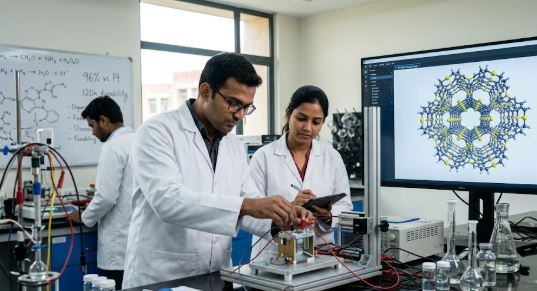
Indian researchers have developed a metal-free porous catalyst that can deliver performance close to commercial platinum catalysts, potentially opening the way for more affordable and sustainable clean-energy technologies.
The new material, called TTT-DHTD, has been developed by researchers from the S.N. Bose National Centre for Basic Sciences (SNBNCBS), Kolkata, the Institute of Nano Science and Technology (INST), Mohali, and SRM University, Amaravati.
The development is significant because platinum, despite its excellent catalytic properties, is among the most expensive and scarce materials used in several clean-energy applications. Finding an efficient alternative made from abundant elements could help reduce technology costs and improve the prospects for large-scale deployment.
Catalyst achieves 96 per cent of platinum’s performance
According to the Ministry of Science & Technology, laboratory tests showed that TTT-DHTD achieved around 96 per cent of the performance of commercial platinum catalysts when used for the oxygen reduction reaction (ORR).
The material also demonstrated strong durability. It maintained its performance after 120 hours of continuous operation, without the degradation or contamination often associated with conventional metal-based catalysts.
Made from abundant elements including carbon, sulfur, nitrogen and hydrogen, TTT-DHTD forms an ultra-porous, honeycomb-like structure. This architecture creates favourable sites for oxygen molecules to attach and undergo reactions efficiently.
Potential breakthrough for zinc-air batteries
The catalyst was tested as an air-electrode catalyst in zinc-air (Zn-air) batteries, an emerging energy-storage technology that uses oxygen from the surrounding air to generate electricity.
Zn-air batteries have attracted attention because they use zinc, which is relatively abundant, inexpensive and considered safer than several materials used in conventional battery technologies. They also have the potential for high energy density and lower material costs.
However, the efficiency of the oxygen reduction reaction remains an important challenge for improving the performance of these batteries. The new catalyst could help address this limitation without relying on expensive precious metals.
Reducing dependence on scarce platinum
Platinum plays a critical role in the oxygen electrochemistry of several clean-energy technologies, including hydrogen fuel cells. While it offers highly efficient catalytic performance, its scarcity, high price and limited availability can make large-scale deployment more expensive.
The development of a metal-free alternative could therefore have implications beyond zinc-air batteries.
If the technology can be further developed and scaled commercially, inexpensive organic catalysts could potentially reduce the cost of energy-storage systems, clean transportation applications, portable power solutions and renewable-energy storage.
Combining molecular design with computational research
The research team used advanced computational simulations alongside experimental studies to understand why the material performs efficiently.
The simulations indicated that the engineered molecular structure creates favourable reaction sites, allowing oxygen molecules to interact effectively with the catalyst and supporting efficient electricity generation.
The findings were published in the journal Science Advances.
The research was led by Dr Pradip Pachfule of SNBNCBS, Prof Ramendra Sundar Dey of INST and Prof Ranjit Thapa of SRM University, Amaravati.
A step towards affordable clean-energy technologies
The development highlights the growing role of advanced materials research in addressing the cost and resource challenges associated with the clean-energy transition.
By demonstrating that earth-abundant elements can approach the performance of precious metals in an important electrochemical reaction, the researchers have provided a promising pathway for developing more affordable and sustainable energy technologies.
The next challenge will be to translate the laboratory results into commercially viable systems that can deliver consistent performance at larger scale.
If successfully scaled, platinum-free catalysts such as TTT-DHTD could help make zinc-air batteries, renewable-energy storage and other clean-energy applications more cost-effective and accessible, supporting India’s broader push towards sustainable and resource-efficient energy technologies.
