• Bhubaneswar India
  • Contact+ 91-9938772605
  • Mon - Sat : 10:00AM - 6:00PM

Archive: July 29, 2022

Nazara Technologies Q1FY23 Revenue grows by 70% to Rs 2,231 Mn; PAT up 22 % to Rs 165 Mn

29th July 2022: Nazara Technologies Limited (BSE: 543280) (NSE: NAZARA) a diversified gaming and sports media platform announced its un-audited Standalone and Consolidated results for the quarter ended 30th June 2022.

Nazara has an ecosystem approach to capture the large gaming opportunity, and has successfully scaled assets in eSports, Gamified early learning, Freemium and Ad-tech. The real money gaming business also continues to grow.

Key Consolidated Financial Highlights for Q1FY23 are as follows:

Revenue increased by 70% to Rs. 2,231 Mn as against Rs 1,312 Mn in Q1FY22 and a growth of 27% QoQ
EBITDA* stood at Rs. 301 Mn as against Rs. 301 Mn in Q1FY22, and growth of 102% QoQ as the company invested in growth initiatives across its key segments
EBITDA* margins stood at 13.5% v/s 22.9% for Q1FY22 and 8.5% for Q4FY22
Delivered a PAT of Rs. 165 Mn, growth of 22% YoY and 237% QoQ

Nazara Technologies Q1FY23 Revenue grows by 70%

Nazara Technologies Q1FY23 Revenue grows by 70%

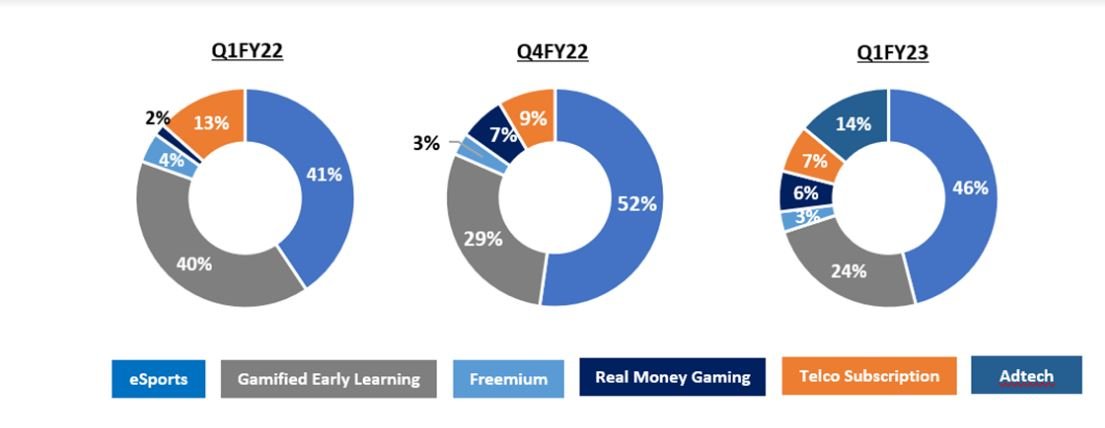
The company has a diversified and de-risked business model, with multiple levers of long-term growth. In this quarter, the company added another growth engine with Datawrkz, a US based advertising technology company. Consolidated Revenue Mix across business segments stood as follows:

Commenting on the Q1FY23 performance, Manish Agarwal, CEO at Nazara Technologies stated:

“We are happy to report an all-round growth. The multi-pronged approach to capture opportunities have been yielding positive traction and we are in line with our target growth plans for FY23. The traction across businesses; E-sports and Real Money Gaming witnessed strong growth while addition of new growth engine in form of Datawrkz has augmented well for the business. We have also seen stabilisation of unit economics for our Gamified Early Learning business.

The overall revenue for Q1FY23 as against the previous year saw a healthy growth of 70%, leading to a PAT growth of 22% year on year. On the operating margin front, we have made investments in our business segments that will provide us with robust growth opportunities in the years to come. The company will continue to look for growth opportunities both organically and inorganically. In particular, we are looking to augment presence in Freemium segment especially in developed markets.”

Fairexpay primed to facilitate ‘cross-border payments’ after RBI’s regulatory sandbox’s test phase

New Delhi, 29 July 2022: Fairexpay, a global aggregator platform which provides a tech stack for finding and providing the best currency exchange rates from various exchange partners and processing them around the world for businesses, has announced that it has received a green light from the RBI for conducting cross border payments in India. The announcement came after Fairexpay fintech products were evaluated on mutually agreed test scenarios and expected outcomes. Following the completion of the regulatory sandbox scheme’s test phase, Fairexpay along with the other three entities was deemed feasible for cross-border payments by the Reserve Bank of India on July 19, 2022. As per the RBI, the product can be considered for adoption by regulated entities subject to compliance with applicable regulatory requirements.”

Fairexpay

The introduction of Fairexpay to the Indian market will be very beneficial to Indian fintech companies, allowing organisations like Neo Banks, Investment applications, Ed Tech, Ecommerce and Travel companies, etc., to provide easy remittance solutions across LRS use cases like overseas university fees payments, travel, medical tourism, family maintenance, purchase of shares, exchange-traded funds (ETF) units, and other assets listed on foreign exchanges using different payment rails like UPI, Net Banking, IMPS etc.

The launch of Fairexpay in India allows Indian customers to take part in a fully integrated digital journey that includes comparing exchange rates provided by different service providers, initiating payments, realising savings and costs associated with transactions in real time, tracking the status of transactions, and having digital access to SWIFT copies and TCS certificates.

“With our induction into the Indian digital payment network after RBI’s approval, we at Fairexpay are looking forward to easing up cross-border payments process in India and enabling Indian individuals, businesses, and enterprises to make use of our extensive global network of licensed partners and save 3%-7% on all forex payments,” said Fairexpay spokesperson Raj, CEO of Fairex Solutions Pvt Ltd, which owns Fairexpay brand.

Early this year, Fairexpay did an equity swap deal with India-based Treasury advisory & consulting firm SaveDesk, which operates in the niche segment of optimizing banking costs associated with international trade and foreign exchange. Current portfolio of Savedesk stands at $3.5 Billion as Fx pass through. One of the common vision of Fairexpay and Savedesk is to provide savings of up to 7% across the use cases, where Fairexpay brings in tech capabilities and Savedesk brings in expertise around Treasury advisory and consulting services.

Colors Bangla gears up for the World Television Premiere of Badsha – The Don

~ Tune In to Colors Bangla on 31st July at 2 pm and 9.30 pm ~ 

Colors Bangla gears up for the World Television Premiere of Badsha – The Don

Mumbai, 29th July, 2022: Colors Bangla gears up to entice its audience with the World Television Premiere of Badsha-The Don Special Partner Dear Lotteries this weekend. With a diversified mix of movies, the channel will air blockbuster movies which one can enjoy with their families sitting at home. Badsha – The Don will air on 31st July at 2 pm and 9.30 pm as part of the World TV Premiere series. The movie is about the story of a boy who always wanted to be a Don from childhood. He reaches London where he befriends a girl named Shreya and he falls in love with her. The film stars superstar Jeet and the beautiful Nusrat Faria.

Released a few years ago, the movie will be aired for the first time on television on Colors Bangla. The film has been directed by ace director and choreographer Baba Yadav. Badsha – The Don is an out and out commercial potboiler with everything on offer — an abundance of action, drama, romance, and comic relief. Badsha leaves home — with just one aim in mind — to become a gangster and be feared by one and all. With Baba Yadav as the director, one can expect some action moves with a lot of adrenaline rush. The beautiful Nusrat Fariya plays the role of Shreya and Shraddha Das plays her friend Priya. Other ensemble includes Biswanath Basu, Rajatava Dutta.

Jeet and Nusrat Faria starrer Badsha- the Don will be aired on Colors Bangla Cinema subsequently on 15th August. The show will be heavily promoted on air and on social media for better reach and engagement.

The background music, melodious songs and captivating cinematography are the icing on the cake. Indulge in a spellbinding experience with the World Television Premiere of Badsha -The Don on 31st July at 2 pm and 9.30 pm only on Colors Bangla.

After Singapore, Japan and Malaysia, GIIS starts Cambridge curriculum in Bengaluru campus

Bengaluru, 29 July 2022 – Global Indian International School (GIIS) Whitefield has received full authorisation to run the Cambridge Assessment International Education at its Bangalore campus, a great achievement for the campus in the field of international education.

Singapore-headquartered GIIS has a decade-long experience in imparting international education to thousands of students in Malaysia, Singapore and Japan; and has produced more than 700 students with A* and A grades.

From August 2022, GIIS Whitefield will commence the three-year Cambridge Lower Secondary programme for Grades 6, 7, 8; and the two-year Cambridge IGCSE for 9 with Grade 10 commencing next year.

Both programmes are designed to pave the way for students to take up other international curricula in their high school years, followed by undergraduate studies in reputed universities around the world.

“This is a giant step for the school which has already been doing a great job with the CBSE cohorts for many years. The new curriculum will add to the proper learning enrichment of students at a time when the 21st century is offering so many international opportunities,” said Whitefield principal Mr Ashwani Saxena.

The Cambridge curriculum will be interspersed with GIIS’s award-winning 9GEMS holistic framework, which allows students to excel in 8 other areas of development, besides academics. The Cambridge students will have special facilities to ensure that holistic learning continues in a modern, high-tech environment, in the fields of STEM, performing arts, sports, leadership and entrepreneurship.

Students will learn in smart classrooms in small cohorts with interactive boards and use tablets for better classroom interaction. They will also have access to music labs, robotics lab, multi-activity rooms, outdoor and indoor sports facilities etc. In their final year of Cambridge, GIIS will also support students through career counselling, with their international counsellors guiding and assisting them in university applications.

GIIS is part of the not-for-profit Global Schools Foundation, which has 6 different international school brands under their aegis in 10 countries. The foundation is bringing quality education to more places in the world through its worldwide network of international schools. The introduction of Cambridge at Bangalore is a feather in the cap for the Foundation which is celebrating its 20th anniversary year in 2022-23. The Foundation is also the most awarded education institution in the world, with 350 awards from renowned world institutions.

“This is just the beginning for GIIS India operations, which is planning to expand its offerings in future,” said Mr Rajiv Bansal, Director of GIIS Operations in the country. “We have already made a mark in CBSE education, and now with Cambridge, GIIS will once again show that it is an institution which produces leaders of tomorrow, who are ready to take on the challenges of the 21st century.”

United Way Mumbai conducts Hepatitis B testing and vaccination camps for healthcare workers at Mumbai Public Hospitals to commemorate World Hepatitis Day

29th July 2022, Mumbai, India:

United Way Mumbai, in collaboration with G.T. Hospital and St. George Hospital in Mumbai, successfully held a Hepatitis awareness session and testing and vaccination camp on 27th and 28th July 2022. The camp was specially held for healthcare workers in public hospitals to commemorate World Hepatitis Day. The camp successfully tested and vaccinated over 550 health care working staff of the hospitals.

Testing and Vaccination camp for Hepatitis B at G.T. Hospital

Infectious diseases such as Hepatitis are a public health concern and as these healthcare professionals are at high risk and it’s a need to implement a prevention protocol for this infection. United Way Mumbai is working to raise awareness of the importance of the health care workers who need to be regularly tested and should vaccinated for Hepatitis B for their own safety and the safety of the patients they are treating.

United Way Mumbai also held a training session for all the working staff of hospitals on what Hepatitis viruses are and what precautions they need to take to prevent communicable disease.

Speaking about the camp, George Aikara, CEO of United Way Mumbai, says, “Throughout the year, we at United Way Mumbai work to increase awareness of Hepatitis B & C amongst high risk groups such as people who inject drugs, sexual minorities, female sex workers, single male migrants & truck drivers. These groups that have remained on the peripheries of public health systems, often losing out on health access because of the stigma faced by them. This year on we chose to work with healthcare workers in public hospitals to protect them from getting infected and passing on infection to patients.”

Problems And Legal Advantages Of Micro, Small And Medium Enterprises (MSMES)

By Mr. Rahul Hingmire, Founding Partner at Vis Legis Law Practice, Advocates 

  • Micro, Small, and Medium Enterprises (MSMEs) in India

Since India’s independence, MSMEs (earlier called Small Scale Industries, SSI) has become a crucial contributor to the Indian economy through rural industrialization, entrepreneurship, and economic empowerment. MSME is predominantly present in the manufacturing, service, and trade sectors of India.

A country like India has an abundance of MSMEs operating within it, and hence the legal framework has been crafted as per the contextual nature. To give a fair idea of the scope of this sector, one can observe that the number of MSMEs in India increased by a CAGR of 18.5% from 2019-2020. We must also note that the loans taken by MSMEs stood at INR ₹10.48 Trillion in 2021 (a 40% increase from the previous year).

  • What is MSME?

Definition in Self-reliant India Scheme 2020

A revision of the MSME definition was announced after 14 years in the Atmanirbhar Bharat Abhiyan Scheme, 2020. From earlier classification criteria for MSME including only ‘investment in plant, machinery or equipment, the new, approved amendment includes ‘annual turnover’ and eliminates the distinction between manufacturing and service sectors.

Unit Investment less than Turnover less than
Micro Rs. 1 Crore Rs. 5 Crore
Small Rs. 10 Crore Rs. 50 Crore
Medium Rs. 50 Crore Rs. 250 Crore


Table 1: Classifications

  • Key points for MSMEs: Aatmnirbhar Bharat Abhiyan Scheme 2020

The new scheme improved access to loans, debts, and equity infusion for MSMEs (with applicable terms and conditions). Fintech will be used to enhance transaction-based lending using the data generated by the e-marketplace (the e-market has also been established in the new scheme). Several other legal advantages have been put in place (mentioned below).

  • What kind of problems do MSMEs face that often leads to failure?

It is observed that MSMEs fail to undertake timely compliances with the regulations associated with their industry due to lack of awareness and knowledge. These unexpected non-compliances can result in unwarranted penalties/prosecutions against the company, which further takes up valuable time and resources. Another aspect, commonly seen as one of the major concerns for MSM the Es is a lack of awareness about protecting their Intellectual Property Rights (IPR). Obtaining immediate certification for the trade name, trademark copyright or patent registrations has become a necessity for any nature business. MSMEs give very little importance to IPR Registrations until they become victims of IPR infringements or are faced with legal and injunctive claims regarding the use of trade name, trademark, copyright, or patent. Lastly, the absence of effitechnicalogical support and timely legal help has led to unnecessary delays and an increase in expenditure for MSMEs.

  • Legal advantages for MSMEs

A // Bank Loans (Collateral Free)

The Credit Guarantee Trust Fund Scheme introduced by the Government Of India, SIDBI (Small Industries Development Bank Of India), and the Ministry of Micro, Small and Medium Enterprise makes sure that this scheme is implemented (Credit Guarantee Scheme) for all Micro and Small Enterprises but NOT medium-sized enterprises.

B // ISO Certification Charges Reimbursement

MSMEs can claim reimbursement of the expenses made to obtain an ISO certification.

C // Fewer Electricity Bills

MSMEs Registration Certificates are entitled to concessions on their electricity bill. 

D // Foreign Direct Investment Approval

A company with an industry-related business can invest up to 24% equity in an MSME; but if the equity goes beyond 24%, the industry will lose its MSME status. The use of foreign brand names and trademarks of goods are now permitted freely.

E // NRI Investment Approval

There is no restriction on the extent of equity held by a non-resident Indian (NRI) as an individual/partner in an MSME. Investment up to 100% equity is allowed with full benefits of repatriation of dividends.

F // Environmental Restrictions for MSME Sector

Environmental clearances procedure for small-scale industries has been rationalized and simplified except in the case of 17 hazardous industries. The State Environment Board’s acknowledgment to an application of MSME will work as clearance.

G // Industrial Licensing

In the case of small units which employ less than 50 workers with power or less than 100 workers without power are not required to obtain any license under Compulsory Licensing Provisions.

H // Subsidy on Patent Registration:

MSMEs can avail of subsidies of 50% on patent registration fees.

I // Protection against Payments:

Under the Act, all pending dues of MSMEs are to be released within 45 days (maximum) after accepting the products or services. If the buyer delays beyond 45 days after accepting the products or services, then the buyer can be called upon to pay interest which is 3 times the rate that is notified as standing lending banking interest, as per the notification of the Reserve Bank of India (RBI). MSME Samadhan is a Portal created by the office of DC (MSME), Ministry of Micro, Small and Medium Enterprises (MSME) where Micro and Small Enterprises (MSEs) can file their applications online regarding delayed payments.

J // Insolvency and Bankruptcy Code framework for Resolving MSME insolvency:

This framework fast-tracks the corporate insolvency resolution process (“fast-track CIRP”) for smaller debtors. The existing management of an MSME debtor will be permitted to initiate proceedings even before a default occurs and will be allowed to remain in control during the process.
Yash Pakka Limited bags international-grade certification for sustainability

India, July 29, 2022: Yash Pakka Limited, India’s major sustainable packaging solutions company, has bagged the coveted Forest Stewardship Council’s (FSC) Chain-of-Custody Certification for its selected products. This esteemed and sought-after title authenticates that the products sold by Yash Pakka Limited originate from well-managed forests and reclaimed materials.

The FSC label credibly links responsible production and consumption, allowing consumers and businesses to make purchasing decisions that are beneficial to people and the environment. The Chain of Custody (COC) verifies that FSC material has been identified and separated from non-certified and non-controlled material across the entire supply chain.

This Chain-of-Custody Certification further means that only eligible materials as per FSC standards are being responsibly sourced by the manufacturer, wherein no illegally harvested wood is being processed to carry out the production. This adornment certifies that Yash Pakka Limited has responsibly complied with all the regulations and requirements of the FSC for sustainable and planet-friendly growth.

Well-deserving of the recognition, Yash Pakka Limited generates its own electricity with an 8.5 MW plant that runs of 100% biomass-based energy. It also sources its raw material and fuel locally and recovers 95% of the cooking chemicals used in manufacturing. The company’s core USP lies in utilization of local agri-residues in creating raw materials. Its strength is rooted in R&D and innovation, it is creating path breaking products and processes for fibre, pulp, paper, biopolymers, moulded products, waste lines, and biomimicry.

Speaking on this achievement, Jagdeep Hira – Business Head Yash Pakka Limited, said, “The FSC Chain-of-Custody Certification is a distinguished feat for our company. While our production has always been environmentally responsible, this international-grade certification is a huge encouragement and recognition for our good work in the industry. Our core identity relies on the fact that we need to be conscious and aware of the environment today, to make the planet better for our future generations. From using agri-residue as raw material to using 100% bio-fuel at our factory, this belief reflects in all our actions. Currently, our innovative green products are changing the way packaging materials have always been seen in the market. From low carbon footprint to responsible sourcing and being creative with waste material reuse, Yash Pakka Limited has made remarkable strides in doing its bit for the environment.”

This accomplishment surfaces the fact that Yash Pakka Limited is an environmentally conscious organization, which cares for the good of the planet. Beyond this, Yash Pakka Limited is a completely off-grid company and meets its energy demands on its own. On top of this, they utilize local agricultural residue as raw material for production. Yash Pakka Limited uses 100% biomass-generated energy for its manufacturing, and the majority of its waste products have found meaningful applications. For instance, they make egg trays from sludge, mineral bags from lime sludge, extract silica from rice husk ash, enhance soil quality from their bio-degradable waste, and generate methane gas from wastewater produced in their units.

Paytm’s Vijay Shekhar Sharma says company is seeing excellent momentum and is on track to achieve operating profitability

One97 Communications Limited which owns the brand Paytm, India’s leading digital payments and financial services company and the pioneer of QR and mobile payments, today shared its first annual report as a listed company with the exchanges. *Paytm’s Founder and CEO Vijay Shekhar Sharma* also wrote a letter to all shareholders, where he said the company is on track to achieve operating profitability.

Sharma gives an insight into how more and more users are coming on the Paytm platform, for their everyday usage without requiring any incentive from the company. He further added that merchant partners intuitively understand the value of digital payments now; and increasingly, they are ready to pay for technology that makes digital payments easier and trusted.

The Annual Report FY 2021-22 gives an overview of Paytm’s business model. Paytm’s business is to offer a comprehensive suite of payments services to acquire consumers and merchants, as well as leverage its two-sided, consumer and merchant ecosystem, and rich insights from its platform to cross-sell high-margin financial services and merchant services (commerce and cloud).

Read Vijay Shekhar Sharma’s complete letter to shareholders here:

“It gives me great pleasure to present Paytm’s annual report for FY 2021-22, our first as a publicly listed company. I am proud of what Paytm has achieved in the last year with rapid growth in payments, and a huge scale-up in lending and payments devices businesses. We remain committed to building a large, profitable company and creating long-term shareholder

value.

India is in the midst of a technology revolution, as consumers and small businesses are adopting technology at a rapid pace. The network effect of this adoption across use cases is visible and is having a profound impact. Payments has been at the forefront of this revolution and now consumers and merchants are increasingly using, and indeed demanding, digital financial services. We are proud to say that our businesses are leveraging this opportunity and contributing in further accelerating the pace of technology adoption. I believe, in the days to come, India will become an exemplar market, especially in payments, leading to financial services.

The core of Paytm’s business model is to acquire consumers and merchants for payments services, and upselling them financial services, by leveraging our distribution, collections and our transactional and behavioural insights. We have sharpened our focus on Payments and distribution of Lending products and have prioritised these businesses in our resource allocation.

Paytm app now has more and more users coming on to our platform for their everyday usage without requiring any incentive from us. We are focused on further expanding our payments network by acquiring quality customers and merchants with high activity rate and transaction frequency. UPI has emerged as one of the key customers and merchant acquisition channels for us. UPI merchant payments, which are free for the merchant, have now also become economically viable because the government is encouraging digital payments through incentives on UPI P2M transactions. We have been able to monetise our platform by upselling financial services to our customers and merchants, and also upselling payment devices to our merchants.

Our team is focused on expanding the payments offerings available to our consumers – on Paytm app, in-store, online, using FASTag affixed on cars, among many other everyday habits. Our focus is also on showing how creditors can leverage this mobile payments relationship for lending. BNPL, which allows our partner financial institutions to issue credit to consumers at the point of sale, has become a consumer favourite.

Our attention is on helping our financial institution partners issue less and less risky loans to more and more people. Aligned to the Government and Regulator expectations of expanding financial services inclusion and digital disbursement of lending, Paytm’s business model expands the creditworthiness of consumers and enables greater access.

We see that merchants intuitively understand the value of digital payments; and increasingly, they are ready to pay for technology that makes digital payments easier and trusted. We are increasingly seeing merchants opt for devices, whether Paytm card machines or Soundbox, on their counter, and this adoption of devices by merchants is almost certainly going to further accelerate. Once merchants start accepting payments through us, they start to become eligible for lending from the lenders that we have partnered with, who are able to rely on our distribution and merchant insights, otherwise unavailable to them. This presents us with a great opportunity to enable financial inclusion for a large number of merchants. This journey means that the relationship we have with our merchants expands over time from QR payments to devices to credit.

Paytm pioneered mobile payments in India, serving customers as well as small and large merchants. Paytm’s technology platform is focused on delivering newer ways for payment solutions, including GPS based payment etc. Our offering to the ecosystem is innovative technology and the ultimate business solution that has become mainstream for the industry and the country. We strive to continue delivering innovative funding sources and payment methods, which is also encouraged by Regulators.

I believe that over the past year, our team has done a great job in massively improving our revenues and contribution profits, which allows for investments in our payments and credit businesses while at the same time reducing our EBITDA losses. We are seeing excellent momentum in our businesses and are on track to achieve operating profitability (EBITDA before ESOP cost) by the quarter ending September 2023.”

Brandintelle Services Signs Up International Auto Major As Its Client

India,29th 2022: Brandintelle signs up India-headquartered automobile giant Tata Motors Ltd as their fifth corporate customer. From custom workflow automation leading to total automation of Marketing Departments to pipelining marketing data into a Marketing Data Lake to increasing visibility via Dashboards to providing Analytics Models linked to the Marketing Data Lake – Brandintelle Services offers IT-enabled services to transform the business of Marketing Departments of large corporates. Having serviced clients from the automobile, FMCG & edutech sectors, Brandintelle looks forward to service the FMCD, BFSI, Mobiles, E-commerce & Telecom sectors.

Sachin Bhosle, Vice President - Research & Marketing, Brandintelle

“Brandintelle is a custom-built solution designed to transform your Marketing Depts. – with workflow automation/transaction processing, virtual collaboration & the need for a single source of truth from your Marketing Data Lake for routine analytics & better visibility.” – Sachin Bhosle, Vice President – Research & Marketing, Brandintelle.