• Bhubaneswar India
  • Contact+ 91-9938772605
  • Mon - Sat : 10:00AM - 6:00PM

Archive: August 17, 2026

Seven Killed, Over 12 Injured in Stampede at Bihar’s Ashok Dham Temple

Lakhisarai, Aug. 17: At least seven devotees were killed and more than 12 others injured after a stampede broke out at the Ashok Dham Temple in Bihar’s Lakhisarai district on Monday morning.

Seven Killed, Over 12 Injured in Stampede at Bihar’s Ashok Dham Temple

The incident occurred as thousands of devotees gathered at the temple to offer prayers and perform Jalabhishek on the third Monday of the holy Shravan month.

According to Lakhisarai District Magistrate Shailendra Kumar, an unprecedented rush of devotees, reportedly intensified by the arrival of two trains between 6:30 am and 6:45 am, led to the collapse of a barricade outside the temple. The sudden surge triggered panic among the crowd, resulting in the stampede.

There were also initial reports that a fallen electric wire may have caused panic among devotees, following which rumours spread through the crowd and people began rushing in different directions.

Several devotees were caught in the crush and fell over one another. Local residents and fellow devotees immediately joined rescue efforts and helped pull people out of the crowded area.

Seven Killed, Over 12 Injured in Stampede at Bihar’s Ashok Dham Temple

Police and administrative officials reached the temple soon after receiving information about the incident. Rescue operations were launched, while the injured were shifted to nearby hospitals for medical treatment.

Senior administrative officials are currently monitoring the situation and overseeing rescue and crowd-management arrangements at the temple premises.

The Ashok Dham Temple, also known as Shri Indradamaneshwar Mahadev Temple, is a major Shiva shrine and attracts large crowds during the month of Sawan. Devotees traditionally visit the temple during Shravan to offer prayers and water to Lord Shiva.

The tragic incident has cast a shadow over the religious gathering, with authorities continuing to assess the situation and take steps to prevent further incidents amid the heavy influx of devotees.

transcosmos receives Special Award for Digital Utilization in JiIT’s Best Customer Support of The Year 2026

Aug 17: transcosmos announced that it has received the Special Award for Digital Utilization at the Best Customer Support of The Year 2026 program, organized by the Japan Institute of Information Technology (JiIT).

The Customer Support Award program was established to promote higher productivity, effective management, enhanced systems, and stronger customer touchpoints in customer support operations across Japanese industry and government organizations. Regardless of organizational size, the program recognizes companies, organizations, institutions, business sites, and departments that have made outstanding contributions to business performance and the advancement of customer support through creative and innovative initiatives in customer support and services, improving customer satisfaction, and addressing other challenges.

■Reasons for the award
At the customer support center recognized by the award, supervisors were spending a significant amount of time on routine tasks such as handling escalations and preparing materials, limiting the time available for higher-value activities such as enhancing the customer experience and delivering value-added proposals to clients.

To address this challenge, transcosmos undertook a business transformation initiative based on the concept of “turning everyday operations into data,” treating conversations during the escalation process as valuable knowledge assets.

Specifically, transcosmos built a fully automated framework that transcribes conversations during the escalation process using an AI voice recorder, generates materials using generative AI, and creates videos using AI video generation tools. This enabled knowledge that had previously resided with individuals to be shared across the organization more quickly, accelerating and standardizing knowledge transfer. In addition, transcosmos continuously refined prompt design and improvement cycles to enhance the accuracy and effectiveness of knowledge sharing.

As a result, transcosmos significantly reduced the time required to prepare escalation materials as well as average handling time (AHT), enhancing both operational efficiency and service quality. By making effective use of the time created through these enhancements, supervisors were able to focus more on voice of the customer (VoC) initiatives and strengthening relationships with clients. This contributed to higher overall customer satisfaction and service satisfaction, as well as lower employee turnover.

The initiative was highly commended for aligning the organization’s Mission, Vision, and Values (MVV) with AI and DX-driven operational efficiency, enabling supervisors to shift away from routine administrative tasks and focus more on enhancing the customer experience and creating value for clients.

 Guided by its vision, “to become a bridge between people’s happiness and a well-being society with the power of communication,” approximately 23,000 communicators in transcosmos’s Digital Customer Communications (DCC) sector provide call center and other communication services from 32 locations across Japan. transcosmos will continue its efforts to contribute to people’s happiness and a thriving society.

* transcosmos is a trademark or registered trademark of transcosmos inc. in Japan and other countries.
* Other company names and product or service names used here are trademarks or registered trademarks of respective companies.


Vodia Phone 2 Turns Android Phones into Vodia Extensions

Vodia Phone 2 Turns Android Phones into Vodia Extensions


BOSTON: August 17 – Vodia Networks, Inc., a provider of unified cloud communications solutions to enterprises, contact centers, and service providers, is pleased to announce Vodia Phone 2, an app that brings the Vodia PBX experience to Android users. Vodia Phone 2 is a companion app to the new Vodia iOS app, which the company announced in July of this year.   

Vodia Phone 2 turns any Android device into a full-featured extension of the Vodia phone system. It integrates with the native Android calling experience, so users can make and receive calls from anywhere via a business phone system.

Vodia Phone 2 Turns Android Phones into Vodia Extensions


Incoming business calls ring like regular calls, even when the app is in the background or the phone is locked – calls can be placed from the Vodia app or directly from the Android dialer.


Vodia Phone 2 makes it easier to manage calls, voicemail, chat, extensions, call history, and active call controls in one place. Users can hold and resume calls, perform blind or attended transfers, park calls for colleagues, access company contacts, and manage how business calls reach them. Integration with Android Telecom Manager also enables support for Bluetooth devices and Android Auto, giving users a familiar mobile calling experience wherever they work.

Vodia Phone 2 Turns Android Phones into Vodia Extensions


For installation instructions and more information about calling, transfers, contacts, extension activity, and settings, visit the Vodia Android app documentation page.

Vodia has been committed since its inception to helping enterprises and SMBs work from anywhere. For more information about our iOS and Android apps, Vodia representatives can be reached at sales@vodia.com or +1 (617) 861-3490.


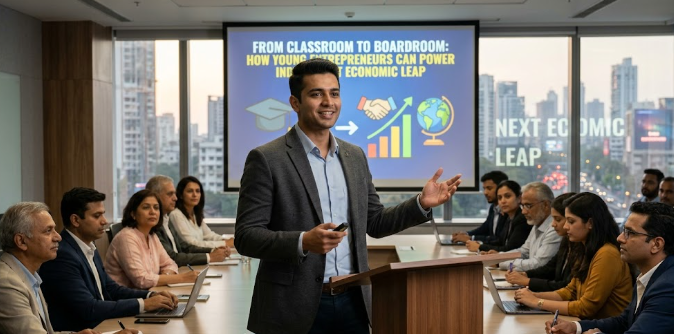
From Classroom to Boardroom: How Young Entrepreneurs Can Power India’s Next Economic Leap

New Delhi, Aug 17: A proposed change to the Companies Act could give younger entrepreneurs a greater opportunity to take on senior leadership roles, particularly in family-owned businesses, promoter-led companies and startups where the next generation is increasingly involved in management at an early age.

From Classroom to Boardroom: How Young Entrepreneurs Can Power India’s Next Economic Leap

A joint parliamentary committee has recommended reducing the minimum age for appointment as a Managing Director (MD) or Whole-Time Director (WTD) from 21 to 18 years. The recommendation, if accepted through the legislative process, could broaden the pool of individuals eligible to take on key executive responsibilities.

The proposal comes at a time when India’s business landscape is changing rapidly. Young entrepreneurs are increasingly entering areas such as technology, artificial intelligence, digital commerce, fintech and new-age services, often building businesses at a much younger age than previous generations.

The proposed reform could also create new opportunities for startups and young entrepreneurs. With the possibility of assuming formal leadership responsibilities at an earlier age, capable young founders could have a clearer pathway to build and expand their businesses. This could encourage more young people to consider entrepreneurship as a career option and contribute to the growth of India’s startup ecosystem.

The impact could extend beyond individual entrepreneurs. As more startups and young-led businesses grow, they could create new employment opportunities across technology, finance, marketing, operations, research, customer services and other sectors. A stronger pipeline of young-led enterprises could therefore contribute to job creation and support the development of new industries.

For family-run and promoter-led companies, the proposed change could also provide greater flexibility in succession planning. In many such businesses, younger family members begin working with the company early and gradually take on managerial responsibilities. Allowing eligible 18-year-olds to formally hold senior executive positions could help align their legal authority with the responsibilities they may already be undertaking within the business.

The reform could also support the development of technology hubs and innovation centres across India. Young entrepreneurs are increasingly building businesses around artificial intelligence, software, deep technology, fintech, e-commerce and digital services. Greater participation of younger leaders in corporate decision-making could encourage investment in innovation and help emerging cities and regions develop as technology and startup hubs.

Another potential benefit is skill development. As young people enter senior positions, there could be greater demand for structured training in leadership, financial management, corporate governance, technology, taxation, regulatory compliance and business strategy. This could encourage companies, educational institutions and industry bodies to develop more specialised programmes aimed at preparing the next generation of entrepreneurs and corporate leaders.

The move could also encourage a new generation of corporate leaders to participate more actively in decision-making, innovation and business expansion. Younger executives may bring fresh perspectives on technology, changing consumer preferences and emerging markets, while experienced directors and senior professionals can continue to provide institutional knowledge and guidance.

However, greater opportunity would also bring greater responsibility. Holding a senior corporate position requires an understanding of financial management, corporate governance, taxation, regulatory compliance, employee management and ethical decision-making. Simply lowering the age requirement would not automatically make a young individual ready to lead a company.

For this reason, mentorship, professional training, skill development and strong corporate governance will remain important if the proposal eventually becomes law. Companies may need to establish structured systems that allow young leaders to work alongside experienced professionals and gradually develop the capabilities required to manage complex organisations.

It is also important to note that the committee’s recommendation does not change the law at present. The proposal must still go through the required legislative process before any amendment comes into effect.

If implemented, the reform could nevertheless mark an important shift in India’s approach to corporate leadership—placing greater emphasis on ability, preparedness and responsibility rather than age alone. It could potentially strengthen the startup ecosystem, encourage employment generation, support emerging technology hubs and create greater opportunities for youth skill development.

The proposal may ultimately give capable young entrepreneurs a clearer path from the classroom and startup ecosystem into the corporate boardroom, while allowing businesses to prepare the next generation of leadership in a more structured manner. In the broader economy, the change could help connect young talent, entrepreneurship, technology, employment and skill development, supporting India’s ambition to build a more innovation-driven and youth-led business ecosystem.

Sensex, Nifty Open Lower as US-Iran War Uncertainty Keeps Crude Prices Elevated

Sensex, Nifty Open Lower as US-Iran War Uncertainty Keeps Crude Prices Elevated

Mumbai, Aug 17: Indian benchmark equity indices opened lower on Monday as persistent uncertainty over the US-Iran conflict and elevated crude oil prices weighed on investor sentiment.

The Nifty 50 opened at 24,343.45, down 22.55 points, or 0.09 per cent, while the BSE Sensex fell more than 100 points to 77,892.92, declining around 0.15 per cent in early trade.

The weakness came amid renewed concerns over the global energy supply outlook as US-Iran peace efforts remained stalled. Brent crude was trading around $89 a barrel, with oil prices continuing to reflect risks surrounding shipping through the strategically important Strait of Hormuz.

The rise in crude prices is a particular concern for India, which remains heavily dependent on imported oil. Higher energy costs can put pressure on inflation, the country’s trade balance and corporate margins, while also weighing on the rupee.

The Indian currency opened weaker at around Rs 95.49 against the US dollar, although dollar sales by state-run banks helped limit the decline, according to market traders.

Sectorally, financial, banking and FMCG stocks came under pressure in early trading, while some pharmaceutical and metal stocks showed resilience. Market participants are expected to remain focused on developments in the Middle East, crude oil movements, foreign fund flows and upcoming domestic economic cues.

Analysts expect the market to remain range-bound with a cautious bias as investors assess the impact of elevated oil prices and geopolitical risks. The lack of a clear resolution to the US-Iran conflict remains a key near-term trigger for both global and Indian equities.

The Indian market had already ended lower on Friday, with the Nifty declining 29.85 points, or 0.12 per cent, to 24,366, while the Sensex fell 70.71 points, or 0.09 per cent, to 78,009.25.

Indian Markets Open Lower as US-Iran Tensions Keep Crude Prices Elevated

Mumbai, Aug 17: Indian equity markets opened marginally lower on Monday as continued uncertainty over the US-Iran conflict kept crude oil prices elevated, weighing on investor sentiment.

Indian Markets Open Lower as US-Iran Tensions Keep Crude Prices Elevated

The Nifty 50 opened at 24,343.45, down 22.55 points, or 0.09 per cent, while the Sensex declined more than 100 points, falling 0.15 per cent to 77,892.92 in early trade.

Selling pressure was visible across several sectors. The Nifty MidSmall Financial Services index emerged as the biggest laggard, falling 0.98 per cent. Nifty PSU Bank and Nifty FMCG indices also declined by up to 0.9 per cent.

Other sectors, including realty, cement, IT, energy and private banks, also traded in negative territory during the early session.

Market participants remained cautious as the lack of progress towards resolving the US-Iran conflict continued to support crude oil prices. Higher oil prices are a concern for India because the country relies heavily on imports to meet its energy requirements and a sustained rise in crude prices could put pressure on inflation and corporate costs.

Analysts expect the domestic market to remain range-bound in the near term, with geopolitical developments and movements in crude oil prices likely to determine the broader market direction.

Despite the cautious start, analysts see opportunities in midcap and smallcap stocks, particularly where company-specific fundamentals remain strong. Investors are expected to focus on individual earnings, valuations and sector-specific developments rather than taking broad market positions.

With global cues remaining mixed and geopolitical uncertainty continuing, market participants are likely to maintain a cautious approach while watching developments in oil prices and the US-Iran situation closely.

Researchers Differentiate New Species of Endangered Baobab Tree in Madagascar

By Elise Mahon

Researchers at the University of Wisconsin–Madison recognize a new species of baobab tree, Adansonia bozy, unique to Madagascar, according to a study published in the journal Taxon. Previously, members of A. bozy were classified within a different species of Malagasy baobab, Adansonia za.

While the species look similar, careful genetic analysis revealed that the northern populations of A. za are more closely related to other northern Malagasy baobab species. This discovery could have implications for conservation efforts for the endangered trees.

Baobabs are charismatic trees that grow in Australia, continental Africa, and Madagascar. Before this paper, there were eight recognized species of baobabs, one in Australia, one in continental Africa, and six in Madagascar.

“It’s surprising that we’re still answering basic biological questions about baobabs, in terms of how many species actually exist on the landscape,” says lead author Nisa Karimi, who worked on the project for her PhD in the former Department of Botany.

She collaborated with UW–Madison co-author David Baum and with researchers from the Missouri Botanical Garden and Iowa State University.. Baum, who has been studying baobabs for over 40 years explains that while the threshold for defining a new plant species is complicated, in the case of A. bozy, the genetic data they collected made it crystal clear.

“Any group that we choose to recognize in a taxonomy should be composed of organisms that are more closely related to each other, than to anything outside the group,” says Baum.

To collect the tissue samples necessary to analyze the baobab’s genetics, Karimi had to navigate to remote parts of Madagascar and locate the trees. Since some species of baobabs in Madagascar can look similar, Karimi says it’s sometimes impossible to identify the species by looking at its leaves alone.

“To know what you’re looking at, you have to see them in flower,” Karimi says.

But that’s easier said than done too. Each species flowers for about one month and the blooms only open after dusk – way up in the branches sometimes over 100 feet above the ground. Timing is crucial, as is training to use the complicated climbing rig required to scale the massive trunks and repel back down.

After collecting leaf samples, Karimi brought them back to Wisconsin to be ground up for extraction. Since the tissues were rich in polysaccharides though, grinding them produced a very slimy substrate.

“If you’re trying to get long genetic sequences, you need high-quality DNA ,” Karimi says. ”But, oftentimes, when you have this sort of slimy tissue, [the DNA] fragments.”

It took a lot of trial and error, but Karimi worked out a way to get the high-quality strands of DNA they needed. Then, they used the gold standard of phylogenetic analysis, a method called targeted sequence capture, which identifies and sequences hundreds of genes of interest from an organism.

Karimi first looked at the fragments of DNA from one organism, identifying which parts of the strands coded for the genes they were interested in tracking. Once that was done for every organism sampled, she could compare the genes across species. Karimi also used computational methods to summarize and integrate the hundreds of gene sequences she was analyzing across species.   

“Despite it sharing morphologies to the species that it was later classified with, [A.bozy] is actually more closely related to two other groups in northern Madagascar than the species it was synonymized with,” Karimi summarizes.

Based on its known distribution across Madagascar, Karimi and Baum also believe the new species is endangered.

Since funding for conservation efforts in Madagascar often prioritize threatened and endangered species, Karimi says there may be more funds available to help A. bozy. Their findings also raise questions about the conservation of A. za, which was once thought to be widespread.

Now with the “loss” of A. bozy individuals, A. za is a smaller species, which may also prompt a reclassification of its conservation status.

“You can’t conserve anything if you don’t know how to describe and name them and understand how they’re related to other things on the landscape,” says Karimi.

She and Baum believe there may be additional species waiting to be discovered in remote areas of Madagascar. Indeed, their results suggest that another widespread species, A. rubropstipa, may also need to be divided. They plan to continue researching baobabs in Madagascar to improve our understanding of the island’s rich biodiversity and ways to improve its conservation.


Pracheen Kala Kendra to Present Three-Day Malhaar Utsav in Chandigarh

Chandigarh, August 17: Pracheen Kala Kendra, supported by the Ministry of Culture, Government of India, will organise the three-day Malhaar Utsav 2026 at Rani Laxmi Bai Hall, Sector 38, Chandigarh, from August 20 to 22.

The festival, themed around “The Magic of Monsoon” and “Timeless Raagas,” will bring together leading Hindustani and Carnatic vocalists for three evenings of classical music. The programmes will begin at 6:30 pm each day.

Dr Sukhminder Kaur Brar, Chairperson of the Chandigarh Sangeet Natak Akademi, will be the chief guest and inaugurate the festival. The organisers have invited music enthusiasts to attend the programme, with entry on a first-come, first-served basis.

The opening evening on August 20 will feature vocal recitals by Vidushi Shubhra Talegaonkar and Vidushi Ronkini Gupta. They will be accompanied by artistes on tabla, harmonium and sarangi.

The August 21 programme will showcase Carnatic vocal recitalist Vidushi Sudha Raghuraman and vocalist Vidushi Dhanashree Pandit Rai. The performances will feature accompaniment on mridangam, flute, tabla and harmonium.

The festival will conclude on August 22 with vocal recitals by Vidushi Ruchira Kedar and Pt Sankumay Debnath, accompanied by tabla and harmonium artistes.

The three-day event is expected to offer Chandigarh’s classical music enthusiasts an opportunity to experience diverse vocal traditions while celebrating the cultural and musical associations of the monsoon season.

The organisers have advised visitors to take their seats before 6:30 pm, with admission being subject to availability on a first-come, first-served basis.

PM Gati Shakti Evaluates 396 Infra Projects Worth Rs 18.66 Lakh Crore

New Delhi, August 17: Infrastructure projects with a combined estimated cost of around Rs 18.66 lakh crore have been evaluated through the Network Planning Group (NPG) mechanism under the government’s PM Gati Shakti National Master Plan, marking a significant push towards integrated infrastructure development.

According to the latest information, a total of 396 infrastructure projects have been assessed through the NPG mechanism. The initiative is designed to facilitate coordinated planning of major infrastructure projects and improve connectivity across different modes of transport.

The PM Gati Shakti framework brings together data and planning for various infrastructure sectors, enabling ministries and government agencies to assess projects from a broader multimodal connectivity perspective.

The NPG mechanism plays a key role in evaluating proposed infrastructure projects based on factors such as connectivity, logistics efficiency and integration with existing and planned infrastructure.

The large pipeline of projects assessed under the framework highlights the government’s emphasis on developing an integrated infrastructure network to support economic activity, reduce logistics bottlenecks and improve the movement of people and goods.

PM Gati Shakti aims to bring greater coordination among infrastructure projects across sectors, including roads, railways, ports, airports, waterways and logistics infrastructure, while supporting more efficient utilisation of resources.