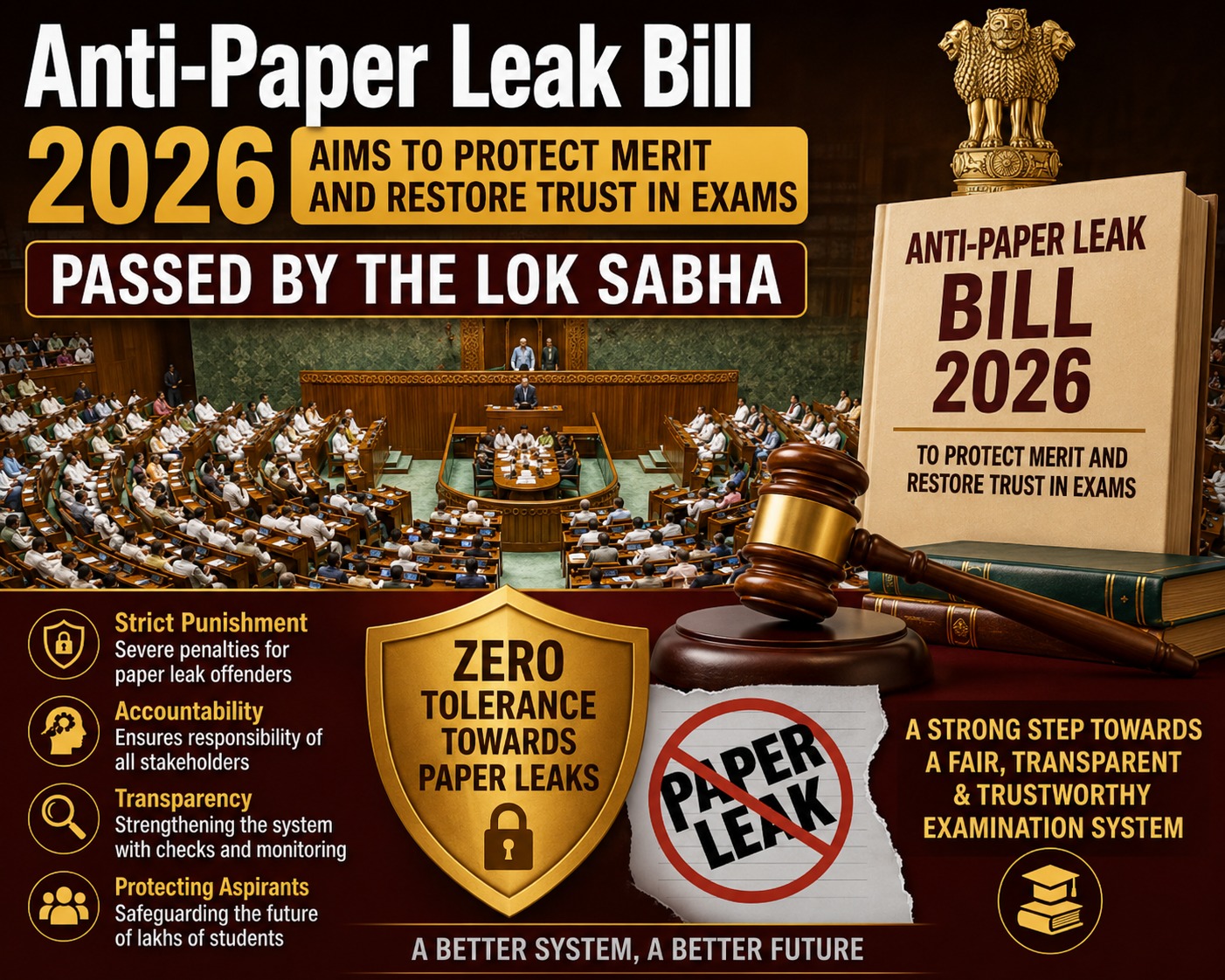
For millions of students across India, competitive examinations are more than just tests — they represent years of hard work, dreams of a better future, and opportunities for education and employment. However, repeated cases of paper leaks and examination fraud have raised serious concerns about fairness and transparency.
To address these challenges, the Lok Sabha has passed the Public Examinations (Prevention of Unfair Means) Amendment Bill, 2026, a major step aimed at strengthening the country’s examination system and protecting honest candidates from unfair practices.
The new legislation focuses on three key areas — stronger punishment for offenders, faster investigation and trial, and greater accountability for organisations involved in conducting examinations.
Why the New Law Matters for Students
Every year, millions of young people appear for government recruitment exams and entrance tests conducted by agencies such as the Union Public Service Commission (UPSC), Staff Selection Commission (SSC), Railway Recruitment Boards (RRBs), Institute of Banking Personnel Selection (IBPS), and National Testing Agency (NTA).
For many students, these exams decide their career path. A paper leak can not only cancel an examination but also create emotional stress, financial loss, and uncertainty for thousands of genuine candidates.
The new amendments aim to ensure that students who prepare honestly get a fair chance and that criminals attempting to manipulate the system face strict action.
Major Changes Introduced Under the Amendment
1. Tougher Punishment to Stop Examination Fraud
The amended law increases penalties for those involved in paper leaks and unfair practices.
Individuals found guilty may face:
- Five to ten years of imprisonment
- A fine of up to ₹50 lakh
The stronger punishment is intended to discourage people from participating in examination fraud and protect the interests of lakhs of students.
2. Strong Action Against Paper Leak Networks
Paper leaks are often carried out through organised networks rather than by individuals alone. The amendment specifically targets such groups.
Organised examination fraud can now attract:
- Seven to ten years of imprisonment
- A fine of up to ₹10 crore
This provision aims to break the networks that exploit students and turn examinations into illegal businesses.
3. Accountability for Examination Service Providers
The Bill also increases responsibility for agencies and service providers involved in conducting public examinations.
If organisations are found involved in malpractice:
- Fines can go up to ₹5 crore
- They may be prevented from conducting examinations for up to eight years
Senior officials and management personnel can also face strict penalties if they are found responsible.
Faster Justice Through Special Courts
One of the biggest concerns in examination-related crimes has been delayed justice. Long legal procedures can leave affected students waiting for years.
To address this issue, the amendment provides for:
- Special Fast Track Courts for examination-related offences
- Completion of investigations within two months
- Completion of trials within three months after filing of the charge sheet
A faster legal process can help students and authorities get clarity quickly and prevent prolonged uncertainty.
Government’s Focus: Building a Transparent Examination System
While responding to the parliamentary debate, Union Minister Dr. Jitendra Singh said the objective of the amendment is to strengthen the examination system and safeguard the future of students and young job aspirants.
He highlighted that the government is committed to maintaining the integrity, transparency, and credibility of public examinations. He also stated that the amendments have been designed by learning from previous experiences and addressing gaps in the existing system.
According to the government, several cases have already been registered under the earlier law, showing continued efforts to take strict action against examination-related offences.
How This Amendment Can Benefit Society
The impact of a fair examination system goes beyond students. It affects families, educational institutions, employers, and the overall trust in public systems.
For Students
- More confidence that success will depend on preparation and ability
- Reduced fear of unfair competition
- Faster action if examination irregularities occur
For Parents and Families
- Greater trust in education and recruitment processes
- Less uncertainty after years of supporting students’ preparation
For Society
- Stronger faith in merit-based selection
- Better credibility of government recruitment and admission systems
- Reduced influence of criminal networks involved in fraud
Technology and Better Monitoring Remain Important
While stricter laws are necessary, experts believe preventing paper leaks requires a complete approach.
Along with legal action, the examination system needs:
- Stronger digital security measures
- Safer question paper management
- Better monitoring during examination preparation and delivery
- Greater accountability at every stage
A secure examination system requires both strong laws and effective implementation.
A Step Towards Protecting Student Dreams
The passage of the Public Examinations (Prevention of Unfair Means) Amendment Bill, 2026 sends a clear message that examination fraud will not be tolerated.
For students who spend years preparing for competitive exams, fairness is not just a legal issue — it is about protecting their dreams, opportunities, and future.
The real success of this law will depend on how effectively it is implemented, but the objective remains clear: to create an examination system where hard work, talent, and dedication — not unfair practices — decide success.
A transparent and trustworthy examination system is not only important for students; it is essential for building a fair and confident future generation.
